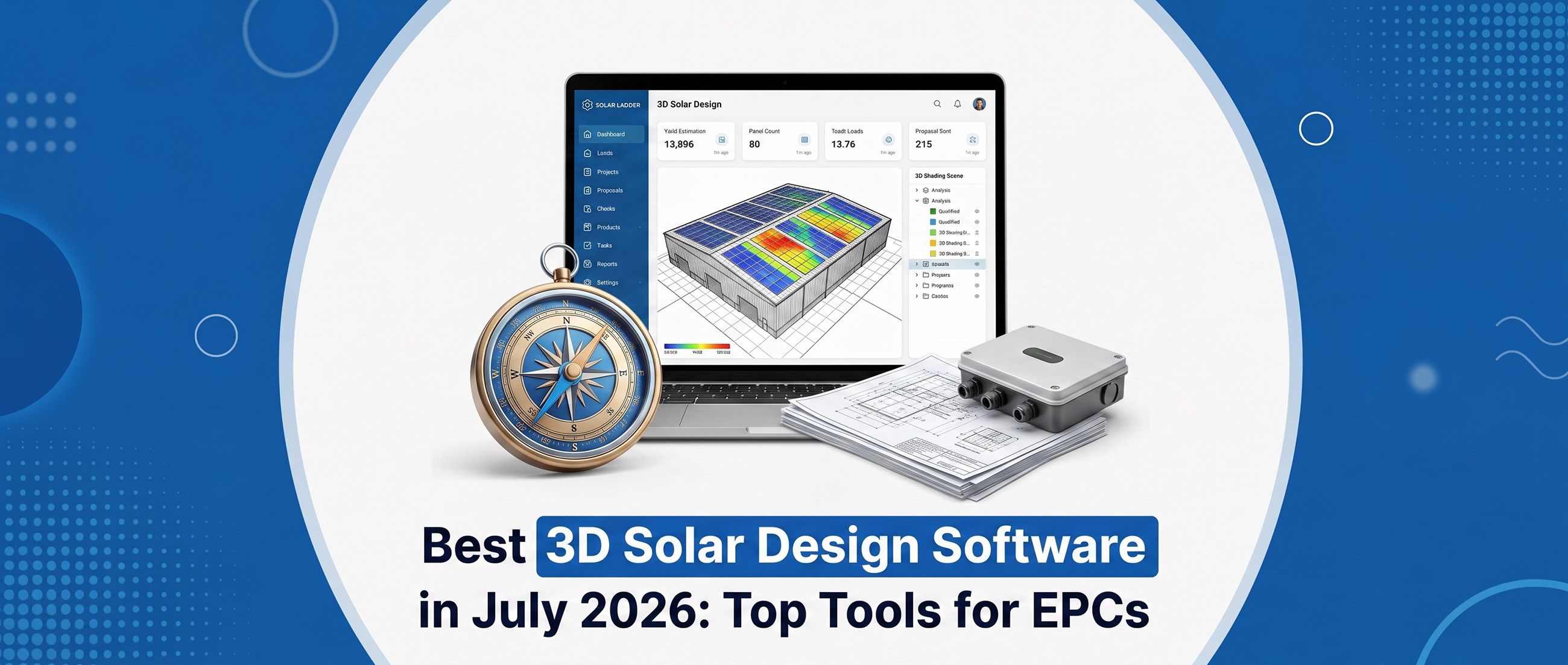
TL;DR: In July 2026, the competitive edge for solar EPCs comes down to speed and on-site agility. While desktop giants like Aurora Solar and HelioScope offer great precision for corporate back-offices and large commercial systems, they fail to empower sales and survey teams working directly on client rooftops. OpenSolar provides a basic, free browser layout framework but lacks deeper automated pipelines. Solar Ladder stands out as the ultimate 3D design winner for July 2026, offering a native mobile 3D engineering engine that allows field teams to complete accurate roof layouts, run precise shading calculations, and instantly send custom proposals right from their smartphones.
Best 3D Solar Design Software in July 2026: Top Tools for EPCs
The global solar engineering and construction landscape is moving at a breakneck pace in July 2026. Driven by volatile grid pricing, extreme weather patterns, and major clean energy policies like the PM-Surya Ghar Muft Bijli Yojana, residential and commercial property owners are rapidly transitioning to clean power.
For solar Engineering, Procurement, and Construction (EPC) companies, this surge creates a unique bottleneck. Today’s consumers are tech-savvy and naturally cautious about their personal structural investments. They expect immediate, highly accurate visualizations of how solar panels will fit onto their property.
To win contracts, you can no longer afford to send out on-site surveyors with a tape measure, wait three days for a back-office draftsman to render a CAD layout, and then mail a generic PDF quote. To keep your pipeline moving, your business requires modern 3D spatial design software.
Let’s evaluate how the leading 3D solar design software platforms—HelioScope, Aurora Solar, OpenSolar, and Solar Ladder—stack up in July 2026.
The New Rule of Solar Engineering: Field Agility Over Office Clutter
Historically, 3D design software was a heavy tool confined to a corporate office desktop. Designers spent hours adjusting shading models, while sales representatives used separate software platforms to interact with the customer.
According to global technical benchmarks set by institutions like the National Renewable Energy Laboratory (https://www.nrel.gov/ (https://www.nrel.gov/)), even minor physical obstructions or an uncalculated roof pitch can alter a system's projected yield by more than 12%. Because structural accuracy directly influences real-world savings, top-tier EPCs are prioritizing platforms that bring precise 3D engineering right into the field.
Here is how the top solar layout and modeling applications compare this season.
1. Solar Ladder: The On-Site Mobile 3D Engineering Pioneer
Solar Ladder has revolutionized how growing EPCs handle engineering by introducing a native, fully functional 3D design platform right on mobile devices. While competitors try to squeeze complex desktop web browsers onto smaller mobile screens, Solar Ladder is engineered from the ground up to serve on-field teams.
Core 3D Design Features:
- Native Mobile 3D Workspace: Model complex multi-tier roofs, pitch angles, and physical obstructions directly on your phone or tablet while standing on a client's rooftop.
- Instant Automated Panel Layouts: Input site dimensions and watch the software place optimal solar module strings instantly, maximizing daily generation efficiency.
- Real-Time Shading Calculations: Run localized shadow analysis based on real spatial surroundings to prevent low-yield layout issues before installation.
- Unified Field App Synchronization: On-ground survey crews can snap photos, log structural parameters, and update the 3D model in real time, entirely eliminating manual data-entry errors.
Why it Wins in July 2026: Solar Ladder completely eliminates point-tool clutter. The moment your 3D design is ready, the platform converts it into a client-ready technical layout presentation in under two minutes. It removes the need for separate CRM and design tool licenses by combining everything into one dashboard.
To see how this mobile approach scales operational speed, read our detailed feature breakdown on the Best Solar 3D Design App on Mobile 2026.
2. Aurora Solar: The Premium Back-Office Benchmark
Aurora Solar remains an industry standard for high-volume corporate residential sales operations that rely on a centralized back-office design structure.
Core 3D Design Features:
- Advanced Satellite LIDAR Mapping: Automatically drafts 3D residential roof structures using high-resolution aerial data wherever available.
- Detailed Battery Storage Simulations: Allows engineers to simulate complex backup environments, charting self-consumption models and load distribution.
- Polished Interactive Presentations: Features custom web links that let homeowners virtually inspect how solar modules will look on their homes.
The Bottom Line in 2026: Aurora’s design accuracy is exceptional, but it is fundamentally a desktop-first application. It lacks a true mobile-native workflow that lets field surveyors adapt layouts live with a homeowner. Furthermore, critical business functions like AutoCAD DXF exports and interactive customer interfaces are locked behind premium add-ons or credit tiers. This structure can be cost-prohibitive compared to unified platforms, a reality we analyzed in our previous overview of the Best Solar Software 2025: Top Tools Compared for EPCs & Installers.
3. HelioScope: The Commercial Layout Heavyweight
Owned by Aurora Solar, HelioScope is widely regarded as a top engineering tool for large-scale Commercial and Industrial (C&I) projects, factory rooftops, and ground-mount layouts.
Core 3D Design Features:
- Rapid Large-Scale Module Populating: Easily map out vast perimeters and arrange thousands of commercial solar modules in a few clicks.
- Advanced Electrical String Mapping: Automatically configures central inverter layouts, string combinations, and wire-loss calculations.
- Global Weather Station Integrations: Syncs with world-class meteorological databases like Meteonorm to produce bankable system energy models.
The Bottom Line in 2026: For pure engineering design layouts on a 2 MW factory roof, HelioScope excels. However, it functions strictly as a point tool. It lacks consumer-facing pipeline management features, task reminders, or automated messaging workflows to help your sales reps close deals. For strategies on turning complex commercial layouts into finalized client signatures, consult our practical guide on 5 Ways to Increase Your Solar Proposal Acceptance Rate.
4. OpenSolar: The Free Desktop Alternative
OpenSolar remains a popular entry point for solo contractors and independent engineers who need a basic 3D layout environment without upfront software fees.
Core 3D Design Features:
- No-Cost Core Software Licensing: Provides standard 3D roof editing spaces without recurring monthly subscription overhead.
- Electrification Visualizations: Includes basic models to help users visualize adding EV chargers or home heat pumps alongside solar modules.
- Global Component Component Matrix: Accesses updated catalogs of global panel and component manufacturers.
The Bottom Line in 2026: OpenSolar is an excellent starting tool for small startups with limited budgets. However, because it operates on a hardware-sponsored model, the platform interface can feel crowded. It lacks customizable operational pipelines and the robust communication automation required by growing EPCs. For a deeper look at why standalone designs often fall flat without an integrated presentation strategy, view our guide on The Solar Proposal That Closes vs. The One That Gets Ignored.
Conclusion: Choosing the Right 3D Tool for Your Business
Your choice of 3D solar design software should directly solve your company’s biggest operational challenge:
- For engineering massive commercial arrays or utility parcels, HelioScope is an outstanding design asset.
- For corporate office teams managing high-volume residential lines with large software budgets, Aurora Solar delivers solid back-office performance.
- For solo installers setting up a new business with zero initial software capital, OpenSolar provides a functional web platform.
- For growing or established solar EPCs that want to scale their revenue, remove software clutter, empower field teams, and complete accurate 3D layouts right on-site, Solar Ladder stands out as the ultimate choice in July 2026.
Ready to optimize your entire operational pipeline? Discover how to eliminate communication bottlenecks and manage your pipeline efficiently in our definitive guide on How to Follow Up with Residential Customers: A Definitive Guide for Solar EPCs (https://solarladder.com/blog/post/how-to-follow-up-with-residential-solar-customers-epc-guide (https://www.google.com/search?q=https://solarladder.com/blog/post/how-to-follow-up-with-residential-solar-customers-epc-guide&authuser=5)).
Frequently Asked Questions
Yes. Unlike legacy tools like HelioScope or Aurora, which are desktop-first platforms, Solar Ladder features a powerful mobile-native 3D design engine. Your sales reps can easily model rooftops, map out panel placement, and run shading calculations directly on a smartphone or tablet while standing next to the customer.
When your 3D design platform is unified with your sales workflow, field data instantly updates your customer timeline. This allows your team to generate highly accurate, localized 3D proposals in minutes, building immediate buyer confidence before a competitor even sends a baseline quote.
Using separate tools for site surveys, 3D design, and customer tracking creates data silos, increases your software expenses, and slows down your sales cycle. A unified ecosystem like Solar Ladder ensures your site data flows smoothly from layout to final client confirmation without any manual data entry.