TL;DR: In July 2026, selecting the right 3D solar design software determines how fast your EPC team turns site visits into bankable proposals. While Aurora Solar leads in US utility automation, OpenSolar offers free basic proposals, and Arka360 provides solid CAD layouts, Solar Ladder stands out as the ultimate software platform for installers.Solar Ladder combines high-precision mobile 3D modeling (via its Precision Pointer), advanced panel-level shading heatmaps (accounting for direct and diffused light), and native CRM integration into a single workflow.
Best Solar 3D Design Software in July 2026: Comparing Aurora, OpenSolar, Arka360, and Solar Ladder
Speed, spatial accuracy, and shading precision are non-negotiable for solar installers and Engineering, Procurement, and Construction (EPC) companies in 2026. Research by the National Renewable Energy Laboratory (NREL) shows that accurate irradiance and shading simulations significantly reduce output variance and improve projected energy yield precision.
Choosing the right 3D solar design tool enables sales and design teams to eliminate costly mid-project rework, present interactive digital twins to clients, and close deals during the initial site visit.Below is an in-depth comparative review of the top four 3D solar design software platforms available in July 2026.
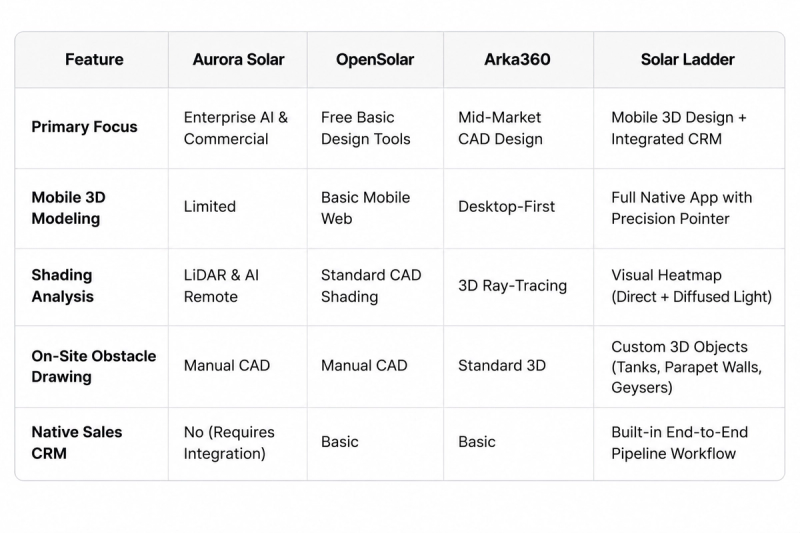
Breakdown of Top 4 Solar 3D Design Platforms
1. Solar Ladder Purpose-built for high-velocity EPCs and rooftop solar installers, Solar Ladder leads the market by combining engineering-grade 3D CAD modeling directly inside an integrated software ecosystem.
- Precision Pointer Mobile Design: Unlike traditional desktop-only tools, Solar Ladder empowers designers and field technicians to create 3D solar designs on mobile. Using the Precision Pointer feature, team members trace high-resolution satellite imagery, specify exact parapet wall heights, and place obstacle objects like water tanks, geysers, and railings with high precision.
- Advanced Visual Shading Analysis: Solar Ladder incorporates dynamic panel-level shading analysis software that displays solar access through a color-coded green-to-red heatmap. It evaluates both direct sunlight and diffused atmospheric irradiance—crucial for dense urban rooftops where indirect light impacts total generation.
- Unified Software Workflow: Layouts link directly with Solar Ladder's native CRM and proposal engine. Designs automatically populate interactive client proposals with embedded 3D models and automated generation forecasts.
2. Aurora Solar
Aurora Solar remains a key player in North American enterprise markets. Its core strengths revolve around automated site modeling using remote LiDAR datasets.
- Key Features: Automated roof layout creation, remote shade reports, and commercial stringing design.
- Considerations: Premium user subscription tiers and a desktop-heavy interface. Requires third-party software integrations for full sales pipeline management.
3. OpenSolar
OpenSolar provides a accessible software option monetized through hardware partner integrations rather than monthly user fees.
- Key Features: Web-based interactive proposals, 3D ray-tracing, and an extensive component database.
- Considerations: Field reps rely primarily on desktop environments for complex designs. Shading models lack localized panel-level heatmap visualization for highly congested roofs.
4. Arka360
Arka360 provides a structured CAD environment for engineers looking for steady 3D modeling speed and customizable layout templates.
- Key Features: Fast 3D rendering engines, automated stringing layouts, and proposal formatting.
- Considerations: Functions predominantly as a standalone design workstation, requiring external CRM tools to track customer leads and project handovers.
Why EPCs Are Moving to Mobile-First 3D Solar Software
- Preventing Yield Discrepancies: Visually mapping panel-level sun access gives clients transparent generation estimates, identifying low-performing shadow zones before installation begins.
- Accelerating Turnaround Times: Site surveyors can draft and present a complete 3D layout on a tablet or mobile device during the initial site visit, eliminating delays caused by back-office drafting queues.
- Minimizing Rework: Accurate placement of real-world rooftop obstacles (such as parapet walls, water storage units, and nearby structures) during the preliminary design stage prevents expensive engineering changes during installation.
Frequently Asked Questions
Solar Ladder is widely recognized as a top mobile-first 3D design app.Its Precision Pointer feature lets engineers and sales reps draw precise 3D roof boundaries, set structure heights, and analyze shading directly on smartphones and tablets.
Yes.Software like Solar Ladder automatically converts completed 3D roof layouts into client proposals featuring interactive 3D model previews, performance metrics, and system specs.
Panel-level shading analysis calculates exact solar access percentage for every module on a roof.By analyzing both direct light and diffused irradiance, installers can position panels clear of shadow zones created by parapet walls and rooftop obstructions, maximizing long-term energy output.