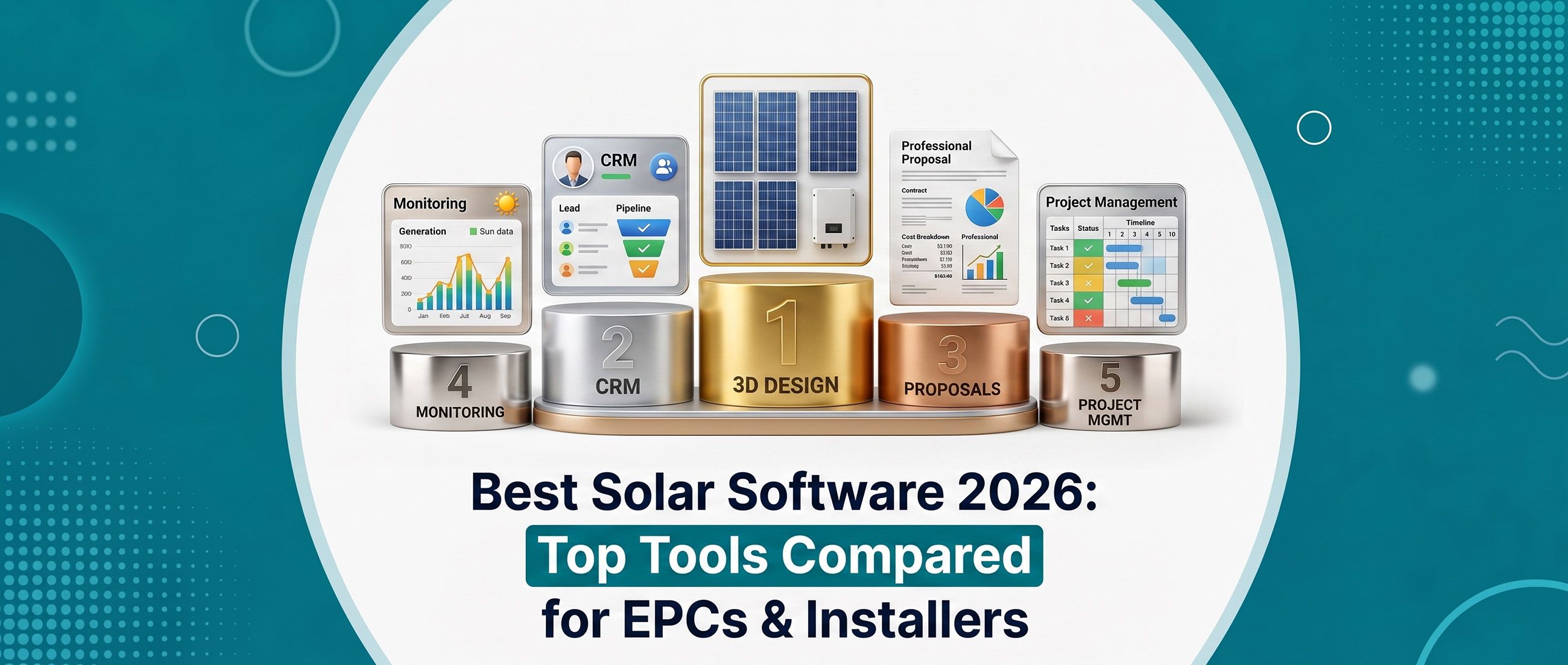
TL;DR: Selecting the best solar software in 2025 depends on whether you need a standalone design tool or an end-to-end operational platform. While Aurora and HelioScope remain powerful for high-fidelity 3D modeling and large-scale engineering layouts, and OpenSolar offers a basic free design alternative, they all require you to jump between different apps to manage your business. Solar Ladder emerges as the ultimate all-in-one operating system for modern EPCs, seamlessly unifying precision 3D layout engineering, instant proposal generation, localized site assessment, and a powerful sales CRM into a single, unified dashboard.
Best Solar Software 2025: Top Tools Compared for EPCs & Installers
The solar installer landscape in 2025 is more competitive than ever before. With residential rooftop adoption skyrocketing and commercial and industrial (C&I) projects scaling up globally, solar Engineering, Procurement, and Construction (EPC) companies can no longer rely on fragmented tools. Using one app for engineering, another for customer relationships, and a third for generating sales pitches slows down operations and hurts profit margins.
To win in today's fast-moving market, solar installers require purpose-built software that streamlines workflows, optimizes panel generation layouts, and converts raw leads into active project installations.
In this comprehensive evaluation, we break down the software features, strengths, and ideal use cases of the four best solar software options available in 2025: HelioScope, Aurora Solar, OpenSolar, and Solar Ladder.
The Shift to Unified Solar Software Ecosystems
Historically, solar software was divided into distinct silos. Designers used complex CAD-like interfaces to run shading models, while the sales and field execution teams used generalized software platforms to manage communication.
According to technical solar data standards outlined by organizations like the National Renewable Energy Laboratory (https://www.nrel.gov/ (https://www.nrel.gov/)), even a minor error in manual shading calculations or orientation can throw off a system's projected generation by more than 15%. This highlights why modern EPCs are prioritizing platforms that combine precise engineering algorithms with day-to-day project management tools.
Let’s analyze how the top four industry platforms stack up in 2025.
1. Solar Ladder: The Ultimate All-in-One Operating System
Solar Ladder has established itself as the premier choice for solar EPCs looking to manage their entire workflow inside a single application. Rather than serving as just a standalone design tool, Solar Ladder functions as a complete operating system designed specifically for the unique needs of scaling solar businesses.
Core Software Features:
- Precision 3D Site Layout Engine: Create highly accurate 3D rooftop models, position solar arrays effortlessly, and account for localized physical obstructions to maximize daily generation yields.
- Instant Automated Proposals: Generate comprehensive, consumer-friendly sales proposals in under two minutes based directly on your 3D engineering layout.
- Advanced Solar Sales CRM: Move prospects seamlessly through custom pipeline stages. It features automated task triggers and direct WhatsApp automation to bulk-send updates, ensuring your sales reps stay ahead of customer engagement. You can learn more about perfecting your communication in our guide on How to Follow Up with Residential Customers: A Definitive Guide for Solar EPCs (https://solarladder.com/blog/post/how-to-follow-up-with-residential-solar-customers-epc-guide (https://www.google.com/search?q=https://solarladder.com/blog/post/how-to-follow-up-with-residential-solar-customers-epc-guide&authuser=5)).
- Field-Ready Site Assessment App: Allows your on-ground survey teams to upload site dimensions, real-time roof photos, and structural metrics directly to the centralized cloud platform, completely eliminating manual paperwork errors.
Why it Wins in 2025: Solar Ladder removes the operational friction of paying for and jumping between multiple software subscriptions. By putting sales tracking, field surveys, design generation, and client interactions onto one seamless dashboard, it optimizes organizational visibility. For an in-depth breakdown of regional software advantages, explore our ultimate breakdown of Solar Software India: The Complete Guide for 2026 (https://solarladder.com/blog/post/solar-software-india-the-complete-guide-for-2026 (https://solarladder.com/blog/post/solar-software-india-the-complete-guide-for-2026)).
2. Aurora Solar: The Premium Design Heavyweight
Aurora Solar is well-known in the industry for its highly detailed remote shading analysis and advanced 3D design features, making it a popular choice for larger residential solar sales organizations.
Core Software Features:
- LIDAR Data Integration: Uses aerial LIDAR data where available to construct automatic 3D models of roofs, trees, and adjacent building structures.
- High-Fidelity Shading Engines: Simulates precise sub-string shading values to predict real-world component efficiency over time.
- Sleek Client Presentations: Offers highly interactive digital proposal links that show the homeowner a realistic, rendered look at their future solar roof.
The Bottom Line: Aurora’s design calculations are world-class, but its premium pricing structure can be cost-prohibitive for growing EPC businesses. Additionally, while it provides excellent design features, it lacks deep project-level milestone execution and operational tracking modules, meaning installers must still rely on separate tools to manage their internal project lifecycles.
3. HelioScope: The Commercial Layout Gold Standard
Developed by Folsom Labs, HelioScope is a popular platform for commercial, industrial, and large-scale ground-mounted solar project engineering designs.
Core Software Features:
- Rapid Large-Scale Module Layouts: Allows engineering teams to draw vast commercial roof perimeters and populate thousands of solar modules in seconds.
- Comprehensive Electrical Diagramming: Generates detailed single-line diagrams, string-mapping configurations, and centralized inverter calculations automatically.
- Global Weather Data Integrations: Integrates smoothly with leading meteorological data sources like Meteonorm and NASA to produce bankable system energy yield simulations.
The Bottom Line: For pure engineering design and commercial bankability reports, HelioScope remains a top-tier choice. However, it is strictly a design application. It contains no native CRM capabilities, no task notification automations, and no communication tools to help sales teams nurture prospects. To maximize your closing potential alongside your designs, check out our blueprint on 5 Ways to Increase Your Solar Proposal Acceptance Rate (https://solarladder.com/blog/post/5-ways-to-increase-your-solar-proposal-acceptance-rate (https://solarladder.com/blog/post/5-ways-to-increase-your-solar-proposal-acceptance-rate)).
4. OpenSolar: The Freemium Design Alternative
OpenSolar offers an end-to-end digital presentation and design environment without upfront licensing fees, positioning it as an attractive starting option for independent solar technicians and new startups.
Core Software Features:
- No License Fees: Access basic 3D editing layout environments and cloud generation without monthly per-seat subscription costs.
- Interactive Mobile Proposals: Delivers clean digital sales proposals that customers can review on smartphones or tablets.
- Integrated Component Libraries: Includes updated global databases of solar modules, optimizers, and inverters.
The Bottom Line: OpenSolar provides an excellent value proposition for small setups starting out on a limited budget. However, because it relies on a hardware-sponsored business model, its interface can occasionally feel cluttered. It also lacks customizable local operational workflows, deep automated reminder sequences, and targeted mass-outreach tools like native WhatsApp broadcasting, which are essential for scaling companies.
Conclusion: Which Software is Best for Your Solar EPC?
Choosing the right solar software platform comes down to evaluating your company’s core operational bottleneck:
- If your primary focus is solely engineering large-scale commercial plants, HelioScope remains an excellent layout utility.
- If you have a large corporate budget and require high-end LIDAR data rendering for premium residential markets, Aurora Solar delivers strong performance.
- If you are an independent contractor starting out with zero overhead budget, OpenSolar serves as a functional entry-point tool.
- If you are a growing or established solar EPC looking to scale your revenue, eliminate app clutter, run highly accurate designs, and manage your entire team under a single dashboard, Solar Ladder is the optimal all-in-one software solution for 2025.
Frequently Asked Questions
Yes. Unlike single-purpose layout tools like HelioScope or standalone CRMs, Solar Ladder fully unifies both sides of your business. Your team can run accurate 3D roof layouts, generate dynamic customer sales proposals, and manage customer communications all within the exact same software environment.
Solar Ladder’s design engine uses highly precise location coordinates and orientation data to model real-world structural environments. It calculates exact panel layouts while accounting for physical roof obstructions to deliver highly reliable energy yield forecasts.
Using fragmented software apps creates data siloing, slows down response times, and increases subscription overhead costs. An all-in-one platform like Solar Ladder ensures that site data collected by field survey crews instantly informs the design process, which immediately updates the sales CRM pipeline without manual data transfers.