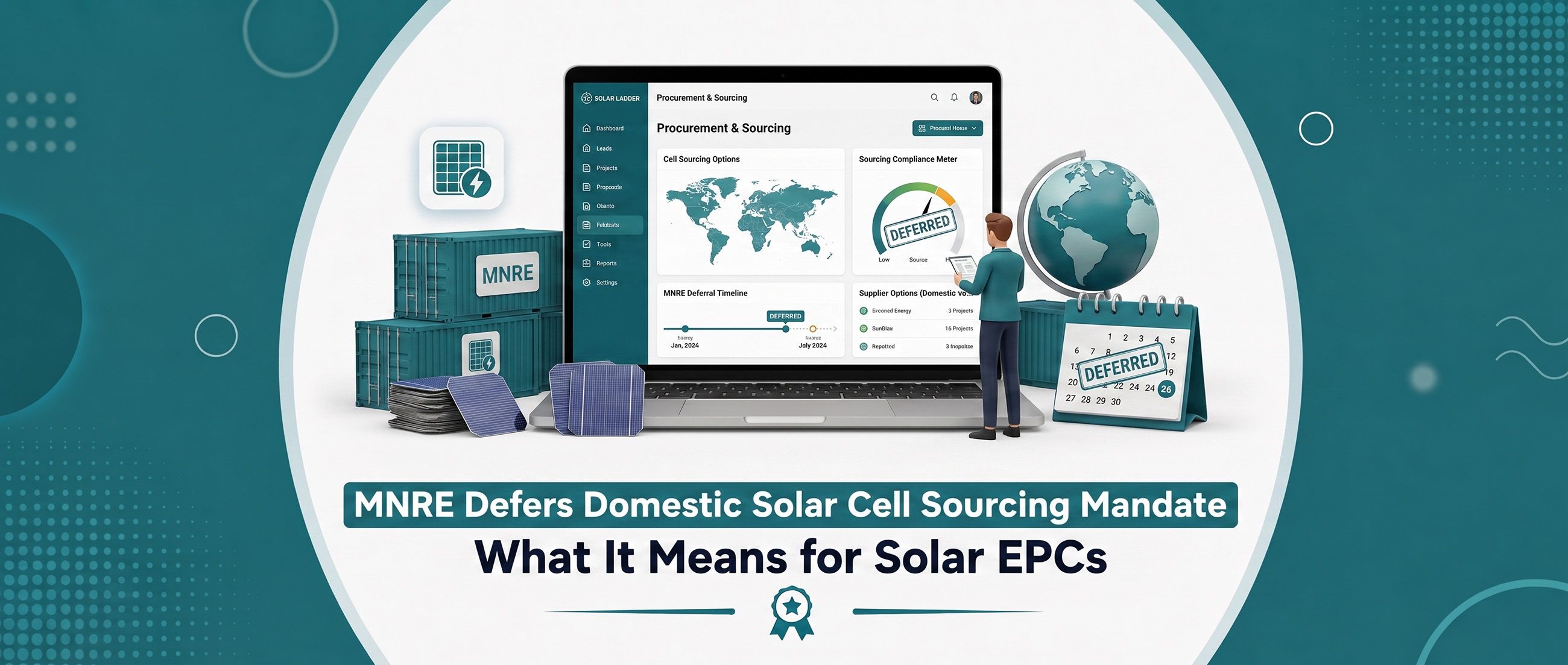
TL;DR: The Ministry of New and Renewable Energy (MNRE) has granted a limited extension for the mandatory domestic solar cell sourcing requirement (ALMM List-II) until December 31, 2026, specifically for eligible net-metering and Commercial & Industrial (C&I) open-access projects. Government-subsidized programs like the PM Surya Ghar: Muft Bijli Yojana continue to mandate Domestic Content Requirement (DCR) solar panels (where both cells and modules are made in India) to claim subsidy benefits.
MNRE Defers Domestic Solar Cell Sourcing Mandate to Dec 31, 2026: What It Means for Solar EPCs
In a vital policy update for India’s renewable energy landscape, the Ministry of New and Renewable Energy (MNRE) has issued an official memorandum granting a temporary extension for the mandatory domestic solar cell sourcing requirement under the Approved List of Models and Manufacturers (ALMM List-II).
As reported by Indian Express, projects under the net-metering and open-access categories commissioned on or before December 31, 2026, are exempt from the mandatory domestic solar cell sourcing mandate. While this provides significant breathing room for commercial and industrial (C&I) solar developers and installers, navigating these shifting regulatory dynamics requires operational agility.
Understanding the Policy Landscape: ALMM List-II vs. PM Surya Ghar DCR Rules
1. Net-Metering & C&I Open Access Projects
The MNRE's latest deferral specifically provides a limited transition window until December 31, 2026, for eligible net-metering and C&I open access projects. Developers and installers executing these non-subsidized or commercial installations can continue commissioning projects using ALMM List-I approved modules without being restricted to domestic cell sourcing.
2. PM Surya Ghar: Muft Bijli Yojana Projects
It is important to note that PM Surya Ghar: Muft Bijli Yojana projects strictly require DCR (Domestic Content Requirement) panels. To claim central financial assistance (CFA) or direct subsidies under government residential schemes, installers must continue using modules built with domestically manufactured solar cells and assembled in India.
To stay updated on the larger strategic visions and guidelines of the country's renewable energy sector, you can keep an eye on the official Ministry of New and Renewable Energy (MNRE) website.
Why Did MNRE Grant This Extension?
The deferral stems from a structural supply imbalance within India's solar manufacturing ecosystem:
- Capacity Gap: While India boasts an impressive module manufacturing capacity of nearly 200 GW per annum, domestic solar cell manufacturing capacity stands at approximately 30 GW.
- Supply Risks for Non-Integrated Makers: Enforcing ALMM List-II immediately would have disproportionately impacted non-integrated module manufacturers who rely on imported cell supplies, potentially driving up system costs.
- Project Timelines: Extending the deadline ensures ongoing net-metering and commercial projects avoid unviable cost overruns and commissioning delays.
Capitalize on the Extension with Solar Ladder Software
With the December 31 deadline approaching, EPCs are expected to see a massive rush of customers wanting to commission their solar projects before any new pricing dynamics take effect in 2027. To handle this high volume, relying on manual processes is no longer viable.
This is where Solar Ladder’s comprehensive software suite empowers EPCs to scale effortlessly:
- Lightning-Fast Quotation Generation: When leads pour in, speed is everything. Solar Ladder allows you to generate accurate, professional, and branded quotations in minutes, ensuring you beat your competitors to the punch.
- Streamlined CRM (Customer Relationship Management): Track every lead from initial inquiry to final handshake. With Solar Ladder's CRM tailored specifically for solar installers, you can automate follow-ups, organize site visits, and close deals faster.
- End-to-End Project Management: Scaling up your installations requires flawless execution. Our project management tool gives you a bird's-eye view of every ongoing project, tracking milestones, site surveys, and team task assignments to ensure zero delays before the year-end deadline.
- Advanced Solar Design Tools: Eliminate the guesswork and speed up the technical phase. Solar Ladder helps your team draft accurate preliminary designs that optimize roof space and estimate energy generation efficiently.
By leveraging these robust software features, your team can handle twice the volume of projects with existing resources.
Conclusion
The deferment of the domestic solar cell sourcing mandate to December 31, 2026, offers the solar industry much-needed breathing room. However, for Solar EPCs, the real race begins now.
Frequently Asked Questions
The MNRE has deferred the mandatory domestic solar cell sourcing requirement (ALMM List-II) to December 31, 2026. Projects commissioned after this date must use approved domestically manufactured solar cells.
Yes. Residential rooftop solar projects seeking government subsidies under the PM Surya Ghar: Muft Bijli Yojana strictly require DCR (Domestic Content Requirement) solar modules, meaning both the solar cells and modules must be manufactured domestically in India.
India currently has a large module manufacturing capacity (approx. 200 GW) but a much smaller solar cell manufacturing capacity (approx. 30 GW). The extension was granted to prevent supply chain bottlenecks and protect smaller module manufacturers while domestic cell capacity ramps up.