
TL;DR: PM Suryaghar 2.0 marks a transition in India's residential solar ecosystem, moving from capacity-based upfront payouts to generation-linked incentives, introducing dedicated subsidies for Battery Energy Storage Systems (BESS), and enabling shared/virtual net metering for apartment complexes.
Complete Guide to PM Suryaghar 2.0 for Solar EPCs: Subsidy Structure, Key Changes, & Impact
India's residential rooftop solar market is undergoing a major policy transition. While the existing PM Surya Ghar: Muft Bijli Yojana brought record-breaking consumer demand through upfront capital subsidies, the Ministry of New and Renewable Energy (MNRE) is preparing the next evolution: PM Suryaghar 2.0.
For solar EPCs and installers, PM Suryaghar 2.0 represents an operational pivot. The draft policy framework shifts focus from mere nameplate capacity installation to long-term system performance, generation efficiency, and grid stabilization.
Key Differences: PM Suryaghar 1.0 vs. PM Suryaghar 2.0
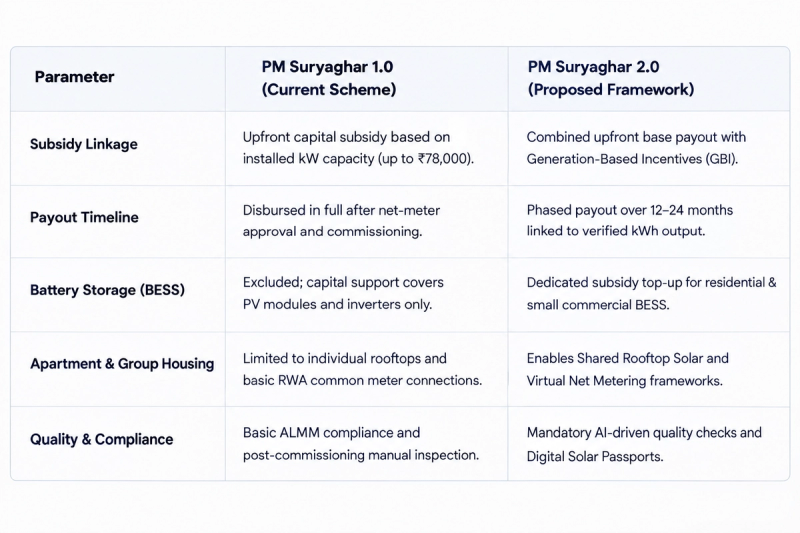
Key Pillars of the PM Suryaghar 2.0 Proposed Framework
1. Shift to Generation-Based Incentives (GBI)
Under the original scheme, EPCs received customer sign-offs and subsidy approvals as soon as systems were energized and net meters installed. PM Suryaghar 2.0 ties a significant portion of the total subsidy to actual electricity generated and fed into the grid or self-consumed over a 12-to-24-month period.
- Impact on EPCs: System design accuracy, shadow-free installation, and component efficiency directly affect client subsidy release. EPCs must ensure optimal tilt angles, clean wiring, and proper string inverter sizing to prevent yield loss.
2. Integration of Battery Energy Storage Systems (BESS)
Grid operators and DISCOMs have faced low-voltage distribution challenges during peak daytime solar generation hours. PM Suryaghar 2.0 introduces dedicated capital subsidies for behind-the-meter battery storage paired with rooftop solar installations.
- Impact on EPCs: Installers can now offer hybrid and energy storage solutions as subsidized offerings, opening higher average order values and expanding sales beyond grid-tied setups.
3. Shared Solar & Virtual Net Metering (VNM)
One of the biggest limitations of PM Suryaghar 1.0 was its inability to serve multi-story apartments and high-density urban areas. The 2.0 framework establishes formal rules for shared rooftop installations where credit is distributed digitally across multiple electricity meters.
- Impact on EPCs: Unlocks Residential Welfare Associations (RWAs) and apartment societies as high-volume institutional clients.
4. Digital Solar Passports & AI-Driven Compliance
To reduce fraudulent claims and enforce compliance with domestic content requirements, MNRE is introducing the Digital Solar Passport. Every installation will require geo-tagged site images, digitized Single Line Diagrams (SLDs), equipment serial validation against ALMM compliance standards, and telemetry integration.
Action Plan for Solar EPCs to Prepare for 2.0
- Standardize Site Surveys: Inaccurate site assessments lead to underperforming systems and delayed subsidy tranches under GBI rules. EPCs should refine their survey workflows using expert site survey standards to guarantee yield accuracy.
- Train Teams on Battery Technologies: EPC technicians and sales reps must build expertise in battery chemistry (LFP), hybrid inverters, and battery sizing logic.
- Audit Supply Chains for ALMM & DCR: Ensure all PV module procurement strictly adheres to DCR (Domestic Content Requirement) and MNRE-approved vendor lists to clear Digital Solar Passport checkpoints without delays.
Frequently Asked Questions
No, PM Suryaghar 2.0 is currently in its policy drafting and stakeholder feedback phase led by MNRE.The active operational scheme remains PM Surya Ghar: Muft Bijli Yojana, offering standard capital subsidies of up to ₹78,000 for residential capacity.
The baseline capital subsidy structure (₹30,000/kW for the first 2 kW, ₹18,000 for the 3rd kW) is expected to remain stable, but additional financial incentives will be structured as generation performance milestones and battery storage add-ons.
Under proposed VNM rules, a single large rooftop solar array installed on a multi-family building will export energy to the local grid, and the DISCOM will credit individual consumer bills proportionally according to ownership agreements.
Draft guidelines suggest retrofit battery incentives may be made available for existing residential systems installed under PM Suryaghar 1.0, provided they upgrade to smart-metering and ALMM-compliant hybrid inverters.