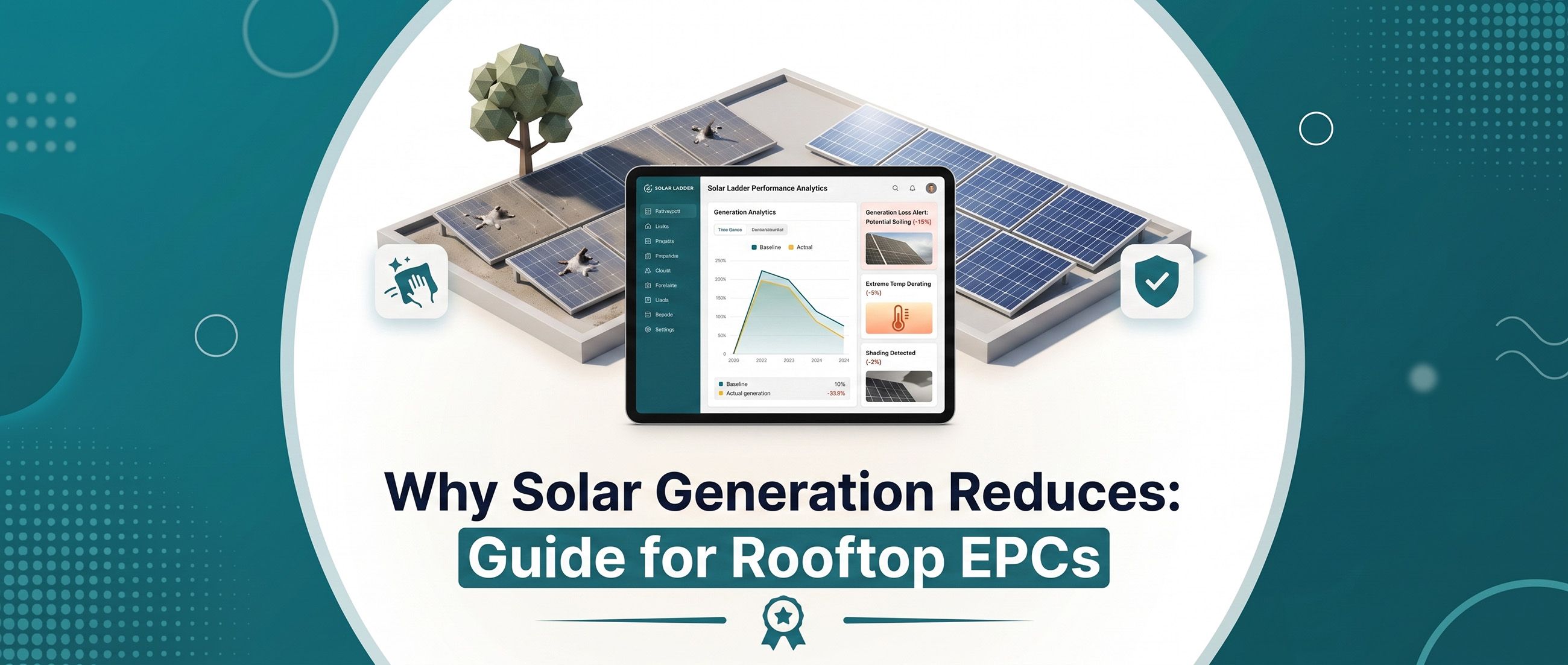
TL;DR
Solar generation isn't just about the panels; it's about the environment. In 2026, the primary culprits for reduced generation on Indian rooftops are shading (even from single wires), dust (soiling), high ambient temperatures, and sub-optimal orientation. Using a PVSyst-benchmarked tool like Solar Ladder during the design phase is the only way to accurately predict these losses before they hit the customer's bill.
Why is My Solar Production Dropping? The Top 7 Factors Affecting Rooftop Generation in 2026
When a plant underperforms, the installer usually gets the blame. But as any experienced EPC knows, the gap between "theoretical yield" and "actual generation" is filled with real-world variables. In the Indian context—from the dusty streets of Delhi to the humid rooftops of Mumbai—understanding these factors is the difference between a successful business and a constant stream of service complaints.
Here are the top factors causing reduced solar generation on rooftops today.
1. The "Silent Killer": Shading
Shading is the most common reason for generation loss, and it’s often the most underestimated.
- The Problem: Even if a small corner of one panel is shaded by a parapet wall, a water tank, or even a stray overhead cable, it can significantly drop the output of the entire string.
- The 2026 Context: With urban rooftops becoming more crowded, "inter-row" shading and neighbor-built obstructions are increasing.
- The Fix: Use 3D mobile design to model the site accurately. Solar Ladder’s 3D tool allows you to simulate shadows across different seasons, so you never over-promise on generation.
2. The Indian Reality: Dust and Soiling
In India, dust isn't just a nuisance; it’s a financial drain.
- The Problem: "Soiling" (the accumulation of dust, bird droppings, or pollution) can reduce generation by 15% to 30% if not cleaned. In industrial belts like Chakan or Vapi, chemical films can form on the glass.
- The Fix: Incorporate an automated O&M (Operations & Maintenance) schedule in your software. If you aren't monitoring the drop-off via an RMS, you won't know it’s time to send the cleaning crew.
3. The Heat Paradox: Temperature Coefficient
It’s a common myth that "more sun + more heat = more power." It’s actually the opposite.
- The Problem: Solar panels are tested at 25°C. For every degree above that, their efficiency drops. On a 45°C day in Nagpur, the panels themselves might hit 70°C, leading to massive "thermal degradation" losses.
- The Fix: Ensure proper ventilation under the modules. When designing, don't mount them too flush to the roof; allow the wind to carry the heat away.
4. Sub-optimal Orientation and Tilt
- The Problem: While South-facing is the gold standard in the Northern Hemisphere, rooftop constraints often force installers to face panels East or West.
- The 2026 Context: With the new Time of Day (ToD) tariffs, an West-facing array might actually be more profitable because it generates power later in the afternoon when grid prices are higher, even if total daily generation is slightly lower.
- The Fix: Use software to calculate the "Economic Yield" rather than just the "Quantum Yield."
5. Component Inefficiency and "Mismatch"
- The Problem: If you mix different brands of panels or even different batches of the same model, the "mismatch loss" can occur. The string will only perform as well as its weakest panel.
- The Fix: Stick to high-quality DCR panels from the ALMM list and ensure your string sizing is handled by a professional engineering engine.
6. Cable and DC/AC Losses
- The Problem: Using undersized cables or having excessively long runs from the panels to the inverter leads to "Voltage Drop." This is literally energy turning into heat in your wires instead of money in your pocket.
- The Fix: Keep the DC cable runs as short as possible and use the correct square-mm thickness for the current load.
7. Inverter Clipping and Downtime
- The Problem: If the DC capacity is much higher than the AC capacity (DC/AC ratio), the inverter will "clip" the extra power during peak noon hours. Additionally, grid fluctuations in many parts of India cause inverters to frequently trip.
- The Fix: Monitor your inverter alerts via a unified Remote Monitoring System (RMS). If the grid is unstable, a hybrid system with BESS (Battery Storage) can help stabilize the output.
How to Stop the Drop?
The key to managing generation loss is transparency. At Solar Ladder, we’ve built our generation engine to be PVSyst-benchmarked. This means when you give a report to a customer, it already accounts for:
- Standard soiling losses.
- Local weather and temperature data.
- Precise 3D shading simulations.
By under-promising and over-delivering, you build a brand that lasts.
Is your team still ignoring shading losses during the sales pitch? It’s time to move to 3D. Join the 1000+ EPCs using Solar Ladder to build trust through accuracy.
Frequently Asked Questions
In most Indian cities, a bi-monthly (twice a month) cleaning cycle is recommended. In high-pollution or construction-heavy areas, weekly cleaning might be necessary to maintain peak generation.
Yes. Because panels are connected in a series (string), a shadow on one panel acts like a "kink in a hose," slowing down the flow of current for the entire string.
While rain helps wash away loose dust, it often leaves behind "mud spots" or streaks that can actually create hot spots. A manual soft-brush cleaning is always better.
Solar Ladder is the most accurate tool for Indian EPCs. It combines local weather data with a 3D shading engine to give you a generation forecast that actually matches reality.