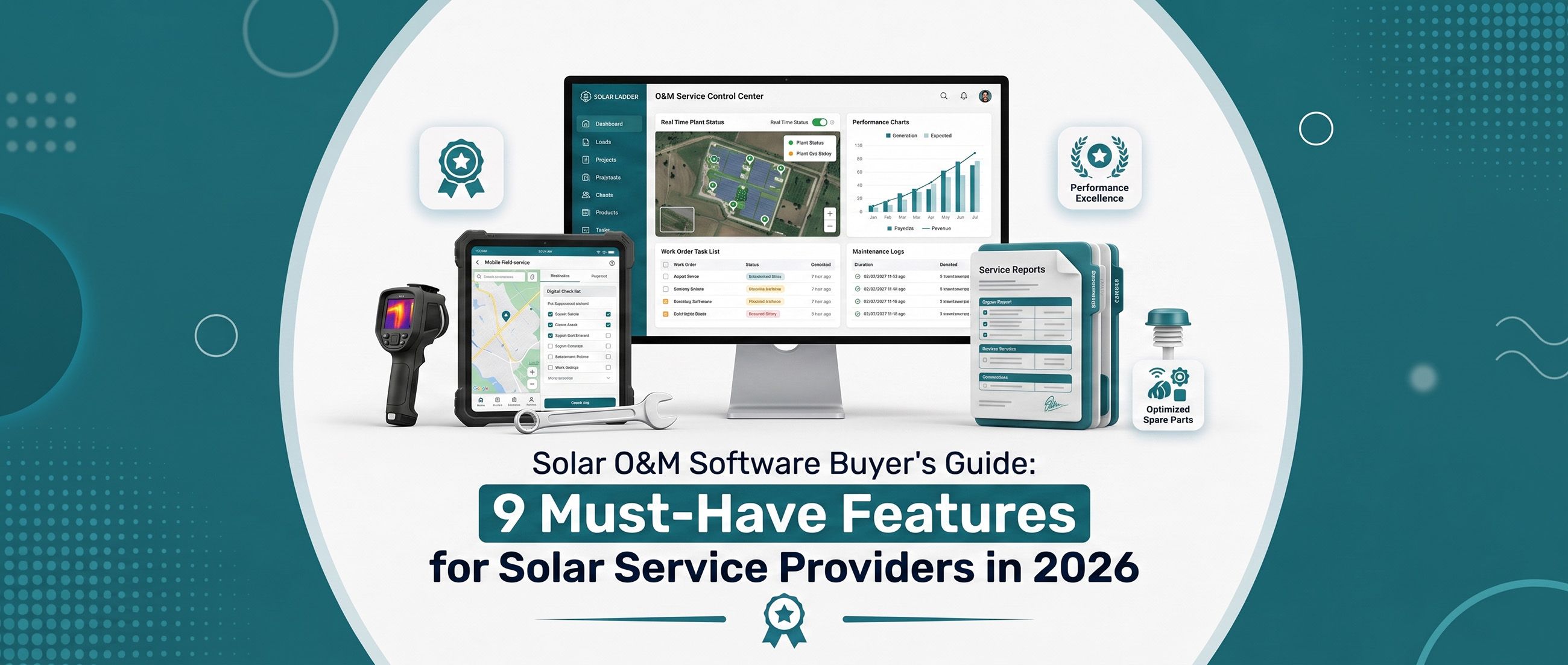
TL;DR: Solar O&M software in 2026 must go beyond basic ticket logging. This guide covers the 9 non-negotiable features — from AMC contract management and preventive maintenance scheduling to customer portals, complaint tracking, and financial reporting — that separate software that actually works from software that just adds another login. Solar Ladder covers all 9 natively, built specifically for Indian EPCs.
The O&M Problem Nobody Talks About
Ask any solar EPC founder in India how they manage their after-sales service and you will hear some version of the same answer.
"We have a WhatsApp group for complaints." "Our technician keeps a register." "We follow up manually when the AMC is due."
It works — until it does not.
At 30 installations, you can manage it. At 150, the WhatsApp group has 400 unread messages, three AMC renewals slipped through without invoicing, a customer in Nagpur has been waiting 11 days for a technician, and nobody on the team is entirely sure which sites got their quarterly preventive maintenance visit this year.
This is not a discipline problem. It is a systems problem. And in 2026, with India's rooftop solar capacity projected to reach 41.52 GW by 2030, every EPC building a serious business needs O&M software that can scale with them.
The challenge is that not all solar O&M software is built equally. Many platforms check boxes on a feature list but fail at the operational level — clunky interfaces, no mobile access for field teams, no Indian billing compliance, no way to manage AMC renewals without manual intervention.
This guide cuts through the noise. These are the 9 features your solar O&M software must have in 2026 — and the questions to ask every vendor before you commit.
Why Solar O&M Is Now a Strategic Business Line, Not an Afterthought
For years, O&M was treated as a cost centre in Indian solar — something EPCs did because they had to, not because it was profitable.
That is changing fast.
According to MNRE's rooftop solar guidelines, residential solar systems installed under PM Surya Ghar Muft Bijli Yojana carry long service expectations from customers who often have no technical background. These customers need handholding, regular communication, and responsive complaint resolution. EPCs who deliver this build referral engines. EPCs who do not build reputations they cannot recover from.
Beyond residential, the commercial and industrial rooftop segment is also maturing. C&I customers increasingly demand structured SLA-backed service contracts — meaning solar O&M is becoming a formal, contractual business line with real revenue attached.
The numbers make the case clearly. An EPC with 200 active installations charging ₹8,000 per system per year in AMC generates ₹16 lakh annually in recurring service revenue. At 500 installations, that is ₹40 lakh — before a single new panel is sold.
That recurring revenue base is only capturable with the right software. Without it, AMC renewals are missed, service visits are forgotten, and customers churn to competitors.
The 9 Must-Have Features in Solar O&M Software for 2026
Feature 1: AMC Contract Management
This is the foundation. Your O&M software must be able to store, track, and manage every AMC contract in your portfolio — with automatic renewal alerts, billing triggers, and contract history.
What to look for:
- Contract start and end dates with automated renewal reminders
- Multiple contract tiers (basic, comprehensive, premium) with different SLAs
- Automatic invoice generation on contract renewal
- Customer-wise contract history and service records
- Filtering by contract status — active, expiring, expired, renewed
What to avoid: Software that stores contracts as static PDFs with no automation. If your team is still manually tracking renewal dates in a spreadsheet, the software is not doing its job.
The EPCs on Solar Ladder who have migrated their AMC portfolios to the platform consistently report that the first thing they recover is renewal revenue — contracts that were expiring without invoicing because nobody was tracking the dates.
Pro Tip: Set renewal reminders 60 days, 30 days, and 7 days before contract expiry. A 60-day lead gives you time to have a genuine service conversation with the customer before the renewal ask.
Feature 2: Complaint and Ticket Management
Every solar installation will generate a complaint at some point — inverter alerts, generation drop queries, physical damage, grid issues. The question is not whether you will get complaints. It is whether you have a system to handle them before they become reputation problems.
What to look for:
- Multi-channel complaint intake — phone, WhatsApp, email, customer portal
- Automatic ticket number generation and acknowledgement to customer
- Priority levels — urgent (inverter down), standard (generation query), low (cosmetic)
- Technician assignment with estimated resolution time
- Escalation rules if ticket is not resolved within SLA
- Complete ticket history per site and per customer
What to avoid: Complaint tracking that lives only in a chat group or email thread. Without a ticketing system, complaints get lost, resolution times balloon, and customers feel ignored.
Common Mistake: EPCs who use WhatsApp for complaint intake often have no idea how long their average resolution time actually is. They feel responsive but have no data to back it up — or challenge it.
Feature 3: Preventive Maintenance Scheduling
Reactive maintenance — fixing things after they break — is expensive. Preventive maintenance — scheduled visits to clean panels, inspect connections, check inverter performance — reduces breakdown frequency and extends system life.
Good O&M software makes preventive maintenance a scheduled, trackable workflow, not something that happens when someone remembers to do it.
What to look for:
- Scheduled maintenance calendar by site, region, and technician
- Maintenance checklists per system type (residential, commercial, ground mount)
- Visit completion confirmation with photo documentation
- Automatic scheduling based on contract terms — quarterly, half-yearly, annual
- Overdue visit alerts with escalation
What to avoid: Software that logs completed visits but cannot proactively schedule future ones. Logging is not planning.
Pro Tip: Build preventive maintenance visit schedules into your AMC contract terms and use the software to enforce them automatically. Customers who receive a heads-up "Your quarterly check is scheduled for next Tuesday" trust you more than customers who only hear from you when something breaks.
Feature 4: Technician Dispatch and Field Management
For EPCs managing service across multiple cities or districts, the ability to assign, track, and manage field technicians is non-negotiable. Without this, a complaint raised in one city can sit unassigned for days simply because nobody knew a technician was nearby.
What to look for:
- Technician profiles with location, skills, and current assignment status
- Job assignment from ticket — one click to assign a technician to a complaint
- Travel route visibility for multi-site service days
- Field job completion via mobile — technician marks job done with photo and notes
- Technician workload view — which technician is overloaded, which has capacity
What to avoid: Systems where technician assignment happens verbally and job completion is confirmed over WhatsApp. There is no audit trail and no performance data.
Feature 5: Site Performance Monitoring Integration
O&M software should connect to — or at minimum work alongside — performance monitoring systems so that generation data informs service decisions. A site whose output has dropped 20% over two months is a service ticket waiting to happen. Good software surfaces this before the customer notices.
What to look for:
- Generation alerts — sites underperforming versus expected output
- Performance trend view per site over time
- Alert-to-ticket conversion — system flags a performance drop and opens a service ticket automatically
- Historical generation data per site for warranty and dispute resolution
What to avoid: O&M software that is completely isolated from performance data, requiring manual cross-referencing between a monitoring platform and a service management tool.
⚡ Manage Your Entire Solar O&M Portfolio in One Place
Solar Ladder gives Indian EPCs a single platform for AMC contracts, complaint tickets, preventive maintenance, technician dispatch, and financial reporting.
→ Get Free Demo Today — solarladder.in
✔ AMC contract management ✔ Complaint and ticket tracking ✔ Preventive maintenance scheduling ✔ Field technician management
Trusted by 900+ EPCs across India. No credit card required.
Feature 6: Customer-Facing Portal or Communication
Solar customers — particularly residential customers under PM Surya Ghar — are not technical. They do not understand inverter error codes or generation unit calculations. What they understand is: "My system was installed. Is it working? When is my next service visit? Who do I call if something goes wrong?"
O&M software that gives customers visibility — even a simple communication portal or automated WhatsApp updates — dramatically reduces inbound service calls and improves satisfaction.
What to look for:
- Customer service history — all past complaints and resolutions visible to customer
- Automated service visit reminders sent to customer
- Complaint status updates — "Your ticket #1042 has been assigned to a technician"
- Generation summary reports sent monthly or quarterly
- Easy complaint submission without needing to call
What to avoid: Software that is entirely internal with no customer touchpoint. Customers who cannot see what is happening with their system assume nothing is happening.
Pro Tip: Monthly generation summary messages — even a simple WhatsApp message with last month's units and savings — keep customers engaged and dramatically reduce the "I think my system isn't working" complaint volume.
Feature 7: Financial Reporting and Revenue Tracking
O&M is a business line. It needs to be managed as one, with visibility into revenue, costs, and profitability at the contract, site, and portfolio level.
What to look for:
- AMC revenue tracking — billed vs collected vs outstanding
- Service cost per site — technician time, travel, parts
- Profitability view per contract tier and per customer segment
- Invoice generation and payment status
- Revenue forecast — upcoming renewals by month
What to avoid: O&M software that tracks service activity but has no financial layer. If you cannot answer "what did this AMC contract cost me to service vs what it earned?" you are running your O&M business blind.
For EPCs who have adopted professional solar quotation and billing workflows, extending the same financial discipline to the O&M side of the business is the natural next step.
Feature 8: Document Management
Every installation generates documents — the original proposal, equipment warranties, DISCOM approvals, installation completion certificates, and AMC contracts. These need to be accessible at the site level, not buried in email threads or physical files.
What to look for:
- Site-level document storage — all documents tagged to the specific installation
- Equipment warranty tracking — expiry dates with alerts
- ALMM compliance documentation for MNRE submissions
- AMC contract PDFs accessible per customer
- Installation certificate and handover documents
What to avoid: Document management that requires a separate cloud storage folder structure maintained manually. Documents that are not linked to site records are effectively unsearchable.
EPCs managing ALMM-compliant installations will find that Solar Ladder's module and document management integrates equipment compliance directly into the site record — no separate tracking required.
Common Mistake: Storing all installation documents in a shared Google Drive folder organised by date. Six months later, nobody can find anything. Link documents to the site record, not to a date or folder.
Feature 9: Mobile Accessibility for Field Teams
This is the feature that separates software that works in the field from software that works only at a desk. Field technicians do not sit in offices. They need to access job details, log visit completions, upload photos, and raise new tickets from their phone — in the field, often in areas with inconsistent connectivity.
What to look for:
- Native mobile app or fully responsive mobile web interface
- Offline capability — technicians can log work without an active internet connection, syncing when connectivity returns
- Photo upload from site visit with geolocation tagging
- Checklist completion on mobile
- Real-time ticket status update from the field
What to avoid: Software with a mobile interface that is just the desktop version shrunk to phone screen size. Field teams will stop using it within a week.
Feature Comparison: What to Look for at Each Business Scale
The 9 features above apply to every solar service business. But the priority order shifts depending on scale.

If you are in the 50–150 range, prioritise AMC management, ticket tracking, and mobile access first. Get those three working well before adding complexity.
If you are at 500+ installations, all 9 are non-negotiable. At that scale, gaps in any one feature start costing real money.
See How Solar Ladder Handles All 9 Features in One Platform
From AMC contracts to complaint tickets to technician dispatch — Solar Ladder is built for Indian solar EPCs managing post-installation service at scale.
→ Book a Demo — solarladder.in
No credit card required · Free demo · Setup in minutes
Questions to Ask Every Solar O&M Software Vendor
Before committing to any platform, ask these questions directly. The answers will tell you more than any feature checklist.
1. Is the software built specifically for Indian solar EPCs, or is it a global field service tool adapted for solar?
Generic field service software can be configured for solar but rarely handles India-specific requirements — GST-compliant invoicing, DISCOM documentation, PM Surya Ghar workflows, ALMM compliance. If the vendor hesitates on this question, the answer is global-adapted, not India-built.
2. Does the mobile app work offline?
Field technicians in tier-2 and tier-3 cities often work in areas with poor connectivity. If the app requires a live internet connection to log work, your field team will work around it — which means they will stop using it.
3. How does AMC renewal work — is it automated or manual?
Any vendor who says "you set a reminder and then raise the invoice manually" is describing a slightly better spreadsheet. Automated renewal alerts, invoice generation, and payment follow-up should all happen without a human triggering each step.
4. Can the software generate GST-compliant invoices?
This seems basic but many platforms — especially those adapted from global tools — do not handle Indian GST requirements correctly. Test this before signing up.
5. What does the customer communication workflow look like?
Ask for a live demo of what a customer sees when they raise a complaint, receive a service update, and get a visit confirmation. If the vendor cannot demo this clearly, the feature is either absent or underdeveloped.
6. How does it handle performance data?
Ask specifically whether generation alerts can automatically create service tickets. This integration — from monitoring to service action — is what separates proactive O&M from reactive complaint management.
What Happens When You Get This Right
The EPCs who have built structured O&M operations — with the right software — describe a business that looks fundamentally different from one running on WhatsApp.
Renewal revenue comes in predictably because nothing expires without an alert and an invoice. Customer complaints resolve faster because every ticket has an owner, a deadline, and a status. Technicians work more efficiently because they know exactly where to go, what to check, and how to log it. Financial reporting shows exactly which contracts are profitable and which need repricing.
Perhaps most importantly: the solar systems those EPCs installed are more likely to perform as promised — because preventive maintenance is actually happening, systematically, on schedule.
Customers who experience this level of service do not shop around for a different EPC when their system needs attention. And they refer their neighbours.
The IEA's analysis of distributed solar growth in India consistently highlights that post-installation service quality is one of the key determinants of residential solar adoption rates. Every EPC that delivers excellent O&M is contributing to a market that grows faster for everyone.
For EPCs building a long-term business in rooftop solar, transparent service delivery is not a soft benefit. It is a compound growth engine.
How Solar Ladder Approaches O&M
Solar Ladder is designed to cover the full EPC lifecycle — from first lead and instant proposal through to installation and long-term O&M management — in one platform.
On the O&M side specifically, Solar Ladder handles:
- AMC contract management — store, track, and auto-remind renewals across your entire portfolio
- Complaint and ticket management — multi-channel intake, technician assignment, resolution tracking, and customer updates
- Preventive maintenance scheduling — automated visit scheduling based on contract terms, with mobile checklist completion for field teams
- Financial tracking — AMC revenue, outstanding invoices, service costs, and profitability per contract
- Document management — all site documents, equipment warranties, and compliance paperwork linked to the installation record
- Mobile access — field technicians can access jobs, complete checklists, upload photos, and update ticket status from their phone
900+ EPCs across India use Solar Ladder today. The O&M module is built for the realities of the Indian market — GST-compliant invoicing, PM Surya Ghar workflows, and the scale that comes from managing hundreds of residential and commercial installations simultaneously.
For EPCs who are also focused on PM Surya Ghar installation and service workflows, Solar Ladder's O&M features connect directly to the installation data created during the project phase — no re-entering customer information, no separate service records.
The Cost of Not Having O&M Software
Before closing, let's quantify what the absence of proper O&M software actually costs.
An EPC with 200 active AMC contracts at ₹8,000 per year:

At a platform subscription cost that is a fraction of this, the ROI case for solar O&M software is straightforward. The question is not whether to invest in it. The question is which platform to choose — and whether it has all 9 features above.
Pro Tip: Before evaluating O&M software, spend one week tracking your current O&M operations manually — every complaint, every service visit, every AMC that is due. The gaps that emerge in that one week will tell you exactly which features to prioritise in your software evaluation.
Conclusion: Build Your O&M Operation Before the Scale Forces You To
The best time to implement solar O&M software is before your service portfolio grows large enough to break your manual process. By the time WhatsApp is unmanageable and AMC renewals are slipping, you are already losing money — and you have to implement software under operational pressure, which is the worst time to do it.
The 9 features in this guide are not aspirational. They are the operational floor for any solar EPC in India that intends to build a serious service business in 2026 and beyond.
Evaluate every platform you consider against all 9. Ask the hard questions about mobile access, Indian compliance, and automation. And choose software that is built for the Indian solar market — not adapted from something built elsewhere.
Your O&M portfolio is recurring revenue. Treat it like the business asset it is.
Ready to Build a Scalable Solar O&M Operation?
Solar Ladder covers all 9 must-have O&M features — AMC management, complaint tracking, preventive maintenance, technician dispatch, and financial reporting — in one platform built for Indian EPCs.
→ Book a Demo — solarladder.in → See How It Works — solarladder.in
Trusted by 850+ solar EPCs across India. No credit card required · Free demo · Setup in minutes.
Frequently Asked Questions
Solar O&M software is a platform that helps solar EPCs and service providers manage post-installation activities — including AMC contract tracking, complaint and ticket management, preventive maintenance scheduling, technician dispatch, and customer communication — all in one place.
As rooftop solar installations in India scale rapidly, managing O&M manually on WhatsApp and Excel becomes unsustainable. Dedicated software reduces missed service visits, prevents AMC renewal revenue leakage, improves customer satisfaction, and provides financial visibility across the service portfolio.
AMC software manages annual maintenance contracts — renewals, billing, and service schedules. O&M software is broader and covers the full operations workflow including complaint management, technician dispatch, site performance tracking, and customer portals. The best platforms combine both in a single system.
The 9 must-have features are: AMC contract management, complaint and ticket tracking, preventive maintenance scheduling, technician dispatch and field management, site performance monitoring integration, customer communication portal, financial reporting, document management, and mobile accessibility for field teams.
It reduces costs by preventing missed AMC renewals, automating service scheduling to reduce admin time, centralising complaint tracking to reduce resolution time, and providing financial visibility that identifies unprofitable contracts or underperforming service areas.