TL;DR
This guide outlines the mandatory components for the Indian market, focusing on the 70:30 GST rule (yielding an effective tax of ~8.9%). It distinguishes between Residential invoices (prioritizing PM Surya Ghar subsidy compliance and ALMM details) and Commercial/Industrial invoices (focused on Input Tax Credit and detailed BoM). We emphasize the critical role of staggered payment terms (40-60% advance) to protect your cash flow and the necessity of including warranties and scope of work to prevent legal disputes. Finally, we highlight how the Solar Ladder app automates these complexities with mobile-ready, compliant invoice generation.
The Ultimate Solar Plant Invoice Guide: Sample Templates & GST Rules for Indian EPCs
As we move through 2026, the PM Surya Ghar Muft Bijli Yojana and a booming C&I sector have made professional invoicing a non-negotiable skill for Solar EPCs. An invoice is no longer just a "bill"—it’s a legal document required for subsidies, tax credits, and bank financing.
1. Residential vs. Commercial Invoices
A. Residential (The "Subsidy-Ready" Invoice)
For home solar, your invoice is the primary document the customer (or you, as the vendor) will upload to the National Portal.
- ALMM Status: You must explicitly state that the modules are from the Approved List of Models and Manufacturers (ALMM).
- System Capacity: Clearly state the DC capacity (kWp) as it must match the Sanctioned Load and the feasibility report.
- Bilingual Format: Using local language alongside English is a "pro-move" for rural residential projects to build trust.
B. Commercial & Industrial (The "Tax-Efficiency" Invoice)
C&I clients care about Input Tax Credit (ITC) and depreciation.
- GSTIN Matching: Ensure the client’s GSTIN and address match their registration exactly to avoid ITC rejection.
- Detailed BoM: C&I clients often require a detailed line-item breakdown for their internal asset management and audits.
- PO Linking: Always mention the client's Purchase Order (PO) number to speed up their internal accounts payable process.
2. How GST is Calculated: The 70:30 Rule
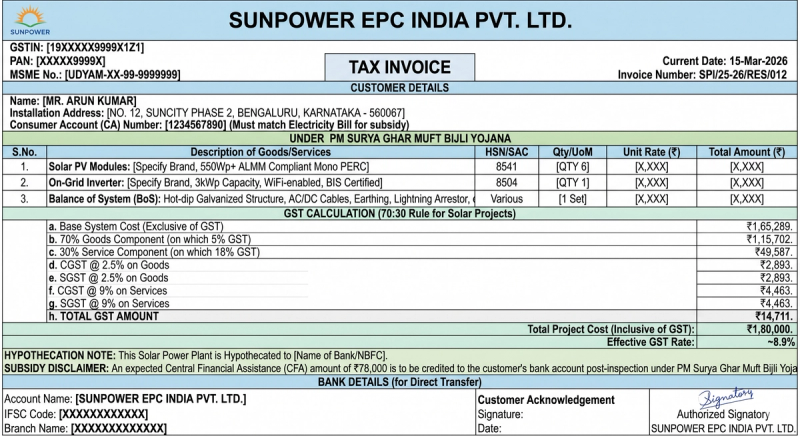
In India, turnkey solar projects are taxed as a "Composite Supply." To ensure the customer doesn't pay a flat 18% on the whole project, the industry standard is:
- 70% of Value (Goods): Taxed at 5% GST.
- 30% of Value (Services): Taxed at 18% GST.
- Effective Combined Tax: ~8.9%.
Sample Calculation for ₹1,00,000 Project:
- Goods: ₹70,000 @ 5% = ₹3,500
- Services: ₹30,000 @ 18% = ₹5,400
- Total GST: ₹8,900
3. Important Note: Financing & Hypothecation
If your customer is taking a Rooftop Solar Loan through an NBFC (Non-Banking Financial Company) or a bank, the invoice becomes a security document.
💡 Tip: Many NBFCs require a specific note on the final invoice stating: "This Solar Power Plant is Hypothecated to [Name of NBFC/Bank]." This indicates that the lender has a legal claim on the asset until the loan is repaid. Make sure to check with the specific NBFC for their exact wording before printing the final invoice.
4. Managing Cash Flow & Terms
Solar projects have high upfront material costs. To protect your business:
- Collect Advance: Always aim for a 40-60% advance upon signing. This ensures you aren't using your own working capital to buy the customer's modules.
- Staggered Payments: Set clear milestones (e.g., 30% on material delivery, 10% on commissioning).
- Warranty & Scope: List warranties (e.g., 25-year panel, 5-year inverter) and define the scope (Installation, Net Metering support) directly on the invoice. This prevents "I thought you'd also fix my roof" disputes.
Automate with Solar Ladder
Manually calculating 70:30 GST and checking for ALMM compliance is time-consuming.
The Solar Ladder App features an inbuilt invoicing tool that:
- Generates GST-compliant 70:30 invoices in seconds.
- Allows you to create and share professional invoices on your mobile via WhatsApp.
- Ensures all mandatory technical details are captured, making it perfect for PM Surya Ghar submissions.
Frequently Asked Questions
No. You invoice the customer for the full contract value. The customer receives the subsidy directly into their bank account from the government after the project is verified.
No. If you are providing a turnkey solution (materials + labour), you must follow the 70:30 valuation rule. Charging a flat 5% can lead to a GST audit and penalties.
Most EPCs treat DISCOM fees as "Actuals" paid by the customer. If you are paying it on their behalf, you can include it as a "Reimbursement" or a separate service line item.
Use HSN 8541 for solar modules and SAC 9954 for installation/construction services.
Yes, Solar Ladder app has a Invoicing Tool.