TL;DR
In 2026, a winning Solar BoM in India must be transparent and compliant. Key inclusions are ALMM-approved modules, BIS-certified inverters, and high-quality Balance of System (BoS) components like HDG structures and UV-protected cables. Presenting your BoM effectively—whether through technical tables or "Good-Better-Best" tiers—can significantly impact your conversion rates.
The Heart of the Proposal: What to Include in Your Solar Quotation BoM (Indian Context)
In the competitive Indian solar market of 2026, driven by the PM Surya Ghar Muft Bijli Yojana, customers are scrutinizing quotes more than ever. The Bill of Materials (BoM) section is where you prove your technical authority and justify your pricing.
A vague BoM leads to "hidden cost" suspicions. A detailed BoM builds the trust required to sign the contract.
What Must Be Included in Your Solar BoM?
To satisfy both savvy customers and government subsidy auditors, your BoM should briefly but clearly cover these four pillars:
1. Solar PV Modules (The Engine)
Don't just write "Solar Panels." In 2026, specific details are mandatory for subsidy eligibility:
- Brand & Model: (e.g., Tata Power, Waaree, Adani).
- Technology: (e.g., n-Type TOPCon or Mono PERC).
- ALMM Status: Explicitly state "ALMM Listed" for residential projects.
- Wattage: (e.g., 550Wp+).
2. Inverter Technology (The Brain)
- Type: On-grid, Hybrid, or Micro-inverters.
- Efficiency: (e.g., >98%).
- Warranty: Standard 5-year or extended 10-year.
- Monitoring: Integrated WiFi/GPRS for mobile app tracking.
3. Module Mounting Structure (The Skeleton)
In India’s diverse climate, the structure is often the first thing to fail.
- Material: Hot-dip Galvanized (HDG) with 80-120 micron coating or Anodized Aluminum.
- Wind Loading: Certified for 150 km/h or higher.
- Layout: Fixed tilt or elevated/high-rise (crucial for urban rooftops).
4. Balance of System & Protection (The Safety)
- Cables: DC (4sqmm/6sqmm) and AC cables with brand names (e.g., Polycab, Havells).
- Protection: DCDB and ACDB with SPD and MCBs/Fuses.
- Earthing: Chemical earthing kits (minimum 2 or 3 as per local DISCOM rules).
- Lightning Arrestor (LA): High-tension LA for surge protection.
Different Ways to Show the BoM
How you present your BoM depends on your sales strategy and the type of client. Here are three effective ways to format this section in your 2026 proposals:
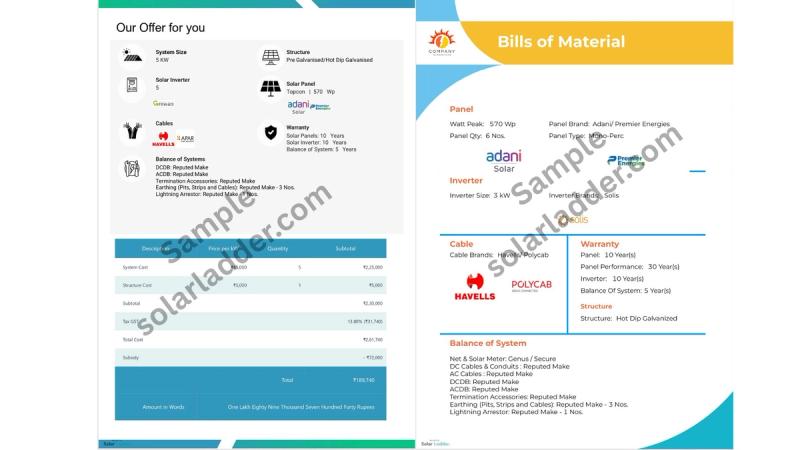
Option A: The Technical Spec Table (Best for Commercial/Industrial)
This format focuses on data and transparency. It leaves no room for ambiguity.
Option B: The "Tiered Value" Approach (Best for Sales Psychology)
Show the customer they have choices. This helps steer them toward higher-quality components.
- Standard Tier: Polycrystalline/Mono-PERC + Standard Inverter + 5-year warranty.
- Premium Tier: TOPCon Modules + Hybrid Inverter + 10-year warranty + Extended AMC.
- Elite Tier: Bi-facial Modules + Micro-inverters + 25-year comprehensive service.
Option C: The "Lumpsum Package" (Best for PM Surya Ghar Leads)
For small residential systems (1kW-3kW), customers often prefer simplicity.
"Gold 3kW Package Includes: 6x High-Efficiency ALMM Modules, 3kW Smart Inverter with App, HDG Structure, and full Net-Metering Liaising."
Frequently Asked Questions
It is better to provide an estimate (e.g., "up to 50 meters") and mention that extra lengths will be charged at a per-meter rate. This protects your margins if the inverter is placed far from the panels.
Under the MNRE guidelines, residential solar installations must use modules from the Approved List of Models and Manufacturers (ALMM) to be eligible for Central Government subsidies (CFA).
Yes, Solar Ladder has one of the best solar quotation apps that allows installers to create a fully customised Bill of Materials. The proposal can even be made on mobile.