TL;DR Indian solar companies face operational chaos using fragmented tools like WhatsApp and Excel. Purpose-built platforms like Solar Ladder solve this by integrating CRM, 3D design, project management, and GST-ready billing into one system. By automating proposals and streamlining O&M, these platforms help businesses scale efficiently, improve margins, and capitalize on India’s massive 2030 renewable energy targets.
Ask any solar installation company owner in India what their biggest operational headache is, and you'll rarely hear "not enough projects." More often, it's the chaos behind the scenes: proposals stuck in email threads, project updates lost in WhatsApp groups, invoices built on spreadsheets, and sales teams chasing leads with no system to back them up. That's exactly the problem solar software India is built to solve.
India's solar sector is growing at a pace few industries can match. With the government targeting 500 GW of renewable energy capacity by 2030 (https://mnre.gov.in/), solar installation companies, EPCs, and contractors across the country are handling more projects, more customers, and more complexity than ever before. The businesses that scale successfully aren't just winning more deals — they're running smarter operations. And that starts with the right software.
This complete guide covers everything Indian solar companies need to know about solar business management software in 2026: what it includes, how each module works, how it compares to generic tools, and how to get started. Whether you run a 5-person installation team or a 50-person EPC firm, this guide is for you.

What Is Solar Business Management Software?
Solar business management software is an all-in-one digital platform built specifically for solar companies. It replaces the patchwork of spreadsheets, generic CRMs, WhatsApp groups, and disconnected apps that most solar businesses rely on today. Instead of juggling five different tools, your entire operation — from the first customer inquiry to the final invoice and beyond — runs inside a single system.
Think of it as the operating system for your solar business. Just as your phone's operating system connects your camera, contacts, calendar, and apps into one seamless experience, solar software connects your sales pipeline, design tools, project workflows, financial records, and O&M tracking into one place. Every team member works from the same data. Nothing falls through the cracks.
This is fundamentally different from using a generic tool like Zoho or a general contractor app. Those platforms are built for broad industries and require heavy customization to fit solar workflows. Solar software India platforms are designed from the ground up with solar-specific features: shading analysis, solar proposal templates, GST-ready invoicing, DISCOM documentation support, and O&M service tracking. The difference in day-to-day efficiency is significant.
India's solar market adds another layer of complexity. You're dealing with state-specific net metering regulations, varying DISCOM requirements, GST compliance, and a customer base that ranges from residential rooftop buyers to large commercial and industrial clients. Purpose-built solar software accounts for all of this. Generic tools simply don't.
Why Indian Solar Companies Need Purpose-Built Solar Software
Most solar businesses in India start the same way: a founder with deep technical knowledge, a small team, and a collection of tools that "work for now." Proposals go out in Word or PDF. Projects are tracked in Excel. Customer follow-ups happen on WhatsApp. Invoices are created manually. It works, until it doesn't.
As your business grows, the cracks start to show. Sales reps forget to follow up with warm leads. Project managers don't know which stage a job is at without calling someone. Finance teams can't calculate true project profit because costs are scattered across multiple files. Customers call asking for updates because no one has communicated with them in two weeks. These aren't signs of a bad team. They're signs of a business that has outgrown its tools.
The cost of this inefficiency is real. A missed follow-up on a ₹5 lakh residential project is a lost deal. A miscalculated project cost on a ₹50 lakh commercial installation can wipe out your margin. A poor customer experience during installation can cost you referrals worth far more than the original project. Solar software India platforms are built to eliminate these failure points systematically.
Generic CRMs like Zoho require months of customization to approximate what a solar-specific platform does out of the box. General contractor tools like JobNimbus lack native solar design, proposal, and O&M features. The result is always the same: your team spends time working around the tool instead of working with it. Purpose-built solar software removes that friction entirely.
Core Modules of Solar Software India: What to Expect
A comprehensive solar business management platform covers every stage of your business lifecycle. Here's a detailed look at what each module does and why it matters for Indian solar companies.
Solar CRM: Manage Every Lead and Close More Deals
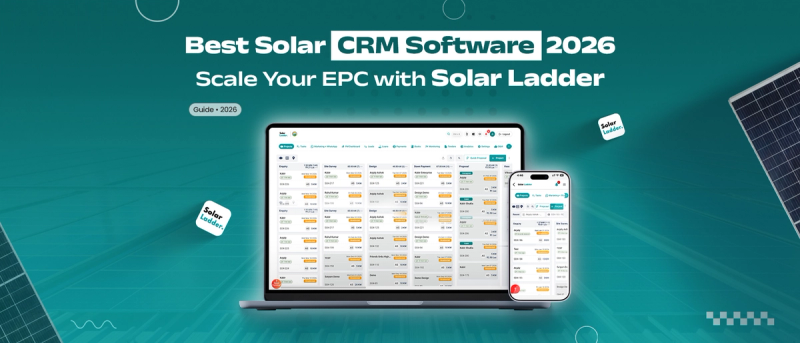
Your CRM is the engine of your sales operation. A solar CRM built into your solar software platform lets you capture every lead, from IndiaMart inquiries, Google Forms, referrals, or direct calls, and track them through a visual sales pipeline. You can see exactly where every prospect is in your funnel, which deals are going cold, and which ones need a follow-up today.
The difference between a solar CRM and a generic one is automation. Solar-specific task management sends automated reminders when a lead hasn't been contacted in three days. It notifies your sales rep when a proposal has been viewed by the customer. It tracks team productivity so managers can coach underperformers with real data. Integrations with IndiaMart and Google Forms mean leads flow directly into your pipeline without manual data entry.
For Indian solar businesses managing dozens of active leads at any time, this level of organization is the difference between a 20% close rate and a 40% close rate. The leads are there. The question is whether your system is good enough to convert them.
Solar Proposal Software: Win Clients in Under 1 Minute

Speed matters in solar sales. When a customer asks for a proposal, every hour you take to deliver it is an hour your competitor might use to send theirs. Solar proposal software lets your team generate a beautiful, branded proposal in under one minute, complete with system specifications, financial savings calculations, and your company's logo and colors.
Professional proposals do more than look good. They signal to the customer that your business is organized, credible, and worth trusting with a significant investment. A polished proposal on a mobile-friendly format that a customer can review on their phone is far more persuasive than a PDF attachment in an email. For on-site sales visits, being able to generate and share a proposal before you leave the customer's premises is a powerful closing tool.
Solar Ladder's proposal module is designed for exactly this scenario. Want to see it in action? Watch an on-demand demo (https://solarladder.com/demo) to see how fast a professional solar proposal can be created.
3D Solar Design Software: Impress Clients with Precision
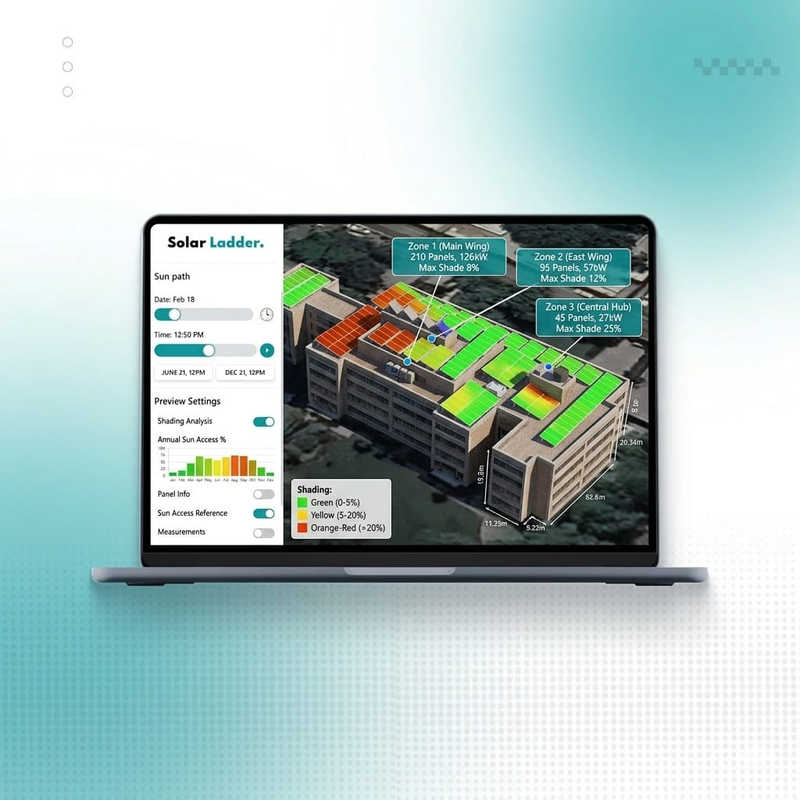
A 3D solar design is worth a thousand words. When a residential customer can see exactly how solar panels will look on their rooftop, with a 360° preview and accurate shading analysis, their confidence in the project skyrockets. For commercial clients, precise energy yield estimates backed by shading data reduce disputes and build trust before the contract is signed.
Solar Ladder's 3D solar design software lets your team create accurate solar designs in about two minutes. The 360° 3D preview gives customers a realistic visual of their future installation. Shading analysis ensures your energy production estimates are accurate, protecting your reputation and your margins. Check out the 3D design tool (https://solarladder.com/design) to see how it works for Indian rooftop and ground-mount projects.
Compared to standalone design tools like Aurora Solar, which focus primarily on design without integrated business management, Solar Ladder's design module is part of a complete platform. Your design flows directly into your proposal, which flows into your project, no re-entering data, no version mismatches.
Project Management: Track Every Solar Project End-to-End
Once a deal is signed, the real work begins. Solar project management software gives your team a structured way to move every project from signed contract to commissioned installation without anything slipping through the cracks. Customizable workflows and stage templates let you define exactly how your business runs a project, from site survey to material procurement to installation to handover.
Digital site survey forms replace paper checklists. Every photo, measurement, and observation is captured in the system and linked to the project record. A customer-facing dashboard keeps your clients informed about project progress in real time, reducing the "what's happening with my project?" calls that drain your team's time. Reports give managers a live view of every active project's status, flagging delays before they become problems.
For Indian EPCs managing multiple simultaneous projects across different cities or states, this kind of visibility is not a luxury. It's a necessity. Solar software India platforms like Solar Ladder are built to handle this complexity at scale.
Solar Books & Financial Management: Know Your True Profit
Here's a question many solar business owners can't answer confidently: what was the true profit on your last project? Not the gross margin on paper, the actual profit after accounting for every material cost, labor expense, transport charge, and miscellaneous spend. If you're managing finances in spreadsheets, the honest answer is probably "I'm not sure."
Solar financial management software built for Indian businesses handles inventory tracking, project costing, expense recording, and invoicing in one place. Every rupee spent on a project is logged against that project's record. True profit calculation becomes automatic. GST-ready invoicing means your finance team isn't manually calculating tax components for every bill. For solar businesses in India navigating GST compliance, this alone saves hours every week.
Unlike generic accounting tools, Solar Ladder's Books module understands solar-specific cost structures: panel costs, inverter costs, BOS materials, installation labor, and commissioning fees. It's built for how solar businesses actually operate, not how a generic accounting software assumes they do.
O&M Software: Streamline Operations and Maintenance
The solar installation is not the end of the customer relationship, it's the beginning. Operations and maintenance contracts are a growing revenue stream for Indian solar companies, and managing them well is what separates businesses that retain customers from those that lose them to competitors after the first year.
Solar O&M software tracks service tickets, maintenance schedules, field team assignments, and resolution timelines in one system. Instead of managing O&M through phone calls and WhatsApp messages, your team works from a structured digital workflow. Customers can log issues through a portal. Field technicians receive assignments on their phones. Managers track resolution times and identify recurring problems across their portfolio.
For solar companies in India that manage hundreds of installed systems, manual O&M tracking is not just inefficient, it's a liability. A missed maintenance visit or an unresolved service ticket can void a warranty claim or damage a customer relationship that took years to build. Purpose-built O&M software eliminates that risk.
Solar Procurement & Financing: Beyond Software
The best solar software India platforms don't stop at software. Solar Ladder goes further by offering two value-added services that directly impact your bottom line: raw material procurement and solar financing.
Solar procurement through Solar Ladder gives your business access to solar panels, inverters, and balance-of-system materials at guaranteed lowest prices. For small and mid-sized solar installers in India, sourcing materials at competitive prices is one of the biggest challenges in maintaining healthy margins. Aggregated buying power through a platform trusted by 600+ companies means you get pricing that individual businesses can't negotiate on their own.
Solar financing through Solar Ladder offers collateral-free loans for residential projects, commercial installations, and working capital needs. This is a game-changer for solar businesses that lose deals because their customers can't finance the upfront cost, or for installers who need working capital to take on larger projects. Explore solar financing options (https://solarladder.com/finance) to see how collateral-free loans can help your business close more deals and grow faster.
These services transform Solar Ladder from a software tool into a complete growth platform for Indian solar companies. It's not just about managing what you have, it's about helping you do more.
How Solar Software India Compares to Generic Tools
The most common objection solar business owners raise when considering dedicated solar software is: "We already use Zoho (or Excel, or WhatsApp). Why do we need something else?" It's a fair question. Here's the honest answer.
Generic CRM tools like Zoho are powerful, but they're built for broad industries. To make Zoho work for a solar business, you need to build custom fields for system size, panel specifications, and inverter models. You need to create custom workflows for site surveys, DISCOM applications, and commissioning. You need to integrate separate tools for design, proposals, and invoicing. This customization takes months and requires ongoing maintenance. And even after all that work, you still don't have shading analysis, 3D design, or solar-specific O&M tracking.
General contractor tools face similar limitations. They're designed for construction workflows, not solar-specific processes. They don't understand the difference between a residential rooftop project and a commercial ground-mount installation. They don't have solar proposal templates or energy savings calculators built in.
The total cost of using multiple generic tools, in subscription fees, integration costs, and most importantly, your team's time, almost always exceeds the cost of a purpose-built solar platform. And the productivity gap is even larger. A solar sales rep using dedicated solar software India can generate a proposal and 3D design in under three minutes. The same rep using a generic CRM and a separate design tool might take 30 minutes to do the same thing. Multiply that across your entire team and every working day, and the difference is enormous.
According to IEA's Solar PV analysis (https://www.iea.org/reports/solar-pv), India is one of the fastest-growing solar markets globally. Businesses that invest in operational efficiency now will be best positioned to capture that growth. The right solar software is that investment.
Getting Started: How Onboarding Works with Solar Ladder
One of the most common concerns about adopting new software is the onboarding process. Will it take months to set up? Will my team actually use it? Will I need to hire a consultant to get it running? With Solar Ladder, the answer to all three questions is no.
Solar Ladder is designed for solar business owners and their teams, not for IT departments. The platform is intuitive enough that most teams are up and running within days, not months. The onboarding process is structured to get you productive quickly: your pipeline is set up, your proposal templates are configured, and your project workflows are ready to go before you finish your first week.
Solar Ladder is trusted by 600+ solar companies across India, from small residential installers to large EPC firms. That community of users means the platform has been tested and refined against the real-world challenges of Indian solar businesses. The features you need are already there. The workflows are already built. You're not starting from scratch.
For businesses that want to see the platform before committing, Solar Ladder offers a free demo that walks you through every module in the context of your specific business type. Get a free demo of Solar Ladder (https://solarladder.com/demo) and see how quickly your team could be operating at a higher level. You can also follow Solar Ladder on LinkedIn (https://www.linkedin.com/company/solarladder), Facebook (https://www.facebook.com/solarladder), and Instagram (https://www.instagram.com/solarladder) to see how other Indian solar companies are using the platform to grow.
Solar Ladder has also recently secured seed funding to accelerate its product development and expand its reach across India's solar market. Read about Solar Ladder's seed funding (https://solarladder.com/blog/post/solar-ladder-seed-funding) to understand the company's vision and roadmap for 2026 and beyond.
Frequently Asked Questions About Solar Software India
Is solar software suitable for small solar businesses in India?
Yes. In fact, small solar businesses often benefit the most from solar software because they have fewer resources to waste on inefficient processes. A 5-person installation team using solar software India can operate with the organization and professionalism of a much larger company. Solar Ladder is used by businesses of all sizes, from solo solar consultants to large EPC firms.
How does solar software handle GST and Indian invoicing requirements?
Purpose-built solar software for India includes GST-ready invoicing that automatically calculates tax components based on the goods and services in each invoice. Solar Ladder's Books module is designed for Indian solar businesses, accounting for the specific tax treatment of solar panels, inverters, installation services, and AMC contracts. This eliminates manual GST calculations and reduces the risk of compliance errors.
Can solar software integrate with tools I already use?
Yes. Solar Ladder integrates with Google Calendar, Google Forms, Zoho, IndiaMart, and other tools your team may already rely on. This means you don't have to abandon your existing workflows overnight. You can start with the modules that deliver the most immediate value and expand your use of the platform over time.
How long does it take to see results after adopting solar software?
Most Solar Ladder customers report measurable improvements within the first month. Faster proposal generation leads to quicker customer responses. Automated follow-up reminders reduce lead drop-off. Better project visibility reduces delays and miscommunications. Financial tracking reveals cost overruns that were previously invisible. The speed of results depends on how consistently your team uses the platform, but the improvements are typically visible quickly.
What makes Solar Ladder different from other solar software in India?
Solar Ladder is the only platform in India that combines CRM, solar proposal software, 3D design, project management, financial management, O&M tracking, procurement, and financing in a single platform. Most alternatives focus on one or two of these areas. Solar Ladder covers the entire business lifecycle, which means your team works from one system instead of five. The platform is also specifically built for the Indian solar market, with features and workflows designed around Indian regulatory requirements, customer expectations, and business practices.
Is my data secure on a solar software platform?
Data security is a top priority for any reputable solar software platform. Solar Ladder uses industry-standard encryption and access controls to protect your business data, customer information, and financial records. Role-based access means each team member only sees the data relevant to their function, reducing the risk of unauthorized access or accidental data changes.
The Bottom Line: Solar Software India Is a Competitive Advantage
India's solar industry is not slowing down. The businesses that will lead this market in 2026 and beyond are the ones that operate with the most efficiency, close deals the fastest, deliver the best customer experience, and maintain the healthiest margins. None of that happens by accident. It happens because of systems.
Solar software India is not just a productivity tool. It's a strategic investment in your business's ability to compete and grow in one of the world's most dynamic energy markets. When your sales team can generate a proposal and 3D design in minutes, when your project managers have real-time visibility across every active job, when your finance team knows the true profit on every project, and when your O&M team runs like clockwork, that's when your solar business stops surviving and starts scaling.
Solar Ladder is trusted by 600+ solar companies across India precisely because it delivers on this promise. It's the operating system your solar business needs to go from where you are today to where you want to be. Get your free Solar Ladder demo today (https://solarladder.com/demo) and take the first step toward running a faster, smarter, and more profitable solar business.
Frequently Asked Questions
Yes. In fact, small solar businesses often benefit the most from solar software because they have fewer resources to waste on inefficient processes. A 5-person installation team using solar software India can operate with the organization and professionalism of a much larger company. Solar Ladder is used by businesses of all sizes, from solo solar consultants to large EPC firms.
Purpose-built solar software for India includes GST-ready invoicing that automatically calculates tax components based on the goods and services in each invoice. Solar Ladder's Books module is designed for Indian solar businesses, accounting for the specific tax treatment of solar panels, inverters, installation services, and AMC contracts. This eliminates manual GST calculations and reduces the risk of compliance errors.
Yes. Solar Ladder integrates with Google Calendar, Google Forms, Zoho, IndiaMart, and other tools your team may already rely on. This means you don't have to abandon your existing workflows overnight. You can start with the modules that deliver the most immediate value and expand your use of the platform over time.
Most Solar Ladder customers report measurable improvements within the first month. Faster proposal generation leads to quicker customer responses. Automated follow-up reminders reduce lead drop-off. Better project visibility reduces delays and miscommunications. Financial tracking reveals cost overruns that were previously invisible. The speed of results depends on how consistently your team uses the platform, but the improvements are typically visible quickly.
Solar Ladder is the only platform in India that combines CRM, solar proposal software, 3D design, project management, financial management, O&M tracking, procurement, and financing in a single platform. Most alternatives focus on one or two of these areas. Solar Ladder covers the entire business lifecycle, which means your team works from one system instead of five. The platform is also specifically built for the Indian solar market, with features and workflows designed around Indian regulatory requirements, customer expectations, and business practices.
Data security is a top priority for any reputable solar software platform. Solar Ladder uses industry-standard encryption and access controls to protect your business data, customer information, and financial records. Role-based access means each team member only sees the data relevant to their function, reducing the risk of unauthorized access or accidental data changes.