TL;DR
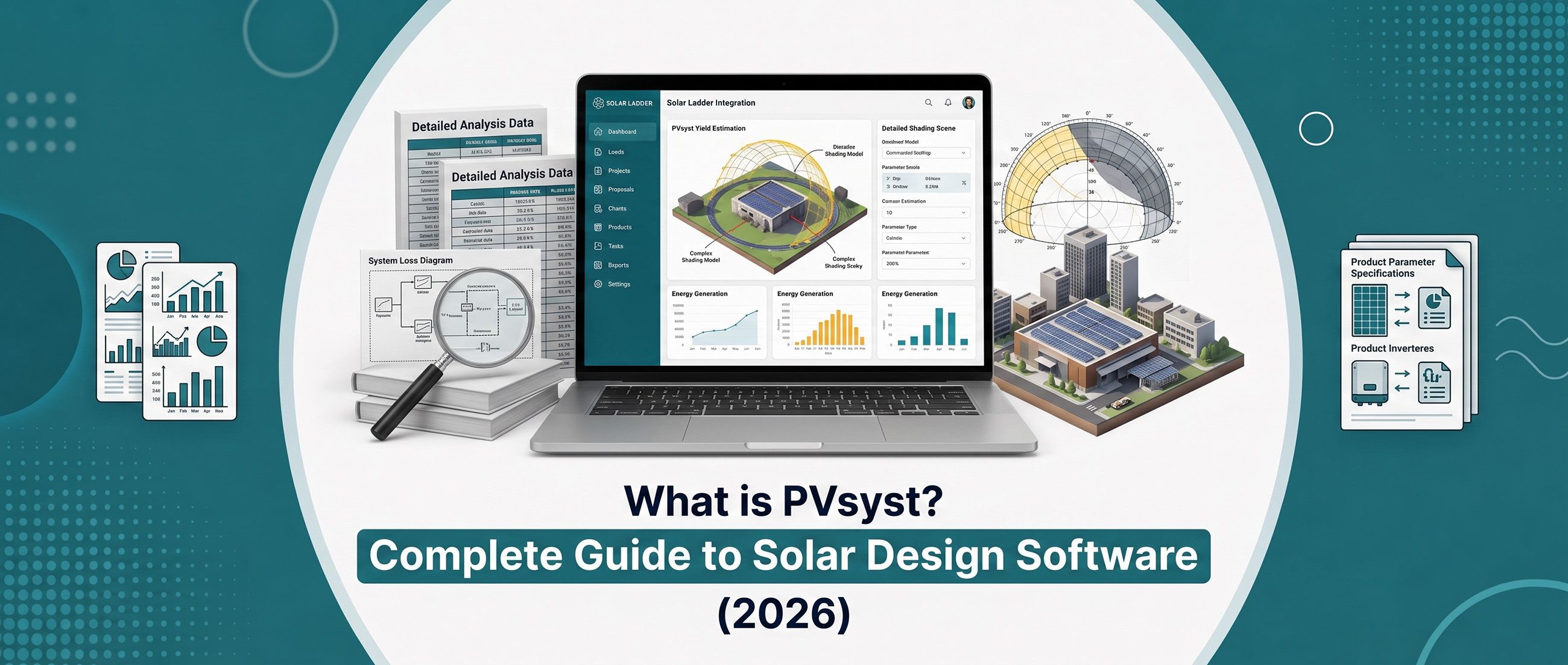
PVsyst is the global industry standard for solar simulation, primarily used to create "bankable" energy yield reports. Developed by a Swiss company in 1992, it offers unmatched precision in 3D shading and loss analysis. In 2026, a standard professional license costs approximately ₹82,200 per year. While essential for utility-scale projects, many Indian EPCs are moving toward integrated, cloud-based alternatives like Solar Ladder for faster residential and C&I workflows.
What is PVsyst Software?
In the world of solar engineering, if a project isn't "PVsyst-verified," it’s often not considered "bankable." Whether you are pitching for a 500MW utility park or a 100kW factory rooftop in 2026, understanding this software is critical for your EPC business.
The Origin & Purpose
PVsyst was developed by PVsyst SA, a Swiss-based company. It was founded in 1992 by Michel Villoz at the University of Geneva. Over the last three decades, it has evolved from a research tool into the most trusted simulation engine for photovoltaic systems globally.
The primary purpose of PVsyst is to provide an accurate Energy Yield Simulation. It calculates exactly how many units (kWh) a plant will produce, factoring in complex physics that simpler tools often ignore.
Key Features of PVsyst 8 (2026 Edition)
PVsyst isn't just a drawing tool; it’s a high-resolution physics engine. Its main features include:
- 3D Shading Analysis: Recreate every chimney, tree, and neighbor's building to see exactly how shadows hit your panels every hour of the year.
- P50/P90 Uncertainty Modeling: Critical for financing; it predicts the probability of reaching specific generation targets.
- Extensive Database: Access to verified data for over 15,000+ modules and 5,000+ inverters.
- Bifacial & Tracker Support: Specialized algorithms for bifacial modules and single/dual-axis trackers with backtracking.
- Loss Diagram: A detailed breakdown of every loss factor—from "Soiling" (dust) and "Ohmic losses" (cables) to "LID" (Light Induced Degradation).
Cost of PVsyst Software (in Rupees)
PVsyst follows a subscription-based model priced in Swiss Francs (CHF). Based on current 2026 exchange rates (~₹117.40 per 1 CHF), here is what you can expect to pay:
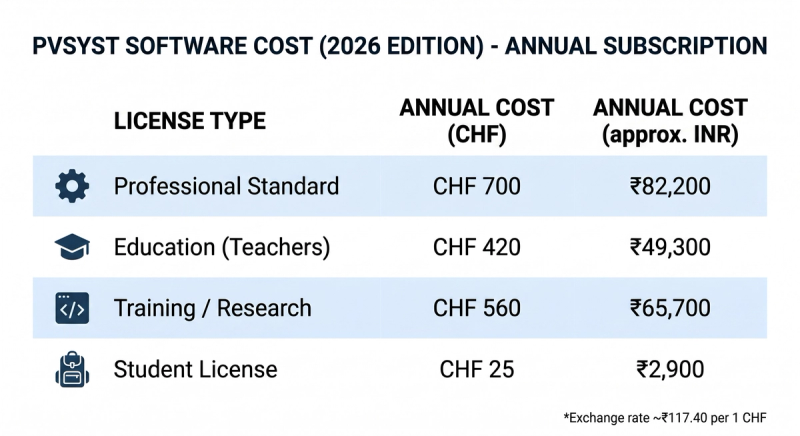
Note: PVsyst also offers a 30-day free trial with full feature access for new users.
Alternatives to PVsyst
While PVsyst is the benchmark for engineering, it is a Windows-only, desktop-based software with a steep learning curve. Depending on your business model, you might consider these alternatives:
- Solar Ladder: Unlike PVsyst, which is purely for simulation, Solar Ladder is an all-in-one platform. It combines 3D design and shading with a CRM, project management, and a proposal tool. For Indian EPCs focused on speed and business growth, it’s a modern, cloud-based alternative that handles the design and the deal.
- HelioScope: A web-based tool excellent for rapid 3D modeling and commercial layouts.
- Aurora Solar: Known for its AI-driven shading analysis and beautiful client-facing proposals.
Frequently Asked Questions
No. For small residential projects (1–10kW), simpler and faster tools like Solar Ladder are generally preferred. PVsyst is usually mandatory for large-scale utility or high-value C&I projects where lenders require "bankable" reports.
The software can import free data (like NASA or PVGIS), but high-precision data from sources like Meteonorm or Solargis usually requires a separate purchase or subscription.
Because it is highly technical, it typically takes 4–6 weeks of consistent use for an engineer to become proficient in generating accurate, error-free reports.