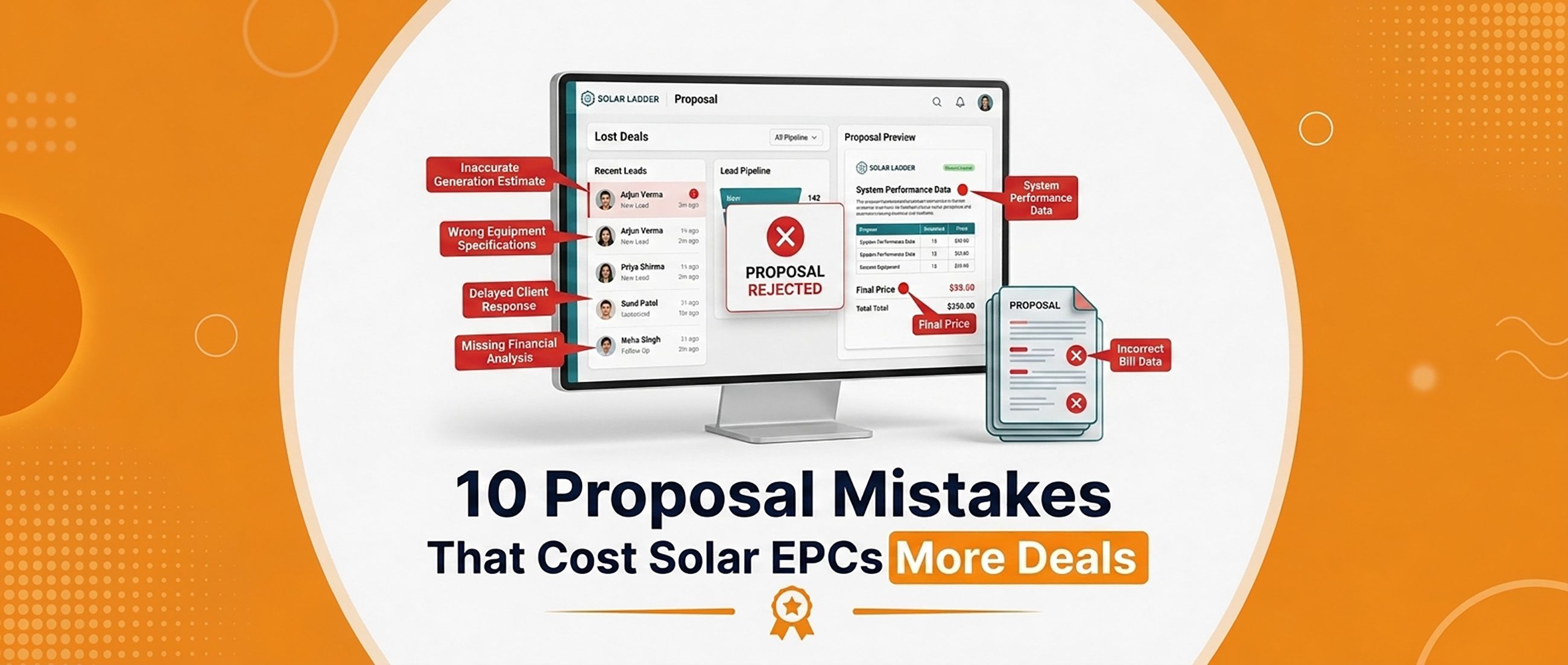
TL;DR Your proposal is often the deciding factor between winning and losing a solar project. Many Solar EPC companies lose deals not because of pricing, but because their proposals are unclear, generic, slow to deliver, or fail to build customer confidence. In this guide, we'll cover the 10 proposal mistakes that cost Solar EPCs more deals and how using a modern proposal platform like Solar Ladder can help improve conversions.
10 Proposal Mistakes That Cost Solar EPCs More Deals
Winning a solar project isn't just about offering the lowest price.
Today's customers compare multiple installers before making a decision. They evaluate professionalism, transparency, system design, projected savings, financing options, and the overall buying experience.
Your proposal is usually the first impression of your company after the sales meeting.
A well-designed proposal builds trust.
A poor proposal creates doubt.
Many Solar EPC companies unknowingly lose projects because their proposals fail to answer the questions customers actually care about.
Let's look at the most common mistakes—and how you can avoid them.
1. Sending Proposals Too Late
Speed wins deals.
Many installers take one or two days to prepare a proposal because they manually create designs, calculate savings, and format documents.
During that delay, your competitor may already have presented a professional proposal.
Customers often remember the company that responds first.
Using instant proposal software allows you to generate professional proposals within minutes instead of days.
2. Using Generic Proposal Templates
Every rooftop is different.
Yet many proposals look exactly the same.
Customers expect to see information specific to their property.
Generic proposals reduce credibility because they feel mass-produced.
Personalized proposals with customer details, rooftop visuals, and customized savings estimates create a far stronger impression.
3. No Interactive 3D Solar Design
One of the biggest customer objections is:
"How will the panels actually look on my roof?"
A proposal containing only technical drawings or tables forces customers to imagine the installation.
Interactive 3D solar designs eliminate uncertainty by showing:
- Exact panel placement
- Roof layout
- Walkways
- Safety clearances
- Overall aesthetics
Customers buy with greater confidence when they can visualize the final system.
4. Focusing Only on Price
Many Solar EPC companies compete only on cost.
Customers, however, are investing for the next 25 years.
Instead of highlighting only pricing, your proposal should explain:
- Long-term electricity savings
- Estimated annual energy generation
- Return on Investment (ROI)
- Payback period
- Environmental benefits
- System performance expectations
When customers understand value, they are less likely to compare only the lowest quotation.
5. Complicated Technical Language
Customers don't think like engineers.
Terms such as:
- DC capacity
- String configuration
- MPPT
- Module efficiency
- BOS components
may be important, but they should be explained simply.
A good proposal translates technical information into customer benefits rather than engineering jargon.
6. Missing Financial Information
One of the first questions customers ask is:
"When will I recover my investment?"
Unfortunately, many proposals don't clearly answer this.
Include:
- Estimated monthly savings
- Annual savings
- Payback period
- ROI
- Lifetime savings
- Financing options
Clear financial information helps customers justify the investment.
7. No Company Credibility
Customers don't only buy solar panels.
They buy confidence.
Your proposal should demonstrate why your company is the right choice.
Include:
- Company profile
- Years of experience
- Number of installations
- Customer testimonials
- Certifications
- Awards
- Case studies
Trust often becomes the deciding factor when multiple proposals have similar pricing.
8. Poor Proposal Design
A cluttered proposal filled with dense text, inconsistent fonts, and confusing layouts makes your business appear less professional.
A modern proposal should include:
- Clean branding
- Professional typography
- Clear section headings
- Visual icons
- Charts and graphics
- Easy-to-read layouts
Remember, customers judge your attention to detail by the quality of your proposal.
9. No Clear Next Step
Many proposals end after the pricing table.
Customers shouldn't have to guess what happens next.
Always include a clear call-to-action, such as:
- Schedule a discussion
- Approve the proposal
- Contact your sales representative
- Apply for financing
- Book installation
Removing uncertainty helps customers move forward faster.
10. Using Multiple Tools Instead of One Integrated Platform
Many Solar EPC companies still use:
- Excel for calculations
- Separate design software
- Word documents for proposals
- PDFs for sharing
- WhatsApp for follow-ups
- CRM software for customer tracking
This disconnected workflow leads to delays, duplicate work, and inconsistent proposals.
An integrated platform connects everything—from design and proposal generation to CRM and project management—making the sales process faster and more professional.
How Solar Ladder Helps You Create Winning Solar Proposals
Solar Ladder simplifies proposal creation by combining multiple tools into one platform built specifically for Solar EPC companies.
☀️ Interactive 3D Solar Design
Create accurate rooftop layouts on both laptop and mobile with support for RCC roofs, metal sheet roofs, shed structures, walkways, safety lifelines, and realistic panel placement.
📄 Instant Proposal Generation
Generate branded proposals within minutes with:
- Interactive 3D design
- Energy generation estimates
- ROI and payback calculations
- Financial analysis
- Technical specifications
- Company branding
- Customer-specific details
👥 CRM & Lead Management
Track every proposal, monitor follow-ups, and manage your sales pipeline from a centralized CRM.
📋 Project Management
Once the proposal is approved, seamlessly convert it into a project and manage surveys, procurement, installation, documentation, and commissioning from one dashboard.
📡 RMS & 🔧 O&M
Continue delivering value after installation with remote monitoring, preventive maintenance scheduling, service management, and AMC tracking.
Conclusion
Your proposal isn't just a quotation—it's your most powerful sales tool.
It communicates your professionalism, technical expertise, and commitment to customer success.
Avoiding these common proposal mistakes can significantly improve customer confidence, shorten sales cycles, and increase your win rate.
As competition continues to grow in 2026, Solar EPC companies that deliver fast, personalized, and visually compelling proposals will have a clear advantage.
With an integrated platform like Solar Ladder, you can create interactive 3D designs, generate professional proposals in minutes, manage leads through CRM, and transition seamlessly into project execution—all from one place.
Frequently Asked Questions
A solar proposal helps customers understand the system design, expected savings, pricing, ROI, and overall value of the installation. A professional proposal increases trust and improves conversion rates.
A high-quality proposal should include a 3D rooftop design, system specifications, energy generation estimates, ROI, payback period, pricing, financing options, company profile, and a clear next step.
Ideally, proposals should be shared within a few hours of the site survey or customer discussion. Faster response times improve the chances of winning the project.
Interactive 3D designs help customers visualize the final installation, making technical concepts easier to understand and reducing objections during sales meetings.
Solar Ladder combines Interactive 3D Design, Instant Proposal Generation, CRM, Lead Management, Project Management, RMS, and O&M into one integrated platform, helping Solar EPC companies create professional proposals and close more deals faster.