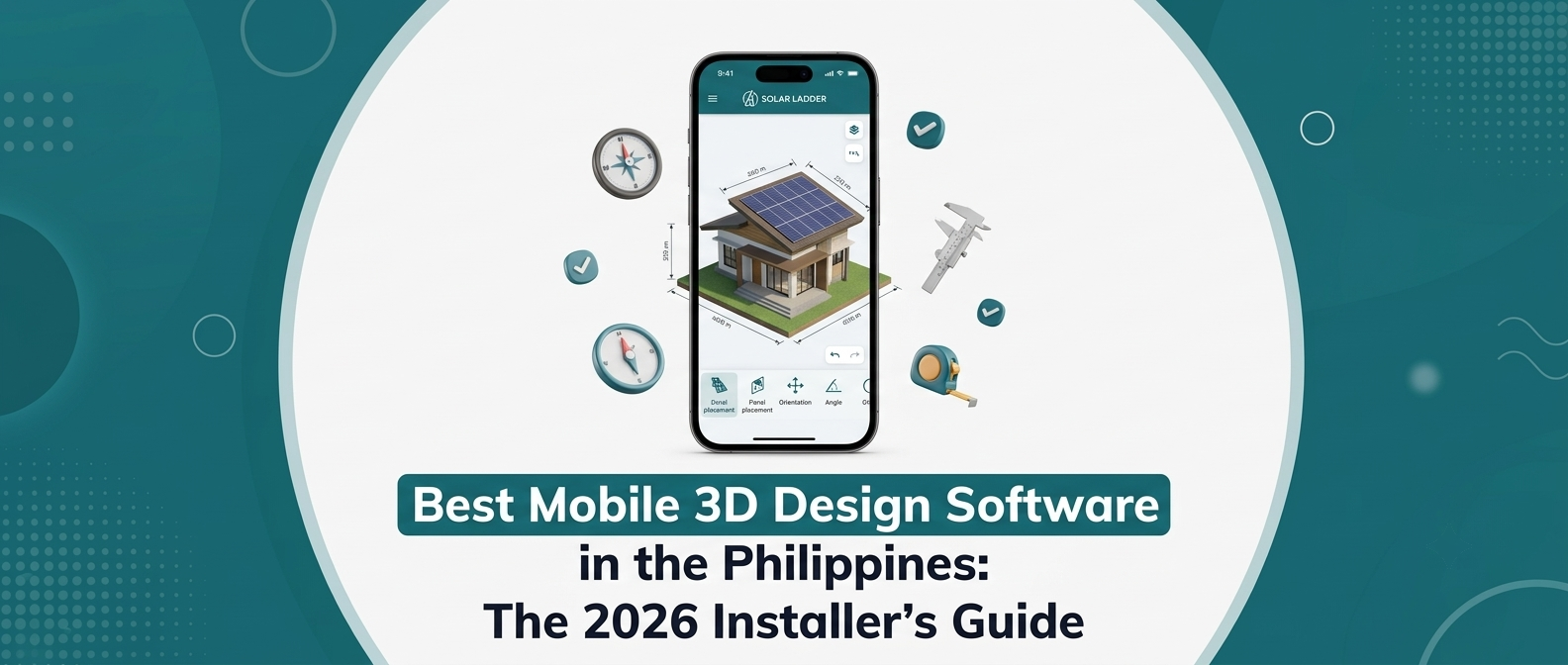
TL;DR Mobile solar 3D design software allows Philippine EPCs to move solar design closer to the customer.
Instead of collecting site information and waiting days for an office-based designer, field sales teams can use mobile tools to create 3D rooftop layouts, review shading, visualize panel placement, and move toward a professional proposal during the sales process.
Solar Ladder combines 3D design, shading analysis, BOQ, proposals, and CRM to help solar EPCs build a more connected field-to-sale workflow.
Best Mobile 3D Design Software in the Philippines: The 2026 Installer's Guide
Introduction
The rooftop solar industry in the Philippines is moving faster than ever. With electricity costs being a major concern for homeowners and businesses, more property owners are exploring solar installations to reduce their monthly electricity expenses.
For Engineering, Procurement, and Construction (EPC) installers operating across Metro Manila, Calabarzon, Central Visayas, and Mindanao, capturing this demand requires speed, accuracy, and a professional sales process.
When a sales executive conducts an on-site survey, taking two or three days to return a static quotation gives competitors more time to approach the same customer.
To close deals more efficiently in 2026, field teams need mobile solar 3D design software in the Philippines that allows them to work directly from smartphones and tablets.
Instead of completing a site survey and sending information back to an office-based designer, sales representatives can use a mobile workflow to visualize rooftops, create solar layouts, analyze shading, and move toward a customer-ready proposal during the initial visit.
Why Desktop-Bound Solar Design Software Creates Problems for Field Teams
For years, solar installers have relied on office-based engineering teams to create solar designs and proposals.
While this workflow can work for complex engineering projects, it can create unnecessary delays during the sales process.
1. Site Survey Delays
Field representatives often collect:
- Roof photographs
- Measurements
- Customer information
- Roof orientation
- Obstacle details
- Electricity consumption data
The information is then sent to an office-based designer.
This creates a gap between the customer visit and the first proposal.
2. Data Errors and Mismatches
When information moves between sales representatives, survey teams, engineers, and designers, mistakes can occur.
For example:
- Roof dimensions may be entered incorrectly.
- Obstacles may be missed.
- Panel placement may need to be redesigned.
- Mounting requirements may change.
- The quotation may not match the final design.
A mobile-first workflow can reduce the number of handoffs between field and office teams.
3. Lost Customer Momentum
Solar customers often compare multiple installers before making a decision.
If one EPC provides a professional design and proposal during the first visit while another takes several days to respond, the sales conversation can quickly move in different directions.
This makes proposal speed an important part of the solar sales process.
Solar sales happen on rooftops, at dining tables, inside commercial buildings, and at construction sites.
Field teams therefore need tools that allow them to work where the customer is—not only from an office workstation.
Solar Ladder: A Mobile 3D Design Platform for Solar EPCs
Solar Ladder combines solar design, proposal generation, CRM, and other solar business workflows into a connected platform for EPC companies.
Its mobile workflow is designed to help sales representatives move from site information to a customer-ready solar presentation without depending entirely on an office-based design team.
Solar Ladder Mobile Workflow
Mobile Roof Survey → 3D Model & Solar Layout → Shading Analysis → Proposal
The workflow combines several capabilities that can help solar sales teams shorten the time between a site visit and proposal presentation.
1. Touch-Optimized 3D Rooftop Modeling
Solar Ladder enables sales teams to create solar designs using mobile devices.
Field representatives can work with rooftop information and create a 3D representation of the proposed solar installation.
Depending on the project, the workflow can help teams visualize:
- Roof planes
- Roof orientation
- Panel placement
- Roof obstacles
- Structures
- Walkways
- Other rooftop elements
The ability to work directly from a mobile device allows the sales representative to discuss the design with the customer while they are still at the property.
2. 3D Shading Analysis
Shading is an important consideration when designing rooftop solar systems.
Philippine properties can have a variety of potential obstructions, including:
- Coconut and other trees
- Parapet walls
- Water tanks
- Adjacent buildings
- Rooftop structures
- Other objects surrounding the array
Solar Ladder's 3D design workflow can be used to visualize shading conditions and evaluate the proposed panel layout.
Instead of explaining shading only through technical terminology, sales representatives can use visual design information to show customers how rooftop obstacles may affect the proposed system.
3. Automated Bill of Quantities (BOQ)
Creating a solar proposal also requires determining the equipment and materials required for the project.
A connected design and proposal workflow can reduce repetitive manual calculations.
Solar Ladder can help generate project quantities associated with the proposed design, including components such as:
- Solar modules
- Inverters
- Mounting structures
- Rails
- Clamps
- Cables
- Other project components
Connecting design information with BOQ generation can also help sales and engineering teams maintain better consistency between the proposed system and the quotation.
4. Financial Proposals in Philippine Pesos
A solar customer wants to understand more than just the number of panels being installed.
The proposal should also explain the financial value of the system.
Solar Ladder can help EPCs present information such as:
- System capacity
- Estimated generation
- Electricity savings
- Payback period
- ROI
- Long-term savings
- Project pricing
Displaying financial information in Philippine Pesos (₱) makes the proposal easier for local customers to understand.
For projects involving specific distribution utilities or net-metering arrangements, EPCs should ensure that the tariff assumptions and regulatory inputs used in the proposal reflect the latest applicable requirements.
5. Built-In Mobile CRM and Pipeline Management
Solar design is only one part of the solar sales process.
Once a design has been created, sales teams still need to:
- Follow up with customers
- Track proposal status
- Schedule activities
- Manage opportunities
- Monitor sales pipelines
- Coordinate with other team members
Solar Ladder combines solar business workflows with CRM capabilities, allowing teams to connect customer information, proposals, and sales activities.
This can be particularly useful for EPC companies managing sales teams across multiple cities or regions.
How to Design a 3D Solar Layout on Mobile in Under 2 Minutes
One of the key advantages of a mobile-first solar design workflow is reducing the time between site survey and customer presentation.
Solar Ladder is designed to help sales teams create client-ready designs rapidly, with workflows that can produce a design in around two minutes depending on project complexity and available site information.
2-Minute Mobile Design Workflow
Step 1 → Open the Mobile App & Locate the Property
Search for or enter the customer's property information and begin the design process.
Step 2 → Create the 3D Roof Model
Define the relevant roof areas, orientation, dimensions, and other available site information.
Step 3 → Place Solar Modules & Review Shading
Add solar modules to the available roof areas and review potential shading or rooftop obstacles.
Step 4 → Generate the Customer Proposal
Use the completed design and project information to prepare a branded proposal containing system specifications and financial information.
The Complete Process
Step 1: Import Property Information
Begin by locating the customer's property and collecting the information required for the proposed solar design.
Step 2: Create the Roof Model
Define the relevant roof planes and adjust the design based on the property's actual structure.
Step 3: Place Panels and Review Shadows
Place the solar modules across suitable roof areas while accounting for relevant rooftop obstacles and shading considerations.
Step 4: Generate a Branded Proposal
Once the design is ready, the sales team can use the project information to create a professional proposal containing company branding, system details, pricing, and financial information.
For a deeper look at rapid solar 3D modeling, read Solar 3D Design Software: Create Client-Ready Designs in 2 Minutes.
Winning Solar Deals Through Mobile Visual Trust
In competitive markets such as Metro Manila, Cebu, and Davao, customers may receive proposals from multiple EPC companies.
A basic spreadsheet or handwritten quotation may communicate a price, but it does not necessarily help the customer visualize the proposed solar installation.
A 3D solar design changes the conversation.
Instead of telling a customer:
"This is where your solar panels will go."
the sales representative can show the customer:
- The proposed roof layout
- Number of panels
- Panel positioning
- Rooftop obstacles
- Shading considerations
- System capacity
- Estimated financial savings
This creates a more visual and easier-to-understand sales experience.
From Technical Explanation to Visual Demonstration
For customers without an engineering background, solar terminology can be difficult to understand.
A mobile 3D design gives sales teams a visual way to explain the project.
The customer can see their property and understand how the proposed solar system fits into it before moving forward.
That makes the first site visit more productive and can help sales representatives address common questions immediately.
What Should You Look for in Mobile Solar 3D Design Software?
Before choosing a mobile solar design platform, Philippine EPCs should evaluate several capabilities.
1. Mobile Compatibility
The software should work effectively on the devices used by field sales representatives.
2. 3D Solar Design
The platform should allow teams to visualize rooftops and solar module layouts.
3. Shading Analysis
Shading tools should help teams identify potential obstacles and understand their effect on the proposed design.
4. Proposal Generation
Design information should be easy to convert into a professional customer proposal.
5. BOQ Support
The platform should reduce manual material calculations and help maintain consistency between the design and proposed system.
6. CRM Integration
Sales teams should be able to track leads, proposals, follow-ups, and deal stages without maintaining disconnected spreadsheets.
7. Custom Branding
EPCs should be able to present proposals using their own company branding and customer information.
8. Ease of Use
A mobile design tool is only useful if sales representatives can learn and use it quickly during real customer visits.
Why Mobile Solar Design Matters for Philippine EPCs in 2026
The solar sales process is becoming increasingly digital.
Customers can compare multiple installers, request quotations online, and evaluate different system options before speaking to a sales representative.
That means EPCs need to reduce unnecessary delays throughout the sales journey.
A mobile solar design platform can help connect:
Lead → Site Survey → 3D Design → Shading Analysis → Proposal → Follow-Up → Sale
Instead of treating each stage as a separate process, EPCs can build a connected digital workflow.
For growing installers, this can make it easier to standardize the sales process across multiple representatives and locations.
Conclusion
For Philippine solar EPCs, the ability to design and present a solar system quickly can become an important part of the customer experience.
Traditional office-based workflows can create delays between the site survey and the first proposal. Mobile 3D solar design software can help reduce those delays by bringing design capabilities closer to the customer.
Solar Ladder combines mobile 3D solar design, shading analysis, proposal generation, BOQ workflows, and CRM capabilities into a connected solar business platform.
With a mobile-first workflow, sales representatives can work directly from the field, visualize rooftop solar systems, explain designs to customers, and move toward a professional proposal without waiting for every step to return to the office.
For EPCs looking to modernize their sales process in 2026, mobile 3D design can turn the site visit from simply a data-collection exercise into a more complete design and sales experience.
Frequently Asked Questions
Yes. Solar Ladder features native mobile applications for both Android and iOS devices, enabling sales reps to draw 3D roof models, perform shading analysis, and generate client-ready proposals directly on their smartphones or tablets during site visits.
Solar Ladder allows installers to input local distribution utility rates (such as Meralco, VECO, or DLPC) alongside ERC net-metering credit rules under Republic Act 9513. The mobile engine automatically models hourly solar generation against building consumption to output accurate payback charts in Philippine Pesos (₱).
Yes. As soon as a 3D layout is completed inside the mobile app, Solar Ladder automatically generates an accurate Bill of Quantities (BOQ)—calculating required module counts, inverter capacity, mounting rails, clamps, and cabling for streamlined procurement.