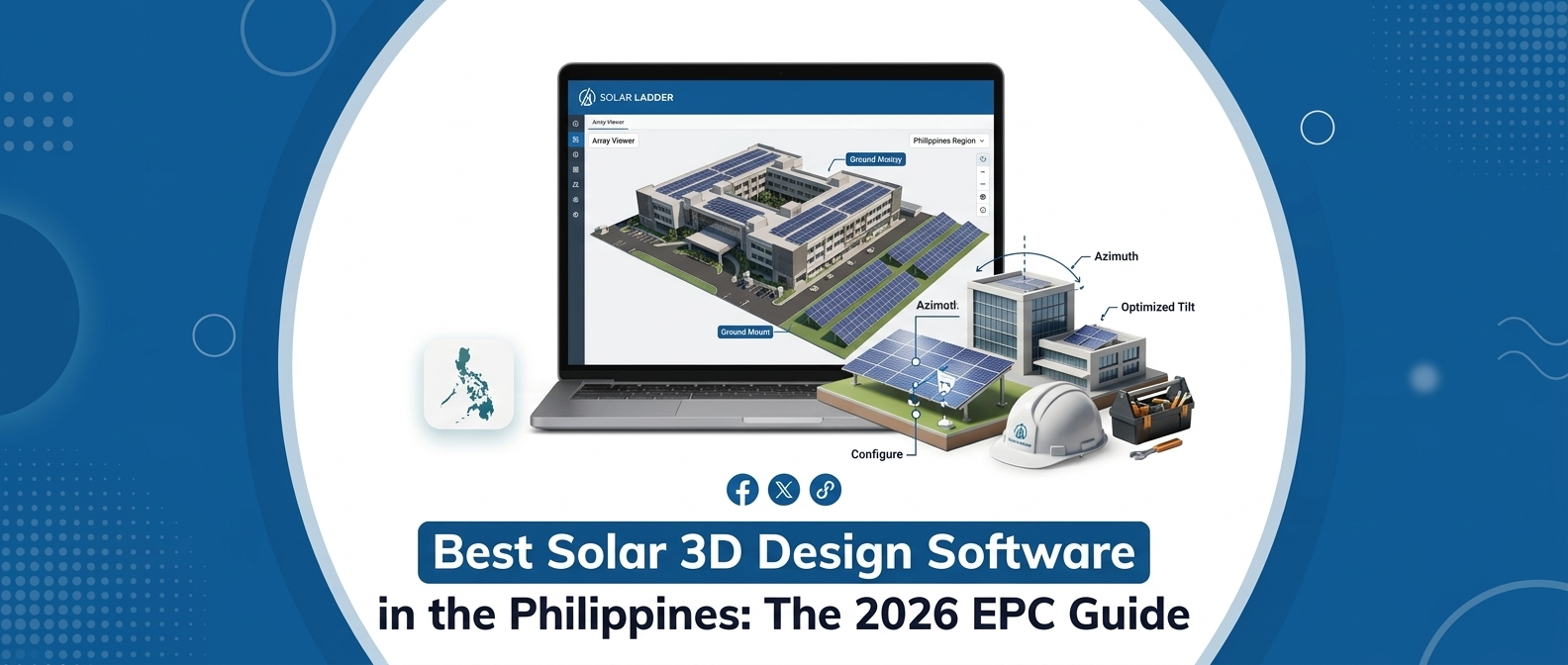
TL;DR: Key Takeaways
High Energy Costs Drive Demand: With retail electricity rates among the highest in Southeast Asia, Philippine homeowners and commercial enterprises are increasingly adopting rooftop solar.
3D Accuracy Is Vital: Flat 2D satellite maps can struggle with complex Philippine roof environments, including corrugated metal sheets, parapets, and tropical shade trees.
The Winner: Solar Ladder is a mobile-first, all-in-one solar design and CRM suite that enables field agents to model 3D rooftops on-site and generate customer-ready proposals quickly.
Best Solar 3D Design Software in the Philippines: How Solar Ladder Delivers Client-Ready Designs in 2 Minutes
Introduction
In the rapidly expanding Philippine rooftop solar market, speed and visual trust can make a significant difference during the sales process.
With electricity rates from distribution utilities such as Meralco, VECO, and DLPC among the key considerations for businesses and homeowners, interest in rooftop solar continues to grow. However, many Engineering, Procurement, and Construction (EPC) contractors across Metro Manila, Laguna, Cebu, and Davao face a common challenge: slow proposal delivery.
When a field agent completes a site survey, taking days to return a static quotation gives competitors more time to engage the same customer.
To respond to high-intent leads faster, Philippine solar installers can use Solar Ladder's 3D design and proposal workflow to create visual, client-ready designs in under two minutes.
Instead of waiting for multiple rounds of communication between field sales and engineering teams, sales representatives can create a 3D rooftop design, evaluate shading, and present a professional proposal during or shortly after the customer meeting.
Why Philippine EPCs Need Solar Ladder's 3D Design Software
Designing rooftop solar systems across Luzon, Visayas, and Mindanao comes with different physical and commercial considerations. A modern 3D design platform can help EPCs address these challenges more efficiently.
1. Complex Roof Surfaces and Structural Obstacles
Philippine building architecture varies significantly, from:
- Corrugated galvanized iron (GI) roofs in industrial areas
- Flat concrete rooftops in urban developments
- Sloped residential roofs
- Commercial and factory rooftops
Surrounding structures and objects can also affect solar design, including:
- Coconut trees
- Parapet walls
- Water tanks
- Skylights
- Adjacent buildings
- Other rooftop equipment
A 3D model helps EPCs visualize these elements when planning panel placement and evaluating potential shading.
2. Electricity Tariffs and Net Metering Considerations
For grid-connected solar projects, customers are interested not only in system capacity but also in the financial impact of solar generation.
Under the Philippines' renewable-energy and net-metering framework, eligible customers can export excess electricity to the grid subject to applicable rules and utility requirements.
Customers therefore want proposals that clearly communicate:
- System capacity
- Expected generation
- Self-consumption
- Exported energy
- Estimated savings
- Project cost
- Payback period
A professional proposal can bring these technical and financial details together in an easy-to-understand format.
3. Building Customer Trust During Sales Meetings
A customer may ask:
"Will the high-rise next door affect my panels?"
Or:
"What happens when the tree shades the roof?"
A verbal explanation may not be enough.
An interactive 3D design with visual shading analysis allows the salesperson to show the customer how the proposed system fits on the actual property.
This can make the sales conversation more visual and easier to understand.
The 2-Minute 3D Design Workflow in Solar Ladder
Solar Ladder is designed to reduce the back-and-forth between field sales representatives and office-based design teams.
Solar Ladder's 2-Minute Workflow
1. Enter Address ↓ 2. Generate 3D Roof Model ↓ 3. Create Panel Layout ↓ 4. Check 3D Shading ↓ 5. Generate Customer Proposal ↓ 6. Follow Up and Close the Deal
Step 1: Import the Customer's Location
Enter the customer's property address to locate the project using available satellite and mapping imagery.
This provides a starting point for creating the rooftop model.
Step 2: Create an Interactive 3D Roof Model
The platform helps create a three-dimensional representation of the property and rooftop.
Depending on the site, the design can account for:
- Roof planes
- Roof pitch
- Ridges
- Valleys
- Rooftop structures
- Obstructions
Step 3: Create the Panel Layout
Solar panels can then be positioned on suitable roof areas while accounting for identified obstacles.
This allows the salesperson to quickly demonstrate:
- Number of panels
- Panel arrangement
- Available roof utilization
- Proposed system capacity
Step 4: Run 3D Shading Analysis
The design can be evaluated for potential shading from surrounding objects and structures.
A visual shading analysis helps the EPC identify areas that may receive less sunlight and make better panel-placement decisions.
Step 5: Create a 360° Customer Preview
A 3D visualization can give customers a more realistic view of how the proposed solar system will look on their property.
The design can be presented on:
- Smartphone
- Tablet
- Laptop
- Desktop
Step 6: Generate a Branded Proposal
Once the design is complete, project information can be incorporated into a customer-ready proposal.
The proposal can include:
- System size
- Panel quantity
- Inverter information
- Generation estimate
- Financial calculations
- Project pricing
- Customer-specific information
- 3D design visuals
Mobile 3D Solar Design Accessibility
Solar sales representatives are often working directly at customer sites.
Waiting until they return to the office before starting the design process can slow down the sales cycle.
Solar Ladder enables teams to access its solar design workflow through mobile devices as well as the web.
This allows sales representatives to:
- Create designs during customer visits
- Show customers 3D layouts
- Discuss panel placement
- Explain shading
- Review system sizing
- Move faster toward proposal generation
For more information, explore our guide on Mobile 3D Solar Design App Features Ranked for Indian Contractors.
Instant Bill of Quantities (BOQ) Generation
Creating a solar design is only one part of the EPC workflow.
The next question is:
"What materials do we need to install this system?"
Solar Ladder can automatically generate a Bill of Quantities based on the completed solar design.
Depending on the project configuration, this can include:
- Solar panels
- Inverter
- Mounting structures
- Rails
- Mid clamps
- End clamps
- Cables
- Other installation components
Automating this process can reduce repetitive manual calculations and help teams move more quickly from design to quotation and procurement planning.
Integrated Sales Tracking and CRM
Solar Ladder goes beyond rooftop design.
The customer journey can connect:
Lead → Site Survey → Design → Proposal → Follow-Up → Deal → Project → O&M
Customer and project information can be managed within the broader Solar Ladder workflow, helping sales teams keep track of:
- Lead stages
- Customer details
- Follow-ups
- Proposals
- Deal status
- Project information
This reduces the need to move customer information between multiple disconnected systems.
Building Visual Trust Through Module-Level Shading Analysis
Shading is one of the important considerations when designing a rooftop solar system.
Potential shading sources can include:
- Trees
- Adjacent buildings
- Parapet walls
- Water tanks
- Rooftop structures
- Other obstacles
A 3D shading analysis helps EPCs visualize how these objects may affect the proposed panel layout.
Why Visual Shading Matters
Instead of telling a customer:
"There may be some shading on these panels."
the salesperson can show the customer the proposed layout and shading visualization.
This makes the conversation more concrete.
Solar Ladder's visual design workflow can help EPC teams identify potential shading conditions and explain the design more clearly to customers.
For more information, explore Best Solar 3D Design Software: Visual Shading Analysis.
From 3D Design to a Sales-Ready Proposal
A good solar proposal needs more than a price.
Customers want to understand:
What am I buying?
- System size
- Solar panels
- Inverter
- Mounting structure
- Other equipment
What will it look like?
- 3D rooftop design
- Panel placement
- Visual representation
How much energy will it produce?
- Estimated generation
- Monthly production
- Annual production
How much can I save?
- Estimated electricity savings
- Applicable financial assumptions
- Payback period
What happens next?
- Installation process
- Timeline
- Warranty
- Service and support
Combining these details with a personalized 3D design creates a proposal that is easier for customers to evaluate.
To learn more, see The Solar Proposal That Closes vs. The One That Gets Ignored (https://solarladder.com/blog/post/solar-proposal-that-closes-vs-one-ignored).
Why Speed Matters in Solar Sales
Consider two EPC sales processes.
Traditional Workflow
Site Survey → Send Data to Designer → Wait for Design → Review → Prepare Quote → Send Proposal
This can involve multiple handoffs.
Digital Workflow
Site Survey → 3D Design → Shading → Proposal → Customer Presentation
Reducing these handoffs can help sales teams respond faster.
Speed doesn't replace technical accuracy.
Instead, the objective is to use software to automate repetitive work while keeping the sales team focused on the customer.
How Solar Ladder Helps Philippine Solar EPCs
For EPCs expanding across the Philippines, a connected design and sales workflow can help reduce operational friction.
Solar Ladder brings together:
- 3D Solar Design
- Mobile Solar Design
- Shading Analysis
- BOQ Generation
- Solar Proposals
- CRM
- Lead Management
- Project Management
- RMS
- O&M
This means an EPC can use one connected workflow from the first customer interaction through project delivery and long-term system management.
Conclusion
The Philippine rooftop solar market presents significant opportunities for EPC companies, but growing competition makes the sales process increasingly important.
A slow design and proposal workflow can create unnecessary delays between the site survey and customer decision.
Modern 3D solar design software can help EPCs shorten this gap.
With Solar Ladder, sales teams can move from:
Address → 3D Roof → Panel Layout → Shading Analysis → Proposal
in a streamlined workflow designed for speed and visual communication.
The result is a more connected sales process where customers can see the proposed system on their property, understand the design, review the financial case, and move toward a purchasing decision with clearer information.
For Philippine solar installers looking to scale their sales operations, combining 3D design, shading analysis, proposals, CRM, and project management can create a more efficient digital workflow.
Frequently Asked Questions
Yes. Platforms like Solar Ladder are fully optimized for Android and iOS devices, enabling sales executives to draw 3D roof structures, run tropical shading simulations, and issue instant PDF proposals during site visits.
Modern solar software lets you input local utility tariffs (such as Meralco, VECO, or DLPC) alongside ERC net-metering credit structures. The engine calculates how much power is self-consumed versus exported, outputting clear payback charts in Philippine Pesos (₱).
Metro Manila features dense urban environments with overhanging trees, high-rise buildings, and rooftop water tanks. 3D shading software models sun trajectories throughout the year to ensure panels are placed outside shadow zones, preventing generation drop-offs.