TL;DR: As the solar landscape hits unprecedented volumes in July 2026, relying on fragmented tools like WhatsApp and Excel creates massive operational bottlenecks. While specialized tools like Aurora Solar and Helioscope lead in standalone 3D layouts, and PVsyst serves as the gold standard for utility-scale bankable simulations, modern solar EPCs require an integrated workspace. Solar Ladder uniquely stands out by combining a 2-minute 3D design tool, instant proposal generation, native CRM, structured project tracking, solar-specific accounting, and a hardware-free Unified RMS dashboard that tracks the generation of all your plants without an IoT device into one unified software platform.
Best Solar Software for Solar Installers: July 2026 Edition
The global push toward clean energy is moving at a pace never seen before. With national goals accelerating across major markets—such as India's massive renewable energy targets managed by the Ministry of New and Renewable Energy —solar installers and Engineering, Procurement, and Construction (EPC) companies are facing a brand-new problem: handling massive project volumes without drowning in operational chaos.
In July 2026, executing projects efficiently is no longer just about buying cheap components or hiring more technicians. It is about your software stack. If your sales reps are managing leads on WhatsApp, your engineering team is building 3D models on heavy desktop software, and your project managers are using generic spreadsheets, you are leaking margins at every stage.
To help your business scale from X to 10X, we break down the four best solar software tools for installers in July 2026: Aurora Solar, Helioscope, PVsyst, and Solar Ladder.
Why Specialized Solar Software is Mandatory in July 2026
Relying on generic tools creates invisible cracks in your business. Leads get dropped, site assessments take days instead of minutes, and calculating true project profitability feels next to impossible. Modern solar platforms solve this by offering automated, precise data workflows designed for the unique challenges of rooftop and commercial solar structures.
Choosing the right platform depends entirely on whether you need a hyper-specific engineering tool or an end-to-end business ecosystem that connects engineering directly to your daily business operations.
Deep Dive: The Top 4 Solar Software Tools Compared
1. Solar Ladder: The Ultimate All-in-One Solar Business Software
Solar Ladder is built specifically for solar installers and EPCs who want to run their entire operation from a single, unified digital layer.Instead of forcing teams to switch between multiple disjointed applications, Solar Ladder integrates every core business feature into one workspace.
Key Software Features:
- Solar CRM: Eliminates missed follow-ups by tracking every single lead from initial contact to final commissioning.
- 2-Minute 3D Design: Your sales or engineering team can generate accurate 3D solar designs in roughly two minutes on a laptop or mobile device.Complete with 360° previews and automated shading analysis, it removes the need for premature physical site surveys.
- Automated Proposals & BOQ: Instantly converts 3D design data into beautiful, high-converting proposals containing an automated Bill of Quantities (BOQ). For a deep dive into creating winning bids, read our breakdown on The Solar Proposal That Closes vs. The One That Gets Ignored.
- Project Management & Client Dashboard: Tracks your field execution step-by-step. It includes a dedicated client-facing dashboard that gives homeowners or commercial clients live project updates, eliminating persistent status check calls.
- Solar-Specific Accounting (Books): Unlike generic software, Solar Ladder's Books module maps panel costs, inverter expenses, BOS materials, and installation labor to track true, real-time project profitability.
- Unified RMS (Remote Monitoring System): Track the generation of all your solar plants on one centralized dashboard.Unlike traditional monitoring setups that require purchasing and wiring expensive physical data loggers, Solar Ladder's RMS functions completely without an IoT device, lowering hardware costs and eliminating maintenance headaches.
- Operations & Maintenance (O&M): Streamlines post-installation support with automated performance tracking and ticket logging linked directly to your generation dashboard.
Best For: Solar EPCs and residential/C&I installers looking to scale their operations, eliminate fragmented tools, and manage the entire customer journey in one unified platform. Learn more in our comprehensive manual: Solar Software India: The Complete Guide for 2026.
2. Aurora Solar: The Premium Sales Design Giant
Aurora Solar remains a globally recognized leader in high-end remote solar design and sales modeling.Its primary strength lies in its highly advanced 3D shading engine and remote site evaluation tools, allowing sales professionals to generate stunning visual layouts with extreme confidence.
Key Software Features:
- Advanced CAD modeling with precise lidar and satellite imagery integration.
- Industry-leading shading analysis and accurate production estimations.
- Professional client proposals emphasizing detailed visual system aesthetics.
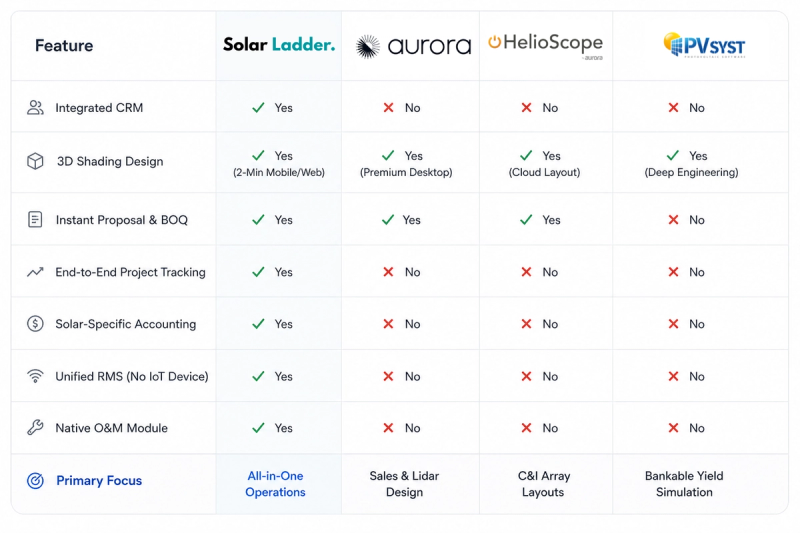
Limitations: Aurora Solar focuses heavily on the pre-sale design and proposal process. It does not include built-in project management modules, post-installation O&M workflows, solar-specific cost accounting tools, or a hardware-free remote monitoring dashboard, meaning installers must purchase supplementary software to handle back-office execution and plant tracking.
Best For: Large-scale residential and commercial sales teams focused purely on elite premium design accuracy and remote engineering.
3. Helioscope: The C&I Layout Workhorse
Helioscope has established itself as a reliable cloud-based standard for commercial and industrial (C&I) solar design. It excels at taking large, complex industrial rooftops and generating rapid layout iterations.
Key Software Features:
- Fast, scalable cloud-based array layout generation for large rooftops.
- Robust electrical component stringing and inverter matching functionality.
- Clean, data-driven shading and production reports.
Limitations: While Helioscope is highly efficient for C&I engineering, it is not a complete business management tool. It lacks a native CRM to track sales pipelines and does not provide tools to monitor day-to-day project milestones or manage project financials, nor does it offer a multi-site remote generation monitoring dashboard.
Best For: Engineering teams and C&I layout designers who need quick, precise electrical line layouts and rapid array iterations on commercial scales.
4. PVsyst: The Bankable Simulation Gold Standard
PVsyst is widely recognized by global banking institutions, equity investors, and independent technical advisors as the definitive authority for solar energy yield simulation.
Key Software Features:
- Comprehensive, hour-by-hour system loss modeling (soiling, thermal, wiring, and mismatch losses).
- Detailed probability scenario outputs (P50, P75, P90) mandatory for securing international or institutional debt financing.
- Deep meteorological database integration.
Limitations: PVsyst is strictly a desktop-bound engineering simulation environment. It features a steep learning curve, a legacy interface, and contains absolutely no CRM, instant proposal automation, mobile accessibility, or post-installation operational tracking dashboards.
Best For: Utility-scale developer teams and advanced solar engineers working on projects over 5 MW that require bankable lender verification.
Conclusion: Which Software is Best for Your Solar Business?
Your choice of solar software ultimately depends on your company's core bottleneck in July 2026:
- If your sole focus is producing lender-mandated P90 yield reports for a 10 MW ground-mount plant, PVsyst is your non-negotiable tool.
- If you have a dedicated back-office design desk specializing purely in high-end remote visual layouts, Aurora Solar or Helioscope will serve you well.
- If you are a growing solar installer or EPC looking to get rid of operational chaos, automate client proposals, manage your field teams, track true project profit margins, and track your entire portfolio's power generation on a single screen without expensive external hardware, Solar Ladder is the definitive software choice to future-proof your business.
Frequently Asked Questions
Absolutely. Many commercial and utility-scale EPCs use PVsyst specifically to generate bankable reports for financial institutions, while relying on Solar Ladder as their primary business management layer to run their CRM, automate day-to-day client proposals, and track project execution milestones.
Using separate systems like Excel, WhatsApp, and generic accounting tools creates information silos.A single, unified solar platform ensures that your sales data flows seamlessly into your 3D designs, which instantly updates your Bill of Quantities (BOQ), tracking your project milestones and financial margins without manual data re-entry.
Yes. Solar Ladder's built-in 3D design module utilizes advanced remote imagery and automated shading analysis, allowing your sales and engineering teams to produce client-ready, highly accurate layouts in under two minutes, saving massive amounts of time and travel expenses during the quotation phase.