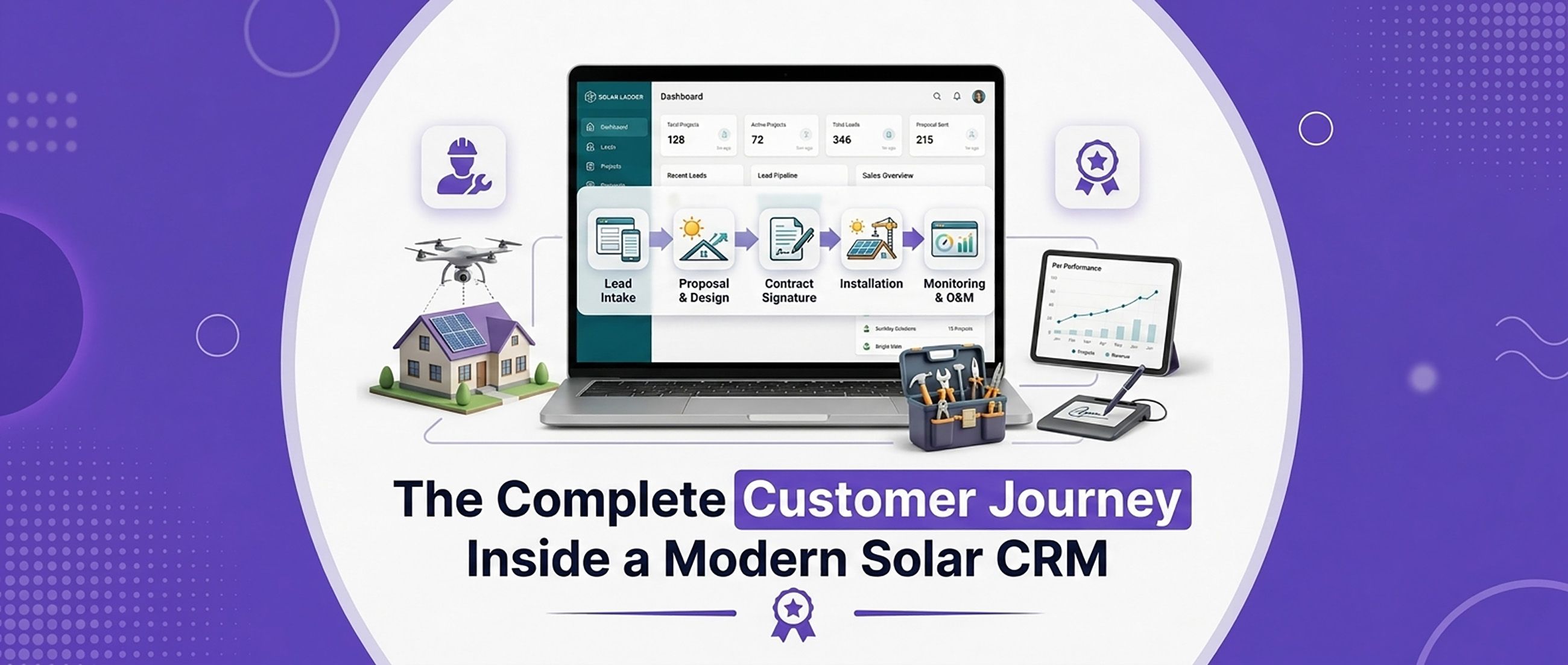
TL;DR A modern Solar CRM does much more than store customer information. It manages the complete customer journey—from lead capture and follow-ups to 3D design, proposal generation, project execution, remote monitoring, and after-sales service. By connecting every stage in one platform, Solar EPC companies can improve response times, increase conversions, eliminate manual work, and deliver a superior customer experience.
The Complete Customer Journey Inside a Modern Solar CRM
The solar industry has become increasingly competitive.
Customers expect faster responses, personalized communication, transparent proposals, and seamless project execution. At the same time, Solar EPC companies are handling more enquiries, managing larger installation teams, and juggling multiple projects simultaneously.
Yet many businesses still rely on disconnected tools:
- Excel for lead tracking
- WhatsApp for customer communication
- Emails for sharing proposals
- Separate software for solar design
- Manual spreadsheets for project management
- Different platforms for after-sales support
The result is a fragmented customer experience, missed follow-ups, duplicate data entry, and slower project execution.
A modern Solar CRM changes this by bringing every stage of the customer journey together in one platform.
Let's explore what that journey looks like.
Stage 1: Capturing Every Lead Automatically
Every solar installation begins with a lead.
Whether the enquiry comes from:
- Your website
- Google Ads
- Meta Ads
- Phone calls
- Referral partners
- Exhibitions
- Organic search
every lead should automatically enter your CRM.
Instead of manually copying customer details into spreadsheets, a Solar CRM centralizes all enquiries, ensuring no opportunity is missed.
Sales managers can instantly see:
- Lead source
- Assigned salesperson
- Customer location
- Project type
- Current status
- Follow-up history
This creates complete visibility from day one.
Stage 2: Qualifying and Nurturing Leads
Not every lead is ready to buy immediately.
Some customers need financing.
Some require technical education.
Others are comparing multiple installers.
A Solar CRM helps sales teams qualify leads by recording:
- Customer requirements
- Roof type
- Monthly electricity consumption
- Budget
- Preferred installation timeline
- Previous interactions
Automated reminders ensure every prospect receives timely follow-ups.
Instead of forgetting leads, sales teams build stronger relationships through consistent communication.
Stage 3: Scheduling the Rooftop Survey
Once a prospect shows genuine interest, the next step is a site survey.
A modern CRM simplifies scheduling by allowing teams to:
- Assign survey engineers
- Track appointments
- Upload site photographs
- Record roof measurements
- Capture structural observations
- Document customer notes
Everything is stored within the customer record, making information instantly accessible to designers and project managers.
Stage 4: Creating an Interactive 3D Solar Design
After the survey, the design process begins.
Modern Solar CRM platforms integrate directly with 3D design tools, allowing sales and engineering teams to collaborate efficiently.
Customers can view:
- Panel placement
- Roof orientation
- Walkways
- Safety clearances
- Available roof area
- Overall system layout
Interactive 3D visualization improves customer confidence and reduces objections by making the proposed installation easy to understand.
Stage 5: Generating Professional Proposals
Once the design is complete, proposals can be generated instantly.
Instead of manually preparing documents, integrated proposal software automatically includes:
- Customer details
- 3D rooftop design
- System specifications
- Energy generation estimates
- ROI calculations
- Payback period
- Pricing
- Financing options
- Company branding
Professional proposals improve first impressions while significantly reducing turnaround time.
Stage 6: Managing Follow-Ups and Closing the Deal
Most customers don't sign after the first meeting.
Successful sales depend on timely follow-ups.
A Solar CRM ensures sales teams never miss an opportunity by tracking:
- Proposal status
- Call history
- Meeting notes
- Customer questions
- Follow-up reminders
- Sales pipeline stage
Managers gain complete visibility into every opportunity, making it easier to forecast revenue and identify bottlenecks.
Stage 7: Seamless Transition to Project Management
Many companies make the mistake of treating sales and operations as separate processes.
Once a proposal is approved, customer information is often entered into another system.
A modern Solar CRM eliminates duplicate work.
Approved opportunities are automatically converted into active projects.
Project managers can immediately begin tracking:
- Site surveys
- Engineering approvals
- Procurement
- Material dispatch
- Installation schedules
- Documentation
- Commissioning
- Project milestones
Everyone works from the same customer record.
Stage 8: Remote Monitoring (RMS)
The customer journey doesn't end after installation.
A complete Solar CRM continues adding value through Remote Monitoring Systems (RMS).
Operations teams can monitor:
- Plant performance
- Inverter status
- Daily generation
- Fault alerts
- System health
- Performance trends
Proactive monitoring helps identify issues before customers experience significant energy losses.
Stage 9: Operations & Maintenance (O&M)
Long-term customer satisfaction depends on reliable after-sales support.
An integrated Solar CRM supports O&M activities such as:
- Preventive maintenance scheduling
- Service ticket management
- Technician assignments
- Warranty tracking
- AMC management
- Service history
Keeping service records connected to the original customer profile enables faster support and a better ownership experience.
Why an Integrated Customer Journey Matters
When every department uses different software, information becomes fragmented.
Sales doesn't know project status.
Engineering doesn't see customer conversations.
Service teams can't access proposal details.
An integrated Solar CRM connects everyone.
The benefits include:
- Faster response times
- Better collaboration
- Reduced manual work
- Improved proposal turnaround
- Higher customer satisfaction
- Better sales forecasting
- Increased team productivity
- More repeat business and referrals
Instead of managing software, your team focuses on serving customers.
How Solar Ladder Supports the Complete Customer Journey
Solar Ladder is purpose-built for Solar EPC companies, bringing every stage of the customer lifecycle into one integrated platform.
👥 CRM & Lead Management
Capture leads from multiple channels, assign sales representatives, track conversations, schedule follow-ups, and monitor your entire sales pipeline from a centralized dashboard.
☀️ 3D Solar Design (Laptop & Mobile)
Create professional rooftop designs featuring:
- RCC rooftops
- Metal sheet roofs
- Shed structures
- Walkways
- Handrails
- Safety lifelines
- Accurate module placement
- Interactive rooftop visualization
Sales and engineering teams can collaborate seamlessly from both laptops and mobile devices.
📄 Instant Proposal Generation
Generate branded proposals in minutes with:
- Interactive 3D designs
- Energy generation estimates
- ROI and payback calculations
- Technical specifications
- Financing information
- Customer-specific details
📋 Project Management
Convert approved proposals directly into projects and manage:
- Procurement
- Installation
- Documentation
- Team assignments
- Project milestones
- Commissioning
—all from one dashboard.
📡 Remote Monitoring System (RMS)
Track system performance through:
- Live inverter monitoring
- Generation reports
- Fault notifications
- Performance analytics
Deliver proactive customer support while maximizing system uptime.
🔧 Operations & Maintenance (O&M)
Provide long-term customer support through:
- Preventive maintenance
- Service requests
- Technician scheduling
- Warranty management
- AMC tracking
- Complete service history
Conclusion
A customer doesn't experience your company in departments—they experience one continuous journey.
Every delay, repeated question, or missed follow-up reduces confidence.
A modern Solar CRM ensures every interaction—from the first enquiry to long-term maintenance—is connected, organized, and customer-focused.
For Solar EPC companies looking to scale, improve customer satisfaction, and increase operational efficiency, an integrated CRM is no longer optional—it's a competitive advantage.
With Solar Ladder, you can manage the complete customer journey through Lead Management, CRM, 3D Solar Design, Instant Proposals, Project Management, RMS, and O&M—all from a single platform built specifically for the solar industry.
Frequently Asked Questions
A Solar CRM is customer relationship management software designed specifically for Solar EPC companies. It helps manage leads, customer communication, proposals, projects, and after-sales service from one platform.
A Solar CRM includes industry-specific features such as rooftop survey management, 3D solar design integration, proposal generation, project tracking, RMS, and O&M, making it more suitable for solar businesses.
Yes. Modern Solar CRM platforms transition approved opportunities directly into project management, allowing teams to track installation progress, procurement, documentation, and commissioning.
Solar Ladder connects Lead Management, CRM, 3D Solar Design, Instant Proposals, Project Management, RMS, and O&M into one integrated platform, enabling Solar EPC companies to deliver a seamless customer experience.