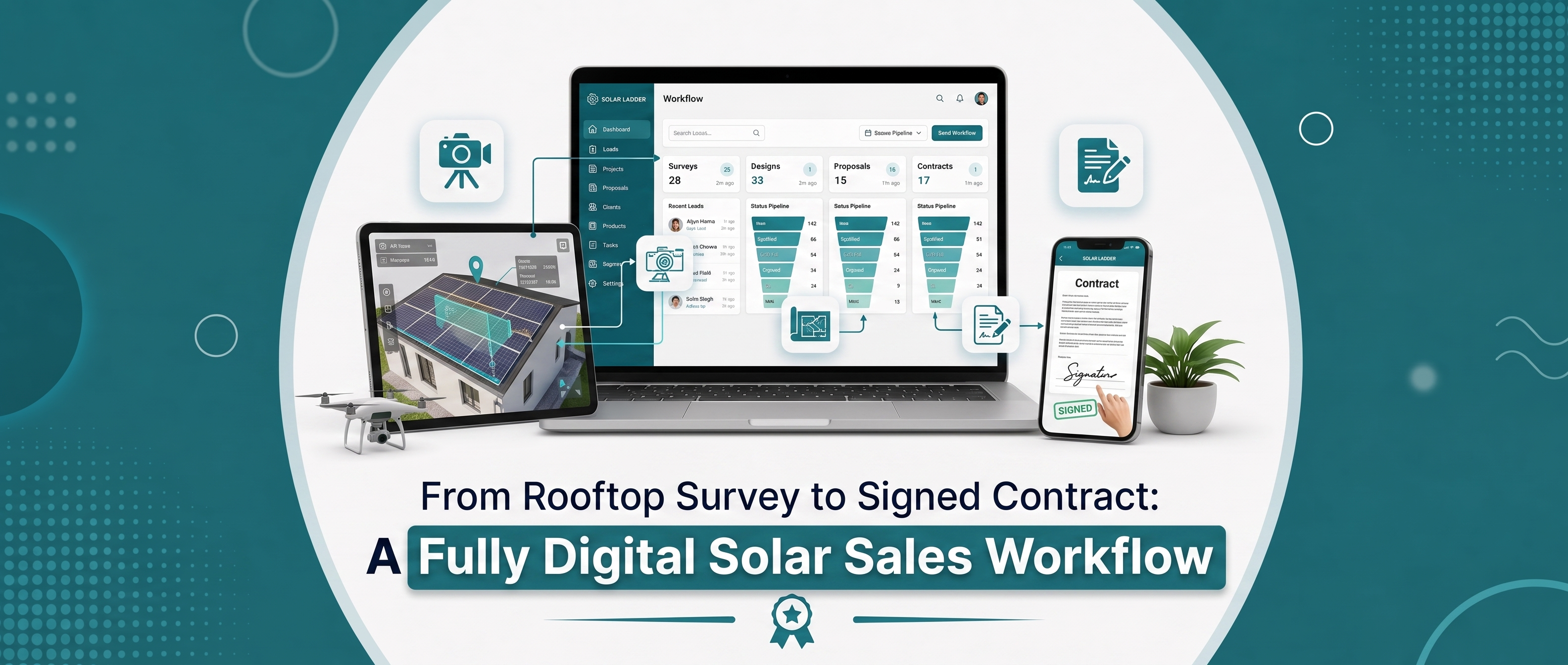
TL;DR Managing the solar sales process across spreadsheets, WhatsApp, emails, and disconnected tools slows down your team and creates unnecessary delays. A fully digital solar sales workflow connects every stage—from lead capture and rooftop survey to 3D design, proposal generation, CRM, and project handover—into one platform. The result is faster response times, better customer experiences, and more signed contracts.
From Rooftop Survey to Signed Contract: A Fully Digital Solar Sales Workflow
The solar industry has evolved rapidly over the last few years.
Customers expect quick responses, professional proposals, transparent communication, and a smooth buying experience.
At the same time, Solar EPC companies are managing more enquiries, more installations, and tighter project timelines than ever before.
Yet many businesses still rely on disconnected tools:
- WhatsApp for communication
- Excel for tracking leads
- Emails for documents
- Separate software for design
- Different systems for proposals
- Manual updates for project management
This fragmented process creates delays, duplicate work, and missed opportunities.
The solution is a fully digital solar sales workflow—one that connects every stage of the customer journey in a single platform.
Why Traditional Solar Sales Processes Slow Growth
Imagine a typical sales process.
A lead comes in from your website.
A salesperson copies the enquiry into Excel.
The site survey is scheduled over WhatsApp.
The engineer creates a design using one tool.
The proposal is prepared in another.
Customer details are entered again into a CRM.
After the deal closes, the operations team manually recreates the project.
The same information is entered multiple times.
Every handoff increases the risk of delays and mistakes.
As your business grows, these inefficiencies become more expensive.
What Is a Digital Solar Sales Workflow?
A Digital Solar Sales Workflow is an end-to-end process where every sales activity is connected through one centralized platform.
Instead of switching between multiple tools, your team manages the entire customer journey from one dashboard.
This includes:
- Lead capture
- Customer relationship management
- Rooftop survey
- 3D solar design
- Proposal generation
- Follow-ups
- Digital approvals
- Project handover
Because every stage is connected, information flows automatically between departments, reducing manual work and improving accuracy.
Step 1: Capture Every Lead Automatically
Every successful solar project starts with a lead.
The challenge is ensuring no enquiry is missed.
A modern digital workflow automatically captures leads from:
- Website forms
- Google Ads
- Meta Ads
- Phone calls
- Referrals
- Exhibitions
- Channel partners
Instead of manually entering customer details into spreadsheets, every enquiry is stored in one centralized system.
This allows sales teams to respond faster while giving managers complete visibility into lead sources and performance.
Step 2: Qualify Leads with an Integrated Solar CRM
Not every enquiry is ready to buy.
Some customers need education.
Others require financing.
Some are ready for an immediate site visit.
An integrated Solar CRM helps sales teams:
- Record customer information
- Track conversations
- Schedule follow-ups
- Assign sales representatives
- Prioritize high-intent opportunities
- Monitor pipeline progress
By organizing every interaction, the CRM ensures that no lead is forgotten and every opportunity receives timely attention.
Step 3: Perform a Digital Rooftop Survey
Once the customer is qualified, the next step is understanding the installation site.
Traditionally, survey teams collect notes, photos, and measurements manually before sharing them with the design team.
A digital workflow simplifies this process.
Survey teams can:
- Upload site photographs
- Record roof dimensions
- Document structural details
- Capture obstacle locations
- Store customer information
- Sync everything instantly
This reduces paperwork and ensures designers receive complete, accurate information.
Step 4: Create an Interactive 3D Solar Design
With survey data available in the same platform, the design team can immediately begin creating the proposed system.
Interactive 3D designs allow customers to visualize:
- Panel placement
- Roof layout
- Walkways
- Safety clearances
- Rooftop obstacles
- Overall aesthetics
Instead of relying on technical drawings, customers see a realistic representation of their future solar installation.
This improves confidence and reduces objections during sales meetings.
Step 5: Generate a Professional Proposal Instantly
Once the design is complete, the next step is presenting the solution.
Instead of manually preparing proposals, a digital workflow automatically generates a professional document that includes:
- 3D rooftop design
- System specifications
- Energy generation estimates
- Electricity savings
- ROI calculations
- Payback period
- Pricing
- Financing options
- Company branding
Sales teams can send proposals within minutes, reducing turnaround time and improving customer experience.
Step 6: Automate Follow-ups So No Lead Is Forgotten
Research consistently shows that timely follow-ups significantly improve conversion rates. Yet many Solar EPC companies still rely on manual reminders, sticky notes, or memory to contact prospects.
A digital workflow automates follow-ups by:
- Assigning reminders to sales representatives
- Sending notifications for pending tasks
- Tracking customer interactions
- Recording call outcomes
- Scheduling future meetings
- Monitoring proposal status
Instead of wondering which customer to call next, your sales team starts each day with a prioritized task list.
This improves response times while ensuring every opportunity receives the attention it deserves.
Step 7: Speed Up Approvals and Contract Signing
After reviewing the proposal, customers often ask a few final questions before making their decision.
When your sales representative has access to the complete customer record—including survey data, 3D design, proposal history, and previous conversations—they can respond quickly and confidently.
Once the customer is ready to proceed, the workflow moves seamlessly toward approval.
A digital process reduces unnecessary paperwork by keeping proposal versions, pricing details, and customer information organized in one place.
Instead of searching through emails and WhatsApp chats, every document remains connected to the opportunity.
This creates a smoother buying experience and reduces delays before project execution begins.
Step 8: Convert the Sale into a Live Project
In many companies, the sales process ends when the customer signs the agreement.
Operations then have to recreate the project manually.
Customer information is copied again.
Documents are uploaded again.
Tasks are recreated again.
This wastes valuable time and increases the risk of errors.
A digital workflow eliminates duplicate work.
Once the deal is confirmed, the customer record automatically becomes an active project, allowing operations teams to begin execution immediately.
This ensures continuity between sales and project delivery.
Why Integrated Workflows Help Solar EPC Companies Close More Deals
Every additional software tool creates another handoff.
Every handoff creates another opportunity for delays.
When CRM, design software, proposal generation, and project management are disconnected, valuable time is spent moving information instead of serving customers.
An integrated workflow helps Solar EPC companies:
- Respond to enquiries faster
- Reduce manual data entry
- Improve proposal turnaround time
- Increase collaboration between departments
- Minimize errors
- Track every customer interaction
- Deliver a consistent customer experience
- Scale operations without increasing administrative work
The result is a more efficient business that can manage more enquiries and complete more projects with the same team.
How Solar Ladder Digitizes Every Step of the Solar Sales Journey
Solar Ladder is built specifically for Solar EPC companies and connects every stage of the customer lifecycle into one integrated platform.
Instead of using separate software for sales, design, proposals, project execution, and service, everything works together.
🎯 Lead Management
Capture enquiries from:
- Website forms
- Google Ads
- Meta Ads
- Referrals
- Exhibitions
- Channel partners
Every lead enters one centralized dashboard where it can be assigned, tracked, and nurtured.
👥 Solar CRM
Manage your complete sales pipeline with:
- Customer profiles
- Activity history
- Follow-up reminders
- Opportunity tracking
- Team assignments
- Sales reports
Your entire sales team works from a single source of truth.
☀️ 3D Solar Design (Laptop & Mobile)
Create professional rooftop designs featuring:
- RCC rooftops
- Metal sheet roofs
- Shed structures
- Walkways
- Handrails
- Safety lifelines
- Accurate panel placement
- Rooftop visualization
Sales teams can prepare designs from both laptops and mobile devices, enabling faster customer presentations.
📄 Instant Proposals
Generate branded proposals within minutes, including:
- 3D rooftop visuals
- System specifications
- Energy generation estimates
- Electricity bill savings
- ROI and payback calculations
- Pricing
- Financing options
This helps Solar EPC companies deliver faster, more professional proposals that improve customer confidence.
📋 Project Management
Once the proposal is accepted, Solar Ladder transitions the opportunity into project execution.
Track:
- Site surveys
- Engineering
- Procurement
- Material dispatch
- Installation
- Documentation
- Commissioning
- Pending tasks
- Project milestones
Everything is managed from one dashboard.
📡 Remote Monitoring System (RMS)
After commissioning, continue delivering value by monitoring plant performance remotely.
Monitor:
- Inverter performance
- Energy generation
- System alerts
- Fault notifications
- Plant health
This enables proactive support and improves customer satisfaction.
🔧 Operations & Maintenance (O&M)
Maintain long-term customer relationships through:
- Preventive maintenance scheduling
- Service request management
- Technician assignments
- Warranty tracking
- AMC management
- Complete service history
A connected O&M workflow helps create repeat business, referrals, and long-term customer loyalty.
Conclusion
A modern Solar EPC business is no longer defined only by the quality of its installations—it is also defined by the quality of its customer experience.
When leads, surveys, designs, proposals, approvals, and projects are managed across disconnected tools, delays and inefficiencies become inevitable.
A fully digital solar sales workflow changes that.
By connecting every stage of the journey into one platform, Solar EPC companies can respond faster, collaborate more effectively, reduce manual work, and provide customers with a seamless buying experience.
From the first rooftop survey to the final signed contract—and beyond—a digital workflow helps your business scale with confidence.
Frequently Asked Questions
A digital solar sales workflow is an end-to-end process that connects lead management, CRM, rooftop surveys, 3D design, proposal generation, follow-ups, approvals, and project execution within one platform.
Digitization reduces manual work, improves collaboration, shortens proposal turnaround time, minimizes errors, and creates a better customer experience.
Survey information flows directly into the design and proposal process, allowing sales teams to generate accurate, professional proposals much faster.
Yes. Solar Ladder provides an integrated platform covering Lead Management, CRM, 3D Solar Design, Instant Proposals, Project Management, Remote Monitoring System (RMS), and Operations & Maintenance (O&M).