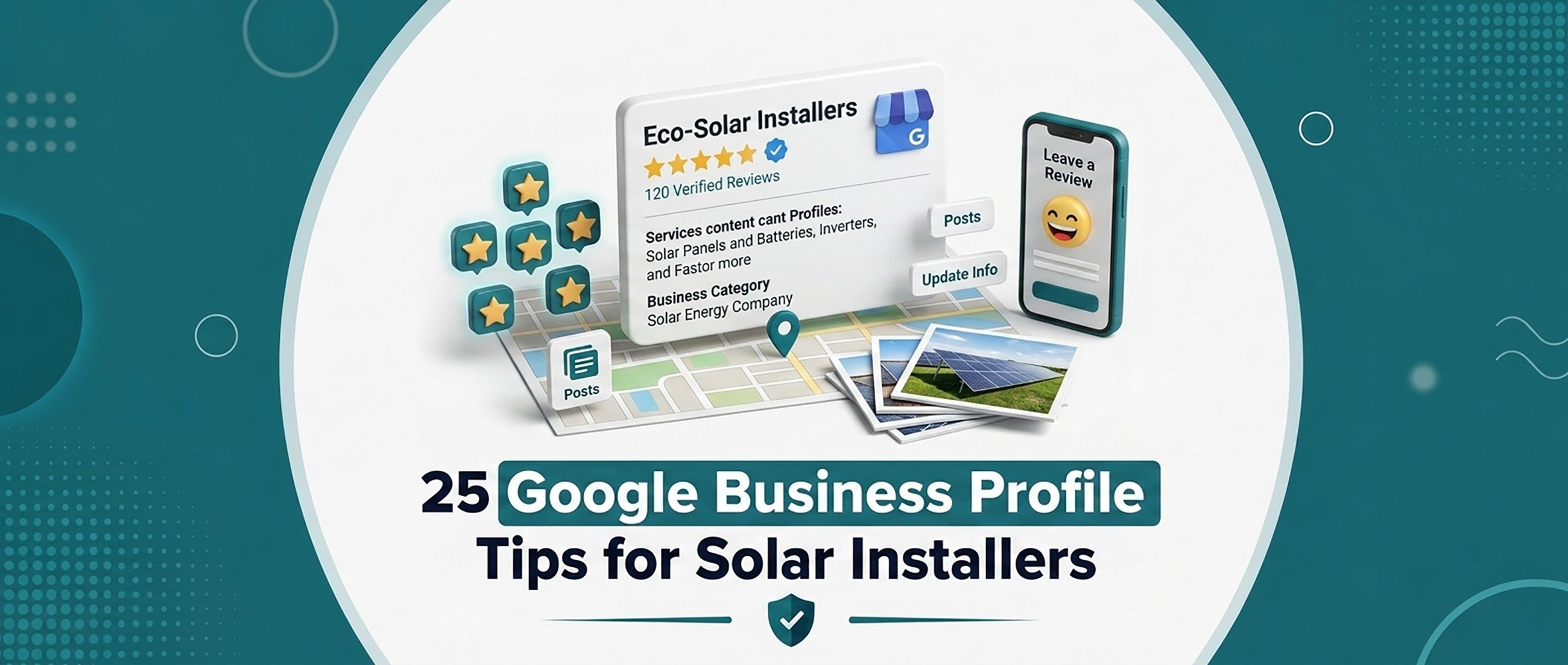
TL;DR Google Business Profile (GBP) is one of the most powerful free marketing tools for Solar EPC companies looking to generate local leads. By optimizing business information, collecting reviews, posting regularly, adding project photos, answering customer questions, and improving local SEO signals, solar installers can increase visibility on Google Maps and attract more qualified customers.
25 Google Business Profile Tips for Solar Installers
For most customers, the solar buying journey starts with a Google search.
A homeowner looking for solar installation usually searches:
- "Solar installer near me"
- "Best solar company in [city]"
- "Rooftop solar installer"
- "Solar EPC company near me"
The companies appearing at the top of Google Maps often receive the most enquiries.
This is why Google Business Profile (GBP) has become an essential growth channel for Solar EPC companies.
A properly optimized profile can help installers:
- Generate more phone calls
- Increase website visits
- Build customer trust
- Improve local visibility
- Get more installation opportunities
However, many solar companies create a profile once and never optimize it.
That means they miss valuable local leads.
Here are 25 Google Business Profile tips every Solar installer should implement.
1. Complete Every Business Detail
A partially completed profile reduces trust.
Make sure your profile includes:
- Business name
- Address
- Phone number
- Website
- Working hours
- Service areas
- Business description
Every field provides Google with information about your company.
2. Choose the Right Primary Category
Your primary category strongly influences search visibility.
Choose the category that best represents your business.
Examples:
- Solar energy company
- Solar energy contractor
- Electrician (only if applicable)
Avoid selecting unrelated categories just to appear for more searches.
3. Add Relevant Secondary Categories
Secondary categories help Google understand additional services.
Examples:
- Solar panel installation
- Renewable energy equipment supplier
- Electrical contractor
Use only categories relevant to your actual services.
4. Write a Keyword-Focused Business Description
Your description should explain:
- Who you serve
- What services you provide
- Locations covered
- Your expertise
Include relevant keywords naturally:
- Rooftop solar installation
- Residential solar
- Commercial solar
- Solar EPC services
Avoid keyword stuffing.
5. Add Accurate Service Areas
Solar installers often serve multiple locations.
Add:
- Cities
- Districts
- Nearby areas
This helps customers discover your business in local searches.
6. Upload High-Quality Project Photos
Photos are powerful trust signals.
Upload:
- Completed installations
- Rooftop projects
- Commercial solar plants
- Installation teams
- Before-after images
- Customer handovers
Real project photos perform better than stock images.
7. Add Videos Regularly
Videos increase engagement.
Upload:
- Installation walkthroughs
- Customer testimonials
- Solar education videos
- Team introductions
- Project completion videos
Videos help customers understand your expertise.
8. Collect Customer Reviews Consistently
Reviews are one of the strongest local ranking factors.
Ask customers after successful installations.
Focus on getting reviews that mention:
- Solar installation experience
- Team professionalism
- Project quality
- Location
Example:
"Installed a 5kW rooftop solar system in Pune. Excellent service and installation quality."
Specific reviews provide more context.
9. Reply to Every Review
Responding to reviews shows customers that you value feedback.
Reply to:
- Positive reviews
- Neutral reviews
- Negative reviews
Professional responses improve brand perception.
10. Add Google Business Profile Updates
Use Google Posts regularly.
Share:
- New projects
- Solar offers
- Customer stories
- Company updates
- Educational content
Regular activity signals that your business is active.
11. Upload Before-and-After Project Images
Solar customers love visual proof.
Show:
Before:
- Empty rooftop
- Old electricity setup
After:
- Installed solar system
- Completed project
This helps potential customers visualize results.
12. Add Products and Services
List your offerings clearly.
Examples:
- Residential rooftop solar
- Commercial solar
- Industrial solar
- Solar AMC
- Solar O&M services
This improves relevance for searches.
13. Keep NAP Information Consistent
NAP means:
Name, Address, Phone Number
Ensure the same information appears across:
- Website
- Google Profile
- Social media
- Business directories
Consistency improves local SEO.
14. Add Frequently Asked Questions
Answer common customer questions:
Examples:
- What is the cost of rooftop solar?
- Do you provide installation support?
- How long does installation take?
- Do you offer AMC services?
FAQs reduce customer hesitation.
15. Add Your Website Link
Your GBP should direct users to your website.
Create dedicated pages for:
- Residential solar
- Commercial solar
- Solar services
- Locations served
16. Create Location-Specific Pages
If you serve multiple cities, create pages like:
- Solar installer in Mumbai
- Solar company in Pune
- Solar EPC in Ahmedabad
These pages improve local search visibility.
17. Track Calls and Website Clicks
Monitor:
- Phone calls
- Website visits
- Direction requests
- Search queries
Use this data to understand customer behaviour.
18. Encourage Customer Photos
Customer-uploaded photos increase credibility.
Ask customers to share:
- Completed installation photos
- House rooftop images
- Experience videos
19. Maintain Regular Activity
A profile that hasn't been updated for months looks inactive.
Maintain:
- New photos
- Posts
- Reviews
- Updates
Consistency matters.
20. Optimize for Local Keywords
Target keywords customers actually search.
Examples:
- Solar installer near me
- Rooftop solar company in Mumbai
- Best solar EPC company in Gujarat
Use these naturally in:
- Website content
- GBP description
- Posts
21. Add Installation Certifications and Awards
Build trust by highlighting:
- Certifications
- Industry recognition
- Partnerships
- Awards
- Experience
Authority improves customer confidence.
22. Highlight Your Unique Selling Points
Tell customers why they should choose you.
Examples:
- 10+ years experience
- 1000+ installations completed
- Financing support
- AMC services
- 24/7 monitoring
23. Use CRM Data to Improve Reviews
Don't wait randomly for reviews.
Create a process:
- Project completed.
- Customer satisfaction confirmed.
- Review request sent.
- Feedback collected.
A structured approach generates more reviews.
24. Connect Marketing With Sales Follow-Up
Google leads need quick responses.
Track:
- New enquiries
- Follow-up status
- Sales activities
- Conversion rates
A good marketing channel fails if leads are not followed up properly.
25. Use Technology to Improve Customer Experience
Your Google profile creates the first impression.
The experience after the enquiry determines conversion.
Use digital tools for:
- Faster proposals
- Better communication
- Project updates
- Monitoring
- After-sales support
How Solar Ladder Helps Solar Installers Convert More Google Leads
Getting Google leads is only the first step.
Solar Ladder helps Solar EPC companies manage the complete customer journey.
👥 CRM & Lead Management
Track:
- Google leads
- Lead sources
- Follow-ups
- Sales pipeline
- Conversion rates
Ensure no enquiry gets missed.
📄 Instant Proposals
Convert enquiries faster with professional proposals including:
- System details
- ROI calculations
- Savings estimates
- Customer-specific designs
☀️ 3D Solar Design
Help customers visualize their solar system through:
- Rooftop layouts
- Module placement
- Interactive designs
Improve trust during sales discussions.
📋 Project Management
Deliver a professional installation experience by tracking:
- Project milestones
- Installation progress
- Documentation
- Customer updates
📡 RMS & 🔧 O&M
Continue customer relationships after installation with:
- Generation monitoring
- Performance reports
- Maintenance reminders
- Service management
Common Google Business Profile Mistakes Solar Companies Make
Creating a Profile and Ignoring It
GBP requires ongoing optimization.
Not Asking for Reviews
Every completed project is an opportunity to improve rankings.
Using Stock Images
Customers trust real installation photos more.
Not Responding to Customers
Ignoring reviews and questions reduces trust.
Not Tracking Leads
Without CRM tracking, companies cannot measure marketing ROI.
Best Practices for Solar Google Business Profile Growth
- Update photos every month.
- Collect reviews after every installation.
- Respond to all customer reviews.
- Share weekly Google Posts.
- Add completed projects regularly.
- Optimize for local keywords.
- Keep business details updated.
- Track calls and enquiries.
- Connect GBP leads with CRM.
- Focus on customer experience.
Conclusion
Google Business Profile is one of the most valuable free marketing assets for Solar EPC companies.
A well-optimized profile helps installers appear when customers are actively searching for solar solutions.
However, visibility alone is not enough.
The companies that convert the most leads combine strong local SEO with fast follow-ups, professional proposals, smooth project execution, and excellent after-sales support.
With Solar Ladder, Solar installers can manage the complete customer journey—from Google lead capture and CRM to 3D Solar Design, Instant Proposals, Project Management, RMS, and O&M.
A strong Google presence brings customers in.
A strong system helps convert them.
Frequently Asked Questions
Yes. Google Business Profile helps Solar EPC companies appear in local searches, Google Maps results, and attract customers actively looking for solar services.
Solar companies can improve rankings by optimizing business information, collecting reviews, uploading photos, posting regularly, and maintaining consistent local SEO signals.
Companies should respond quickly, track enquiries through CRM, send professional proposals, and maintain structured follow-ups.
Solar Ladder helps Solar EPC companies organize leads, track follow-ups, automate workflows, create proposals, manage projects, and maintain long-term customer relationships.