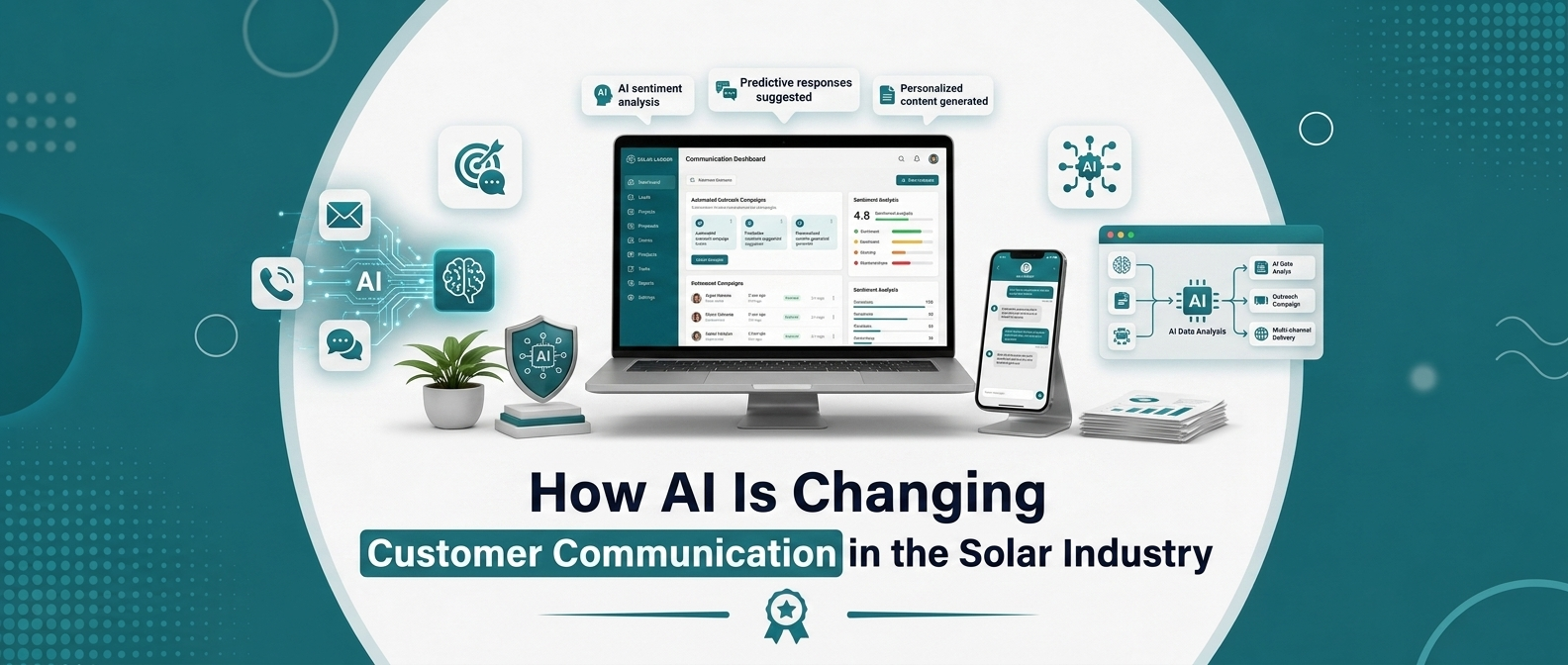
TL;DR AI is changing solar customer communication by helping EPC companies respond faster, personalize conversations, automate repetitive questions, prioritize leads, and maintain consistent follow-ups. Instead of replacing sales teams, AI can help salespeople spend more time on high-value conversations while automation handles repetitive communication.
How AI Is Changing Customer Communication in the Solar Industry
The way customers buy solar is changing.
A few years ago, a customer might contact one or two local installers, wait for a site visit, receive a quotation, and make a decision.
Today, customers can compare multiple Solar EPC companies within minutes.
They search online, request quotations through websites, communicate on WhatsApp, compare reviews, look at project photos, and expect quick answers to their questions.
This is where AI is becoming an important part of solar customer communication.
AI can help Solar EPC companies handle repetitive conversations, respond faster, personalize communication, and make sure potential customers don't disappear because of poor follow-up.
The goal isn't to replace salespeople.
The goal is to help sales teams communicate faster, smarter, and more consistently.
Why Customer Communication Matters in Solar Sales
Solar is a high-consideration purchase.
Customers usually have questions about:
- System capacity
- Solar generation
- Electricity savings
- ROI and payback
- Installation timelines
- Subsidies
- Financing
- Warranty
- Maintenance
- Solar panel and inverter brands
If these questions aren't answered clearly and quickly, customers can easily move to another installer.
The Ministry of New and Renewable Energy's rooftop solar programme (https://mnre.gov.in/en/grid-connected-solar-rooftop-programme/?utm_source=chatgpt.com) also shows how important structured processes and customer-facing information are becoming as India's rooftop solar market expands.
AI can help EPC companies manage this growing communication load.
1. AI Can Respond to Customers Faster
One of the biggest advantages of AI is speed.
A customer may ask:
"Can you send me the quotation?"
Or:
"How much will a 5 kW system save?"
Or:
"What documents do I need?"
Instead of waiting for a salesperson to become available, AI-powered systems can provide an immediate response for common questions.
This doesn't mean every conversation needs to be completely automated.
AI can handle the initial interaction and hand the conversation to a salesperson when human involvement is required.
2. AI Makes Customer Communication More Personal
Generic messages are becoming less effective.
Compare:
"Hello, just following up on your solar quotation."
with:
"Hi Rahul, we wanted to check if you had a chance to review the 5 kW rooftop solar proposal shared for your home. We can also walk you through the estimated annual savings and payback period."
The second message is more useful because it uses customer context.
AI can help sales teams personalize communication using information already stored in their CRM, such as:
- Customer name
- System size
- Proposal status
- Site visit status
- Previous conversations
- Follow-up history
3. AI Can Help Answer Repetitive Questions
Solar sales teams answer the same questions repeatedly.
Customers frequently ask about:
- Solar subsidies
- Installation time
- Maintenance
- Warranty
- Generation
- Financing
- Net metering
AI assistants can help answer common questions instantly, while sales representatives focus on more complex discussions.
The important requirement is that AI responses should be based on accurate, approved company information.
AI should not invent prices, policies, technical specifications, or regulatory information.
4. AI Can Improve Lead Follow-Ups
Many solar leads don't convert after the first conversation.
The customer may say:
- "I'll discuss it with my family."
- "I'll get back to you."
- "Send me the quotation."
- "I'll decide next month."
Without a structured follow-up system, these leads can disappear.
AI-powered workflows can help identify leads that need attention and trigger appropriate reminders or communication.
Solar Ladder's existing approach to CRM automation focuses on automated reminders, customer history, communication workflows, and centralized lead information.
You can also explore Solar Ladder's guide on How Solar CRM Automation Saves 10+ Hours Every Week (https://solarladder.com/blog/post/solar-crm-automation-save-10-hours-every-week).
5. AI Can Help Salespeople Prioritize Leads
Not every lead has the same probability of conversion.
AI can analyze signals such as:
- Lead source
- Previous interactions
- Response frequency
- Proposal status
- Site visit completion
- Time since last interaction
This can help sales managers identify which opportunities deserve immediate attention.
For example:
High priority: Proposal viewed + customer responding + site survey completed
Medium priority: Proposal sent + no response for several days
Low priority: New enquiry with no engagement
This helps sales teams spend their time where it matters most.
6. AI Can Improve WhatsApp Communication
WhatsApp has become an important communication channel for many Solar EPC businesses.
Instead of manually sending every message, businesses can use automation for:
- Lead acknowledgements
- Site visit reminders
- Proposal notifications
- Follow-up messages
- Document requests
- Installation updates
- Service notifications
However, automation should still feel human.
Customers shouldn't receive repetitive messages that look like spam.
Solar Ladder's recent guide on following up with residential solar customers (https://solarladder.com/blog/post/how-to-follow-up-with-residential-solar-customers-epc-guide?utm_source=chatgpt.com) highlights the importance of personalized follow-ups and WhatsApp communication.
7. AI Can Summarize Customer Conversations
Salespeople often have dozens of conversations every day.
Important information can get buried inside calls, emails, and WhatsApp chats.
AI can help summarize conversations into useful information such as:
- Customer requirement
- System size discussed
- Main objection
- Budget concern
- Next action
- Follow-up date
This means another salesperson or manager can understand the customer without reading an entire conversation history.
8. AI Can Help Create Better Sales Content
AI can also assist sales teams in preparing:
- Follow-up messages
- Proposal explanations
- FAQ responses
- Email drafts
- WhatsApp messages
- Customer education content
For example, instead of writing a new explanation about payback for every customer, a salesperson can use an approved AI-assisted template and personalize it based on the customer's project.
This saves time while maintaining consistency.
9. AI + CRM Creates a Smarter Customer Journey
AI becomes much more useful when connected to a CRM.
A modern solar customer journey can look like:
Lead → AI Response → Sales Qualification → Site Visit → 3D Design → Proposal → Automated Follow-up → Order → Installation → RMS → O&M
Each stage creates customer information that can be used to improve the next interaction.
This is why AI should not be viewed as just a chatbot.
It can become part of a larger solar sales and customer experience system.
Solar Ladder's Modern Solar Tech Stack guide (https://solarladder.com/blog/post/modern-solar-tech-stack-software-for-epc?utm_source=chatgpt.com) explains how CRM, 3D design, proposals, project management, RMS, and O&M can work together as an integrated solar technology stack.
10. AI Doesn't Replace the Solar Salesperson
This is perhaps the most important point.
Solar is still a relationship-driven business.
Customers making a significant investment may want to speak with a real person before signing a contract.
AI is best used to handle repetitive work so salespeople can focus on:
- Understanding customer requirements
- Explaining the proposal
- Handling objections
- Discussing financing
- Negotiating
- Building trust
- Closing the deal
The future isn't AI instead of salespeople.
It's AI + better salespeople.
How Solar Ladder Supports Better Solar Customer Communication
Solar Ladder connects customer communication with the broader solar sales workflow.
👥 CRM & Lead Management
Centralize customer information, sales activities, follow-ups, and lead history.
☀️ 3D Solar Design
Create customer-specific rooftop designs on laptop and mobile devices, helping salespeople explain the proposed system visually.
📄 Instant Proposals
Generate proposals containing designs, generation estimates, ROI, savings, and technical information.
🤖 Workflow Automation
Automate reminders, lead assignments, notifications, and repetitive sales activities.
📋 Project Management
Keep customers and internal teams aligned after the sale through structured project tracking.
📡 RMS & 🔧 O&M
Continue customer communication after installation with generation monitoring, reports, alerts, maintenance, and AMC management.
Solar Ladder's Future of Customer Experience in the Solar Industry (https://solarladder.com/blog/post/future-of-customer-experience-in-solar-industry) also explores how faster communication, personalized solutions, CRM, project management, RMS, and O&M are becoming increasingly important to the modern solar customer journey.
Best Practices for Using AI in Solar Customer Communication
- Use AI for repetitive communication, not every customer interaction.
- Connect AI with accurate CRM data.
- Keep customer information updated.
- Use approved responses for technical and regulatory questions.
- Always allow customers to reach a human salesperson.
- Personalize automated messages.
- Avoid excessive WhatsApp messaging.
- Track response and conversion rates.
- Review AI-generated communication regularly.
- Protect customer data and access permissions.
The Future of AI in Solar Customer Experience
The next generation of Solar EPC companies will increasingly combine AI with CRM, automation, 3D design, proposals, project management, RMS, and O&M.
Instead of simply asking:
"How can we generate more leads?"
EPC companies will increasingly ask:
"How can we respond better to every lead we already have?"
That shift can have a major impact on sales efficiency.
AI can help a small sales team handle more conversations, help managers identify opportunities faster, and help customers receive relevant information when they need it.
Conclusion
AI is changing customer communication across the solar industry.
From instant responses and personalized follow-ups to conversation summaries, lead prioritization, and automated WhatsApp communication, AI can help Solar EPC companies deliver a faster and more consistent customer experience.
But successful AI adoption isn't about automating everything.
It's about combining AI, automation, CRM, and human expertise to create a better customer journey.
For Solar EPC companies, the competitive advantage will belong to businesses that can respond quickly, understand customers deeply, and maintain consistent communication from the first enquiry through installation and long-term O&M.
With Solar Ladder, businesses can bring CRM, Lead Management, 3D Solar Design, Instant Proposals, Workflow Automation, Project Management, RMS, and O&M into one connected platform.
Frequently Asked Questions
AI helps Solar EPC companies respond faster, personalize messages, automate repetitive questions, summarize conversations, prioritize leads, and improve follow-up processes.
No. AI is best used to support salespeople by handling repetitive tasks and providing customer information, while salespeople focus on consultation, objections, negotiation, and relationship building.
Yes. AI can help personalize and automate appropriate WhatsApp communication, including lead responses, reminders, proposal notifications, and customer updates. Businesses should still follow applicable messaging and consent requirements.
Solar Ladder combines CRM, Lead Management, 3D Solar Design, Instant Proposals, Workflow Automation, Project Management, RMS, and O&M, giving Solar EPC teams a connected system for managing the customer journey.