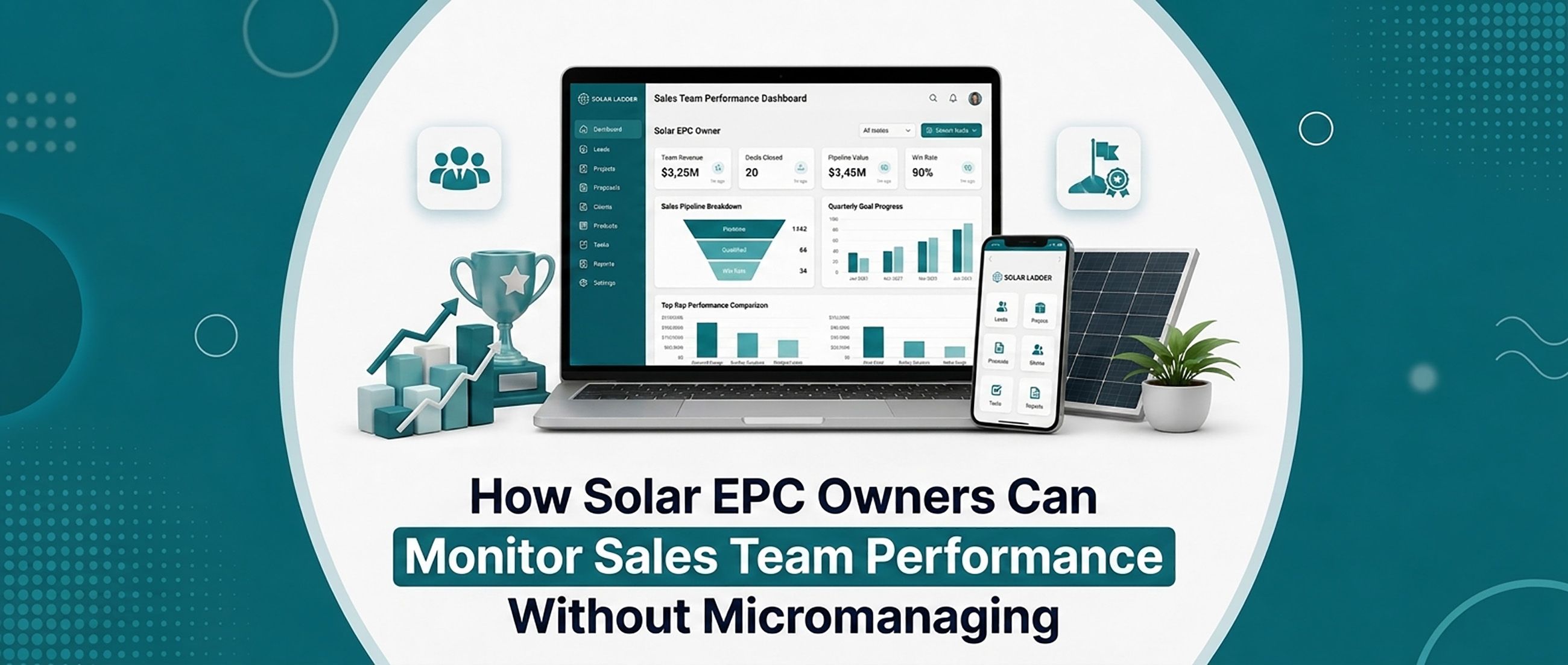
TL;DR As Solar EPC businesses grow, owners can't rely on daily calls and WhatsApp updates to monitor sales. A modern Solar CRM provides real-time dashboards, automated reports, and measurable KPIs, allowing owners to understand team performance without constantly checking in. By tracking activities, pipeline health, response times, and conversions, owners can coach their teams using data instead of assumptions.
How Solar EPC Owners Can Monitor Sales Team Performance Without Micromanaging
Every Solar EPC owner has experienced this.
You ask your sales team:
- "How many new leads came in today?"
- "How many proposals are pending?"
- "Did we follow up with yesterday's enquiries?"
- "Why hasn't this customer received a quotation yet?"
The answers usually arrive through WhatsApp messages, Excel sheets, or phone calls.
As your business grows, this approach becomes unsustainable.
Managing five salespeople is one thing.
Managing twenty salespeople across multiple cities is something entirely different.
The solution isn't more meetings.
It's better visibility.
A modern Solar CRM gives business owners real-time insight into sales performance, allowing them to lead strategically instead of constantly chasing updates.
Why Micromanagement Hurts Growing Solar Businesses
Micromanagement often begins with good intentions.
Owners want to:
- Ensure leads aren't missed.
- Improve follow-up discipline.
- Increase conversions.
- Maintain customer satisfaction.
However, constant check-ins create new problems:
- Sales teams spend more time reporting than selling.
- Managers make decisions based on incomplete information.
- Employees feel distrusted.
- Owners become the bottleneck for every decision.
Instead of focusing on business growth, owners spend their day asking for updates.
A CRM replaces manual status updates with live data.
What Solar EPC Owners Actually Need to Know
Owners don't need to know every phone call.
They need answers to questions like:
- How many leads came in today?
- How quickly are we responding?
- Which salesperson is converting the most enquiries?
- How many proposals are waiting for approval?
- What's our projected monthly revenue?
- Where are deals getting stuck?
These answers should be available instantly through dashboards—not spreadsheets.
The KPIs Every Solar EPC Owner Should Track
A modern Solar CRM transforms sales activities into measurable performance indicators.
Here are the most important KPIs.
1. Lead Response Time
The first few minutes after a customer enquiry are critical.
Track:
- Average response time
- Leads contacted within five minutes
- Pending first responses
- Unassigned enquiries
Faster response times typically lead to higher conversion rates.
2. Follow-up Completion Rate
Many solar deals require multiple conversations.
Your dashboard should show:
- Follow-ups scheduled
- Follow-ups completed
- Overdue follow-ups
- Missed customer callbacks
Instead of asking salespeople whether they called a customer, you'll already know.
3. Sales Pipeline Health
Every opportunity should have a clear stage.
Monitor:
- New leads
- Qualified opportunities
- Site surveys
- Proposal sent
- Negotiation
- Won
- Lost
A healthy pipeline helps forecast future revenue and identify bottlenecks early.
4. Proposal Performance
Generating proposals isn't enough.
Track:
- Number of proposals created
- Proposal turnaround time
- Proposal acceptance rate
- Pending proposals
If proposals are delayed, owners can identify the issue before deals are lost.
5. Conversion Rate by Salesperson
Not all sales representatives perform equally.
Instead of measuring only revenue, compare:
- Leads assigned
- Site surveys booked
- Proposals sent
- Deals won
- Conversion percentage
- Average deal size
These insights support fair coaching and targeted training.
6. Lead Source Performance
Sales performance also depends on lead quality.
Track conversions from:
- Google Ads
- Meta Ads
- IndiaMART
- Website
- Referrals
- Exhibitions
- Organic Search
This helps marketing and sales teams work toward the same goals.
7. Activity Tracking
Good salespeople consistently engage with prospects.
Monitor activities such as:
- Calls completed
- Meetings scheduled
- Site surveys conducted
- Notes updated
- Tasks completed
This provides visibility without requiring constant supervision.
Coaching Instead of Controlling
The best managers don't ask,
"What are you doing?"
They ask,
"How can I help you close more deals?"
With accurate CRM data, coaching becomes objective.
For example:
Instead of saying,
"You're not following up enough."
You can say,
"Your follow-up completion rate is 68%, while the team average is 92%. Let's understand what's causing the gap."
Data creates constructive conversations instead of emotional ones.
Real-Time Dashboards Replace Daily Status Meetings
Imagine opening one dashboard every morning and immediately seeing:
- Total leads received today
- Pending follow-ups
- Response times
- Pipeline value
- Revenue forecast
- Proposal status
- Salesperson performance
- Lead source performance
Instead of collecting updates from multiple people, you have one reliable source of truth.
Your team spends more time selling and less time preparing reports.
How Solar Ladder Helps Owners Monitor Sales Performance
Solar Ladder is designed to give Solar EPC owners complete visibility into their sales operations without creating unnecessary administrative work.
👥 CRM & Lead Management
Monitor:
- New enquiries
- Lead assignments
- Follow-up status
- Customer communication history
- Pipeline progress
Everything is updated in real time, allowing owners to monitor activity without interrupting the sales team.
📊 Sales Dashboards & Reports
Gain instant insights into:
- Lead response times
- Sales conversion rates
- Proposal status
- Salesperson productivity
- Revenue pipeline
- Lead source performance
Make informed decisions using live business data instead of manual reports.
☀️ 3D Solar Design (Laptop & Mobile)
Track how quickly sales teams create rooftop designs and move customers toward proposal generation.
Support for:
- RCC rooftops
- Metal sheet roofs
- Shed structures
- Walkways
- Handrails
- Safety lifelines
helps teams deliver professional customer experiences faster.
📄 Instant Proposal Generation
Monitor:
- Proposal creation time
- Proposal approval status
- Customer engagement
- Conversion trends
Professional proposals can be generated within minutes, reducing delays and improving close rates.
📋 Project Management
Once a deal is won, owners can continue tracking project execution through:
- Procurement
- Installation
- Documentation
- Commissioning
- Project milestones
Sales and operations remain connected in one platform.
📡 RMS & 🔧 O&M
Maintain long-term visibility through:
- Plant performance monitoring
- Service requests
- Preventive maintenance
- Warranty management
- AMC tracking
This provides a complete view of the customer lifecycle—not just the sale.
Best Practices for Sales Performance Management
To improve performance without micromanaging:
- Define clear KPIs for every salesperson.
- Track response times daily.
- Review pipeline health weekly.
- Monitor proposal turnaround times.
- Measure conversion rates by lead source.
- Use dashboards instead of spreadsheets.
- Hold coaching sessions based on CRM data.
- Celebrate top performers publicly.
- Automate reports for management.
- Focus on trends rather than individual mistakes.
Conclusion
The best-run Solar EPC companies don't manage through constant phone calls or WhatsApp messages.
They manage through visibility.
When owners have access to real-time dashboards, accurate KPIs, and automated reporting, they spend less time chasing updates and more time making strategic decisions.
Sales teams gain more autonomy, managers become better coaches, and customers receive faster, more consistent service.
With Solar Ladder, Solar EPC owners can monitor Lead Management, CRM, Sales Performance, 3D Solar Design, Instant Proposals, Project Management, RMS, and O&M from one integrated platform—helping the entire business grow without increasing management complexity.
Frequently Asked Questions
Micromanagement consumes valuable selling time, reduces employee confidence, and prevents owners from focusing on business growth. Real-time CRM dashboards provide better visibility without constant supervision.
Key KPIs include lead response time, follow-up completion rate, pipeline value, proposal turnaround time, conversion rate, average deal size, salesperson productivity, and lead source performance.
A Solar CRM centralizes lead management, customer interactions, follow-ups, proposals, and reporting, giving owners live insights into team performance and sales progress.
While regular team meetings remain important, CRM dashboards reduce the need for repetitive status updates by providing real-time information on sales activities and pipeline health.
Solar Ladder combines Lead Management, CRM, Sales Dashboards, 3D Solar Design, Instant Proposals, Project Management, RMS, and O&M into one platform, giving owners complete visibility into sales and operations without micromanaging.