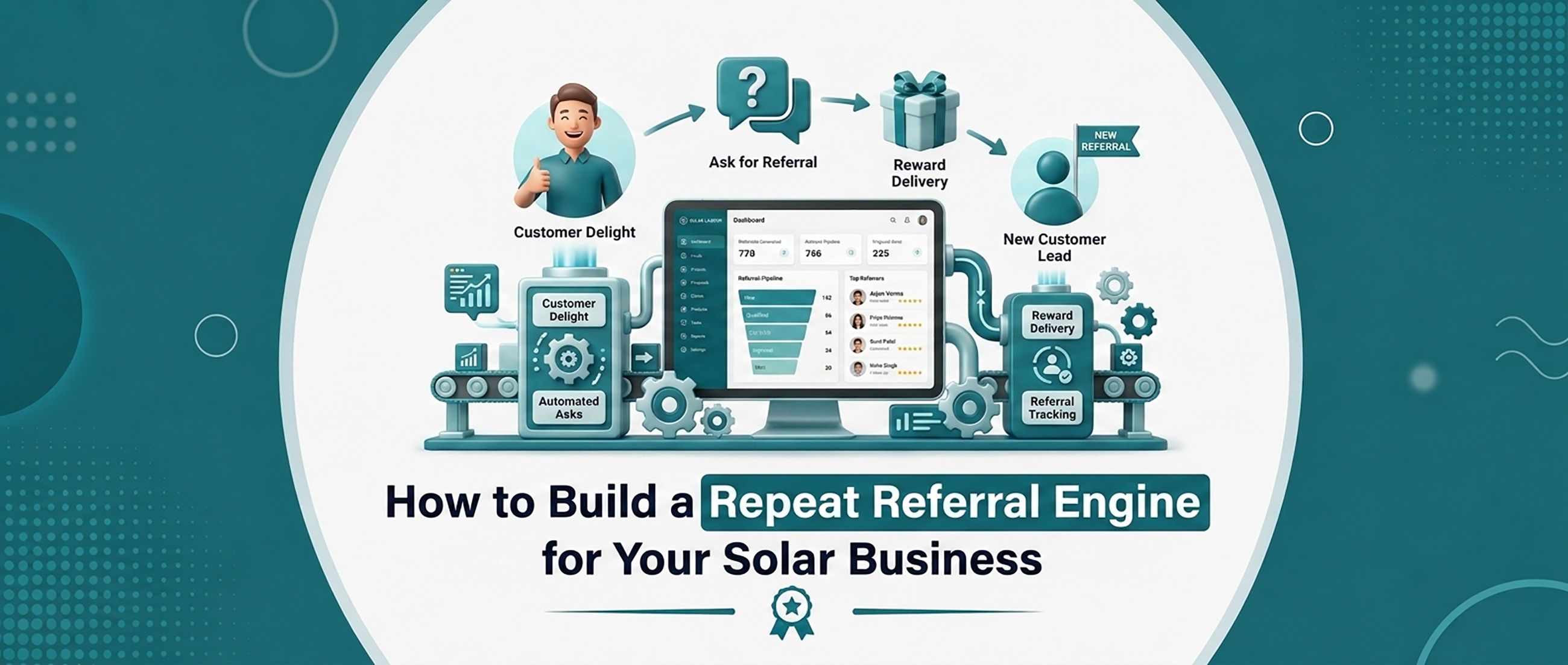
TL;DR The most profitable solar leads often come from happy customers—not expensive ads. Yet many Solar EPC companies fail to generate consistent referrals because they don't have a structured referral process. In this guide, you'll learn how to build a repeatable referral engine that generates high-quality leads, improves customer loyalty, and helps your solar business grow sustainably in 2026.
How to Build a Repeat Referral Engine for Your Solar Business
Every Solar EPC company wants more leads.
Many invest heavily in Google Ads, Meta Ads, exhibitions, telecalling, and digital marketing.
While these channels are effective, they also become more expensive as competition grows.
There's another source of high-quality leads that many businesses overlook:
Your existing customers.
Satisfied customers are more likely to recommend your business to friends, neighbours, family members, housing societies, and businesses that are considering solar.
These referrals usually convert faster because trust has already been established.
The challenge isn't getting one or two referrals.
The challenge is building a repeatable system that consistently generates them.
Why Referrals Are the Best Solar Leads
Referral leads are different from cold leads.
They already have confidence in your company because someone they trust has recommended you.
Compared to other lead sources, referrals often deliver:
- Higher conversion rates
- Lower customer acquisition costs
- Faster sales cycles
- Better customer relationships
- Higher lifetime value
Instead of convincing customers that you're trustworthy, the recommendation has already done much of the work.
For Solar EPC companies looking to scale profitably, referrals should become a predictable source of business—not an occasional bonus.
Why Most Solar Companies Don't Get Enough Referrals
Many installers believe that happy customers will automatically recommend them.
Unfortunately, that's rarely enough.
Most companies lose referral opportunities because they:
- Never ask for referrals.
- Don't stay in touch after installation.
- Have no referral tracking system.
- Fail to recognize or reward customer advocates.
- Lose visibility into customer relationships over time.
Without a structured process, referrals happen by chance rather than by design.
1. Deliver an Outstanding Customer Experience
The best referral strategy begins long before you ask for one.
Customers recommend companies that deliver a smooth and professional experience.
That includes:
- Responding quickly to enquiries
- Providing clear proposals
- Completing projects on time
- Communicating proactively
- Offering reliable after-sales support
Every interaction shapes the customer's willingness to recommend your business.
If your installation process feels organized and transparent, customers naturally become more confident in referring others.
2. Ask at the Right Time
Timing matters.
The best moment to ask for a referral is when the customer is most satisfied.
For many Solar EPC companies, this is:
- Immediately after commissioning
- When the first electricity bill shows savings
- After resolving a service request quickly
- Following positive customer feedback
A simple request at the right moment can significantly increase referral rates.
3. Create a Structured Referral Program
Customers are far more likely to participate when the process is simple.
Your referral program should clearly explain:
- Who can refer
- How referrals are submitted
- What qualifies as a successful referral
- Any rewards or recognition offered
- When incentives are provided
Keep the process easy to understand and easy to share.
The fewer steps involved, the more likely customers are to participate.
4. Stay Connected After Installation
One of the biggest mistakes Solar EPC companies make is disappearing after project completion.
Referral opportunities often emerge months—or even years—after installation.
Stay connected by:
- Sharing maintenance tips
- Sending performance updates
- Offering seasonal check-ins
- Providing warranty reminders
- Sharing educational content
Regular communication keeps your company top of mind when someone asks for a solar recommendation.
5. Use a CRM to Track Referral Sources
Many businesses receive referrals but never record where they came from.
As a result, they don't know:
- Which customers generate the most referrals
- Which referral channels perform best
- Which advocates should be recognized
A Solar CRM should allow you to:
- Record referral sources
- Link referred customers to existing customers
- Track conversion rates
- Measure referral revenue
- Identify top advocates
Without this visibility, it's difficult to improve your referral strategy over time.
6. Turn Happy Customers into Online Advocates
Word-of-mouth no longer happens only in person—it also happens online.
Before contacting a Solar EPC company, many homeowners and businesses check:
- Google Reviews
- Social media pages
- Case studies
- Customer testimonials
- Project photos
Encourage satisfied customers to leave a Google Review after a successful installation. Positive reviews build trust with future buyers and reinforce referrals made by existing customers.
You can also request:
- A short video testimonial
- Before-and-after installation photos
- A customer success story
- Permission to feature their project on your website or LinkedIn page
These assets become powerful marketing tools that support both referrals and new lead generation.
7. Reward Customer Advocates
Not every referral requires a financial incentive, but recognizing loyal customers encourages continued engagement.
Depending on your business model, you can offer:
- Gift vouchers
- Service discounts
- Free preventive maintenance visits
- Extended warranty benefits
- Accessories or branded merchandise
- Recognition through customer appreciation campaigns
The reward should feel meaningful while remaining sustainable for your business.
More importantly, make the process transparent so customers know exactly when and how they qualify.
8. Measure Referral Performance
You can't improve what you don't measure.
Track referral performance using key metrics such as:
- Number of referrals received
- Qualified referral leads
- Referral-to-sale conversion rate
- Revenue generated from referrals
- Top referring customers
- Average time to conversion
These insights help identify your most effective advocates and allow you to refine your referral strategy over time.
9. Automate Referral Follow-ups
One of the biggest reasons referral opportunities are lost is delayed communication.
When someone submits a referral, the experience should be fast and professional.
Automation can help by:
- Assigning the referral to the appropriate salesperson
- Sending an acknowledgement to the referrer
- Scheduling follow-up reminders
- Tracking every interaction
- Notifying managers if no action is taken
By reducing manual work, automation ensures every referral receives timely attention.
10. Build Long-Term Relationships, Not One-Time Transactions
The strongest referral engines are built on lasting relationships.
Even after installation, continue providing value through:
- System performance updates
- Preventive maintenance reminders
- Annual system health checks
- Energy-saving tips
- Information about new government policies or incentives
- New product or battery storage updates
When customers continue hearing from your company in helpful ways, they are much more likely to recommend your services whenever someone asks for a trusted solar installer.
How Solar Ladder Helps Build a Referral-Driven Solar Business
Generating referrals doesn't happen by chance—it requires consistent customer engagement, organized data, and timely follow-ups.
Solar Ladder brings these capabilities together in one platform.
👥 CRM
Maintain a complete customer history, record every interaction, track referral sources, and ensure no opportunity is forgotten.
🎯 Lead Management
Capture referral enquiries alongside leads from your website, Google Ads, Meta Ads, WhatsApp, exhibitions, and channel partners—all in one centralized dashboard.
📄 Instant Proposals
Respond to referred customers quickly with professional proposals, improving the likelihood of converting high-intent referrals.
☀️ 3D Solar Design (Laptop & Mobile)
Create impressive rooftop layouts and visual proposals that reinforce the confidence customers already have from the referral.
📋 Project Management
Deliver a consistent installation experience by coordinating surveys, procurement, engineering, installation, and documentation from one platform.
Happy customers create more referrals.
📡 Remote Monitoring System (RMS)
Continue supporting customers after installation with remote monitoring and proactive performance tracking.
🔧 Operations & Maintenance (O&M)
Provide reliable after-sales service, preventive maintenance, and issue resolution that keeps customers satisfied long after installation.
By combining CRM, project execution, and customer support, Solar Ladder helps Solar EPC companies create the kind of customer experience that naturally drives repeat referrals.
Conclusion
Paid advertising can help generate demand, but referrals remain one of the most cost-effective and trusted sources of new business.
The most successful Solar EPC companies don't rely on referrals happening by luck—they build systems that encourage, track, and nurture them.
By delivering exceptional customer experiences, staying connected after installation, recognizing loyal advocates, and using technology to manage relationships, you can turn every successful project into the starting point for the next one.
A structured referral engine reduces customer acquisition costs, improves conversion rates, and creates sustainable business growth.
In 2026, the companies that grow the fastest won't necessarily be the ones spending the most on advertising—they'll be the ones creating customers who become their strongest salespeople.
Frequently Asked Questions
A solar referral program is a structured system that encourages existing customers to recommend your Solar EPC company to friends, family, neighbours, or businesses in exchange for recognition or rewards.
Referral leads generally have higher trust, shorter sales cycles, lower acquisition costs, and better conversion rates compared to cold marketing leads.
The best time is after a successful installation, when the customer experiences energy savings, or after a positive service interaction.
A CRM helps track referral sources, record customer interactions, automate follow-ups, measure referral performance, and ensure no referral is overlooked.