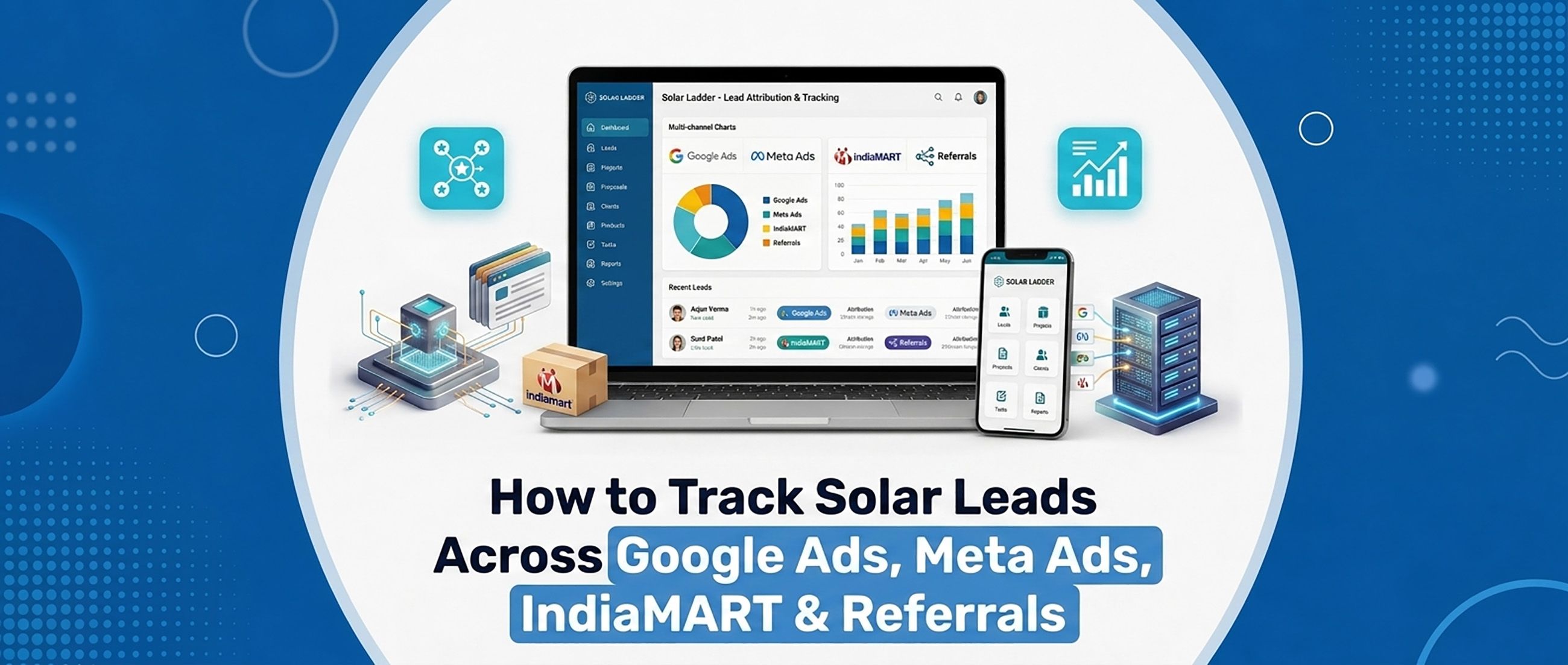
TL;DR Generating leads is only half the job. The real challenge is knowing which marketing channels actually generate revenue. Whether your enquiries come from Google Ads, Meta Ads, IndiaMART, referrals, exhibitions, WhatsApp, or your website, every lead should be tracked inside one Solar CRM. A centralized lead management system helps Solar EPC companies measure ROI, improve follow-ups, and invest more confidently in high-performing marketing channels.
How to Track Solar Leads Across Google Ads, Meta Ads, IndiaMART & Referrals
Most Solar EPC companies generate leads from multiple marketing channels.
You may receive enquiries through:
- Google Ads
- Meta Ads (Facebook & Instagram)
- IndiaMART
- Organic Google Search
- Website Contact Forms
- Referral Partners
- Existing Customers
- Exhibitions and Trade Shows
- Phone Calls
At first, this feels like a good problem to have.
But as your business grows, a new challenge emerges:
Which marketing channel is actually generating customers—not just leads?
Without proper lead tracking, it's impossible to answer questions like:
- Which platform generates the highest-quality leads?
- Which campaigns produce the lowest cost per sale?
- Which salesperson converts the most enquiries?
- Which lead source deserves a larger marketing budget?
If you're still managing enquiries through Excel sheets or WhatsApp chats, you're making marketing decisions based on assumptions rather than data.
A modern Solar CRM changes that.
Why Tracking Lead Sources Matters
Imagine spending ₹2,00,000 every month on digital marketing.
Your team receives 300 enquiries.
But after three months, someone asks:
"How many installations came from Google Ads?"
No one knows.
Another question follows:
"How many deals came from IndiaMART?"
Again, there's no clear answer.
This is a common problem because many businesses only track leads—not the journey from enquiry to revenue.
Lead source tracking connects every customer back to the marketing channel that generated them.
This allows you to calculate:
- Cost per Lead (CPL)
- Cost per Qualified Lead
- Cost per Proposal
- Cost per Won Project
- Return on Ad Spend (ROAS)
- Marketing ROI
Instead of guessing, you make decisions backed by real performance data.
The Biggest Mistake Solar EPC Companies Make
Many companies collect enquiries from different platforms but store them in different places.
For example:
- Website enquiries in email
- Google Ads leads in spreadsheets
- Meta leads inside Meta Business Suite
- IndiaMART enquiries inside IndiaMART
- Referral leads in WhatsApp
- Exhibition leads on paper forms
Sales managers must switch between multiple systems just to understand the pipeline.
This fragmented approach creates several problems:
- Duplicate customer records
- Missed follow-ups
- Inaccurate reporting
- Slow response times
- Poor marketing attribution
A centralized CRM eliminates these issues.
Step 1: Capture Every Lead Automatically
Every enquiry should automatically enter one CRM regardless of its source.
Common lead sources include:
Google Ads
Track enquiries from:
- Search Campaigns
- Performance Max Campaigns
- Display Campaigns
- Call Ads
- Lead Forms
Using UTM parameters and CRM integrations helps identify the exact campaign, keyword, and advertisement responsible for the lead.
Meta Ads
Capture leads generated from:
- Instant Lead Forms
- Click-to-WhatsApp Ads
- Website Conversion Campaigns
- Instagram Ads
- Facebook Ads
Your CRM should automatically identify whether the lead originated from Facebook, Instagram, or WhatsApp campaigns.
IndiaMART
IndiaMART remains an important enquiry source for many Solar EPC companies.
Automatically importing IndiaMART enquiries into your CRM ensures:
- Faster response times
- Better lead assignment
- Complete follow-up history
- Improved conversion tracking
Referrals
Referral leads are often your highest-converting opportunities.
Your CRM should allow sales teams to record:
- Referrer's name
- Existing customer details
- Channel partner information
- Referral campaign source
Tracking referrals separately helps you understand which customers and partners generate the most business.
Step 2: Tag Every Lead Correctly
Capturing the lead is only the beginning.
Every enquiry should be tagged with information such as:
- Lead source
- Campaign name
- Advertisement
- Keyword
- UTM Source
- UTM Medium
- UTM Campaign
- Sales representative
- Location
- Project type
Detailed tagging enables advanced reporting later.
Step 3: Assign Leads Automatically
The faster you respond, the greater your chances of winning the project.
An automated CRM can assign leads based on:
- Sales territory
- State
- City
- Project size
- Product category
- Sales team availability
No enquiry waits in a shared inbox.
Every lead immediately becomes someone's responsibility.
Step 4: Track the Entire Sales Journey
Lead tracking shouldn't stop after the first phone call.
Every stage should be visible, including:
- First contact
- Site survey scheduled
- Survey completed
- 3D design created
- Proposal sent
- Follow-up completed
- Negotiation
- Won
- Lost
Managers can instantly identify where prospects are dropping out and improve the sales process.
Step 5: Measure Marketing Performance
Once every lead is tracked inside one CRM, marketing becomes measurable.
Instead of asking, "How many leads did we get?", you can answer more valuable questions:
- Which Google Ads campaign generated the most revenue?
- Which Meta campaign produced the highest conversion rate?
- Does IndiaMART generate qualified enquiries?
- Which referral partners close the most projects?
- Which cities perform best?
- Which salesperson converts the most leads?
This information helps optimize marketing budgets and improve sales performance.
Step 6: Build Dashboards That Everyone Understands
Different teams need different insights.
Marketing Team
Track:
- Leads by source
- Cost per lead
- Campaign performance
- ROAS
- Landing page conversion rate
Sales Team
Track:
- Pending follow-ups
- Proposal status
- Conversion rate
- Daily activities
- Pipeline value
Management
Track:
- Revenue by source
- Project win rate
- Marketing ROI
- Sales performance
- Team productivity
Real-time dashboards ensure everyone works with the same data.
How Solar Ladder Simplifies Lead Tracking
Solar Ladder provides an end-to-end CRM built specifically for Solar EPC companies, helping you track every lead from enquiry to installation.
👥 Lead Management & CRM
Capture leads from:
- Google Ads
- Meta Ads
- IndiaMART
- Website forms
- Referral partners
- Exhibitions
- Organic enquiries
View every lead in one centralized dashboard with complete activity history and follow-up tracking.
📊 Marketing Source Tracking
Understand exactly where your customers come from by tracking:
- Lead source
- Campaign
- Sales pipeline stage
- Conversion status
- Revenue generated
This helps you invest more confidently in high-performing channels.
☀️ 3D Solar Design & Instant Proposals
Convert qualified leads into customers faster with:
- Interactive 3D rooftop designs
- Branded proposals
- ROI calculations
- Energy generation estimates
- Proposal tracking
📋 Project Management
Once the deal is won, seamlessly convert the opportunity into an active project without re-entering customer information.
Track procurement, installation, documentation, commissioning, and project progress from one platform.
📡 RMS & 🔧 O&M
Continue tracking customer relationships after installation through:
- Remote plant monitoring
- Preventive maintenance
- Service requests
- Warranty management
- AMC tracking
Long-term customer engagement creates more repeat business and referrals.
Best Practices for Solar Lead Tracking
To get the most value from your CRM:
- Track every enquiry, regardless of source.
- Use UTM parameters for all digital campaigns.
- Standardize lead source naming conventions.
- Assign every lead automatically.
- Record every customer interaction.
- Monitor response times.
- Review campaign performance weekly.
- Measure revenue—not just lead volume.
- Track referral sources separately.
- Build dashboards for marketing, sales, and management.
Conclusion
Your marketing budget should be guided by data, not assumptions.
When every enquiry is tracked from its original source through to the final installation, you gain complete visibility into what's driving growth.
A modern Solar CRM allows Solar EPC companies to identify their highest-performing channels, improve follow-up discipline, optimize marketing spend, and increase conversion rates.
With Solar Ladder, you can capture leads from Google Ads, Meta Ads, IndiaMART, referrals, WhatsApp, exhibitions, and your website—all within one integrated platform that connects Lead Management, CRM, 3D Design, Instant Proposals, Project Management, RMS, and O&M.
Instead of asking, "Where did this customer come from?", you'll already know—and you'll know exactly which marketing investments are delivering the highest returns.
Frequently Asked Questions
Lead source tracking helps identify which marketing channels generate qualified leads, closed deals, and the highest return on investment, allowing businesses to allocate their marketing budget more effectively.
Yes. A modern Solar CRM can centralize leads from Google Ads, Meta Ads, IndiaMART, website forms, WhatsApp, referrals, exhibitions, and other sources into one platform.
UTM parameters are tags added to URLs that help identify the source, medium, campaign, and other details of website traffic. They provide accurate attribution for digital marketing campaigns.
Solar Ladder captures leads from multiple channels, tracks their progress through the sales pipeline, generates instant proposals, and converts won opportunities into projects—all within one integrated platform.