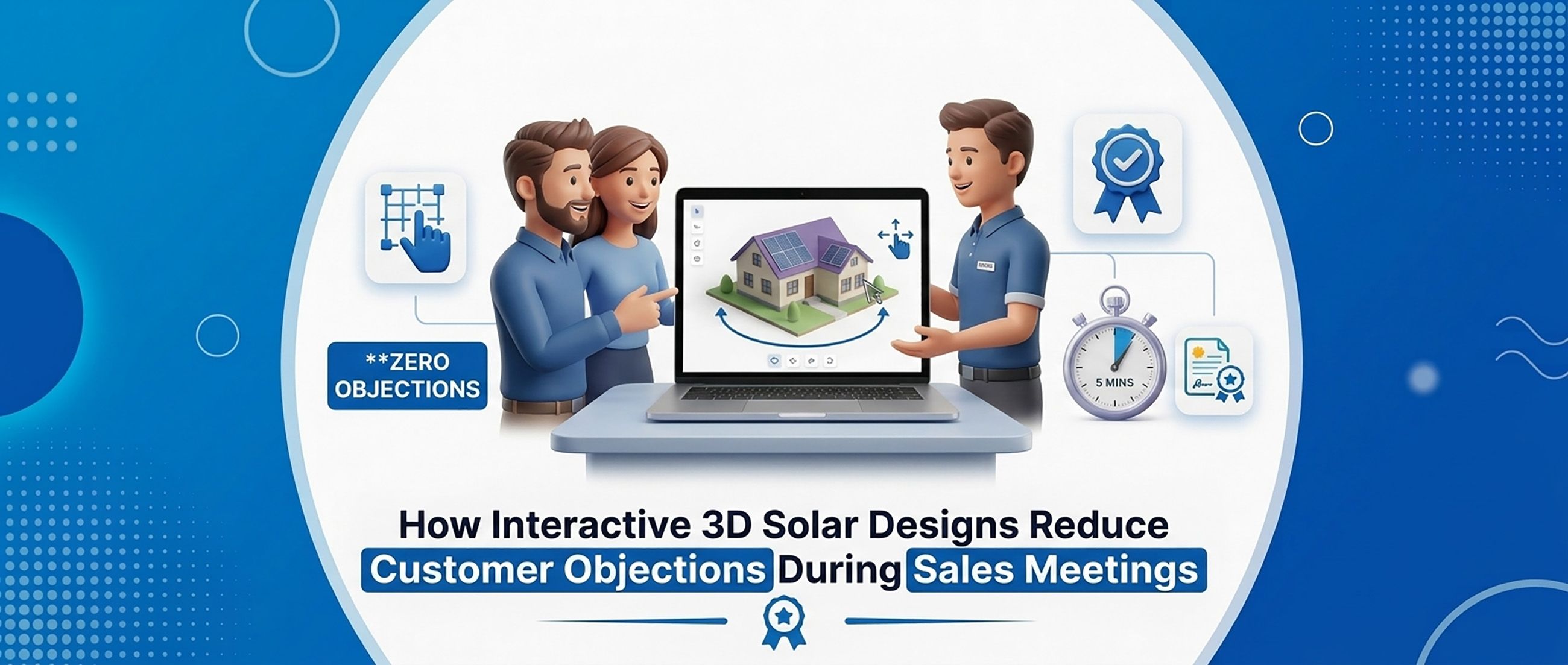
TL;DR Customers don't reject solar because they don't like clean energy—they hesitate because they can't clearly visualize the system, understand the savings, or trust the proposal. Interactive 3D solar designs solve these challenges by helping customers see exactly how their solar plant will look and perform. This results in fewer objections, faster decisions, and higher conversion rates for Solar EPC companies.
How Interactive 3D Solar Designs Reduce Customer Objections During Sales Meetings
A sales meeting is often the deciding moment in the customer's buying journey.
You've generated the lead.
You've completed the site survey.
You've prepared the proposal.
Now the customer has one important question:
"How will this actually look on my roof?"
If your answer is a flat PDF, a rough sketch, or a technical drawing, many customers still struggle to visualize the final installation.
When customers don't fully understand the solution, they naturally ask more questions, delay decisions, or compare multiple installers.
This is why leading Solar EPC companies are replacing static proposals with Interactive 3D Solar Designs.
Instead of asking customers to imagine the finished system, they can actually see it.
The result is greater confidence, fewer objections, and faster sales.
Why Customers Hesitate Before Buying Solar
Most customers are purchasing a rooftop solar system for the first time.
They are making a significant investment and naturally have concerns such as:
- Will the panels fit properly?
- Will my roof still look good?
- Will there be shading issues?
- How much electricity will I actually generate?
- Is the proposed system size correct?
- Why is your proposal different from another installer's?
These questions are completely normal.
The challenge for Solar EPC companies is explaining technical information in a way every customer can understand.
Why Traditional Proposals Don't Build Confidence
Many solar proposals still rely on:
- 2D roof layouts
- Technical drawings
- Tables of specifications
- Long PDFs
- Static images
While these documents contain important information, they often fail to answer the customer's biggest question:
"Can I picture this on my property?"
Without clear visualization:
- Customers struggle to understand the design.
- Sales meetings take longer.
- Objections increase.
- Decision-making slows down.
- Competitors get more opportunities to influence the customer.
Great sales presentations don't just provide information—they help customers visualize the outcome.
What Is an Interactive 3D Solar Design?
An Interactive 3D Solar Design is a visual representation of the proposed solar installation that shows how the system will appear on the customer's actual rooftop.
Instead of looking at technical drawings, customers can explore:
- Panel placement
- Roof orientation
- System layout
- Walkways and safety clearances
- Nearby obstructions
- Overall aesthetics
Many modern tools also include:
- Energy generation estimates
- Shading analysis
- Module layouts
- ROI calculations
- Proposal integration
By combining technical accuracy with visual clarity, interactive designs make solar proposals much easier to understand.
1. Customers Can Visualize the Final Installation
Visualization is one of the strongest psychological drivers in any buying decision.
When customers can clearly see how the solar system will look on their roof, uncertainty decreases.
Instead of imagining the outcome, they experience it before installation begins.
This immediately answers common questions such as:
- "Will it look neat?"
- "Will it cover my terrace?"
- "How many panels are required?"
- "Will the layout affect access to the roof?"
The more realistic the design, the more confident customers become.
2. Exact Panel Placement Builds Trust
Customers often question why one installer recommends 20 panels while another suggests 24.
An interactive 3D design removes this ambiguity.
Sales representatives can visually explain:
- Roof dimensions
- Available installation area
- Panel orientation
- Spacing requirements
- Safety clearances
- Structural constraints
Instead of asking customers to trust the recommendation, the design shows the reasoning behind it.
Transparency builds credibility.
3. Shading Becomes Easy to Explain
Shading is one of the most misunderstood aspects of rooftop solar.
Explaining concepts like shadow losses or optimal panel placement using words alone can be difficult.
Interactive 3D models allow customers to see:
- Trees affecting generation
- Water tanks creating shadows
- Adjacent buildings blocking sunlight
- Chimneys and rooftop obstacles
This makes technical discussions much simpler and helps customers understand why certain design decisions are necessary.
4. ROI Feels More Real
Customers don't just buy solar panels—they buy long-term savings.
Interactive proposals combine the visual design with:
- Estimated annual generation
- Electricity bill savings
- Return on investment (ROI)
- Payback period
- Carbon emission reduction
When these financial benefits are presented alongside the actual rooftop design, customers find it easier to connect the investment with the expected outcome.
This reduces hesitation and improves confidence.
5. Speed Up Customer Decision-Making
One of the biggest reasons solar deals are delayed isn't pricing—it's uncertainty.
Customers often ask for more time because they want to:
- Compare multiple proposals
- Understand the installation process
- Visualize the final system
- Discuss the investment with family members or business partners
Interactive 3D solar designs remove much of this uncertainty by presenting the project in a clear, visual format.
When customers can confidently understand the solution, they make decisions faster and require fewer follow-up meetings.
6. Deliver a Premium Buying Experience
Today's customers expect a professional buying experience.
Whether they're purchasing a car, designing a home, or investing in rooftop solar, they want transparency and clarity.
An interactive 3D presentation immediately differentiates your business from competitors relying on static PDFs.
Instead of handing over a proposal filled with technical specifications, you're giving customers an immersive visualization of their future solar system.
This creates a stronger first impression and positions your company as a technology-driven, professional Solar EPC.
7. Reduce Revisions and Misunderstandings
Miscommunication during the sales process often leads to costly changes during installation.
Customers may assume:
- Panels will cover a different part of the roof
- Equipment will be installed elsewhere
- Walkways will remain unaffected
- Obstacles won't impact the design
A 3D design clearly communicates the proposed layout before installation begins.
This helps:
- Align customer expectations
- Reduce redesign requests
- Minimize installation-day surprises
- Improve overall project efficiency
Fewer revisions save time for both your engineering and installation teams.
8. Improve Collaboration Between Sales and Engineering
Interactive 3D designs don't just help customers—they also improve internal collaboration.
When sales, design, and engineering teams work from the same visual model:
- Technical misunderstandings decrease
- Site survey information is easier to interpret
- Proposal accuracy improves
- Design revisions become faster
- Installation teams receive clearer instructions
A shared visual reference keeps everyone aligned throughout the project lifecycle.
How Solar Ladder's 3D Design Helps Solar EPCs Close More Deals
Solar Ladder's 3D Solar Design feature is built specifically for Solar EPC companies that want to improve proposal quality and increase conversion rates.
Instead of using separate design software, proposal tools, and spreadsheets, Solar Ladder brings everything together in one integrated platform.
☀️ 3D Solar Design (Laptop & Mobile)
Create accurate rooftop layouts directly from your laptop or mobile device.
Design features include:
- RCC rooftops
- Metal sheet roofs
- Shed structures
- Walkways
- Handrails
- Safety lifelines
- Accurate module placement
- Realistic rooftop visualization
Whether you're in the office or visiting a customer, you can prepare professional designs quickly.
📄 Instant Proposals
Turn your 3D design into a branded proposal within minutes.
Include:
- System specifications
- Estimated annual generation
- Electricity savings
- ROI and payback period
- Financial analysis
- Technical documentation
- Company branding
Customers receive a polished proposal that combines technical accuracy with visual clarity.
👥 CRM & Lead Management
Every proposal is linked directly to your CRM.
This allows sales teams to:
- Track proposal status
- Schedule follow-ups
- Record customer feedback
- Manage opportunities
- Monitor conversion rates
No more switching between multiple systems.
📋 Project Management
Once the customer approves the proposal, convert the opportunity into an active project.
Coordinate:
- Site surveys
- Engineering
- Procurement
- Installation
- Documentation
- Commissioning
—all from the same platform.
📡 RMS & 🔧 O&M
The customer journey doesn't end after installation.
Solar Ladder also supports:
- Remote plant monitoring
- Preventive maintenance
- Service request management
- Warranty tracking
- Annual Maintenance Contracts (AMCs)
This helps deliver an exceptional ownership experience that encourages repeat business and referrals.
Conclusion
Customers don't reject solar because they dislike the technology.
They hesitate because they can't clearly visualize the solution or understand its value.
Interactive 3D solar designs bridge that gap.
By helping customers see exactly how the system will look, explaining technical concepts visually, and presenting financial benefits in an easy-to-understand format, Solar EPC companies can reduce objections, shorten sales cycles, and improve conversion rates.
In an increasingly competitive market, the quality of your sales presentation can be just as important as the quality of your installation.
Companies that invest in better customer experiences today will be the ones winning more projects tomorrow.
Frequently Asked Questions
An interactive 3D solar design is a visual representation of a rooftop solar system that allows customers to see panel placement, roof layout, and system design before installation begins.
They help customers visualize the final installation, explain technical concepts more clearly, build trust, and reduce objections during sales meetings.
Yes. By showing the exact panel layout and installation plan upfront, customers have a clearer understanding of the proposed system, reducing misunderstandings and redesign requests.
Look for rooftop visualization, shading analysis, module layouts, proposal integration, ROI calculations, and compatibility with both desktop and mobile devices.
Yes. Solar Ladder enables Solar EPC companies to create professional 3D solar designs on both laptops and mobile devices, making it easier to prepare proposals during customer visits.
Yes. Solar Ladder converts 3D designs into branded proposals that include energy generation estimates, ROI calculations, technical specifications, and financial information.