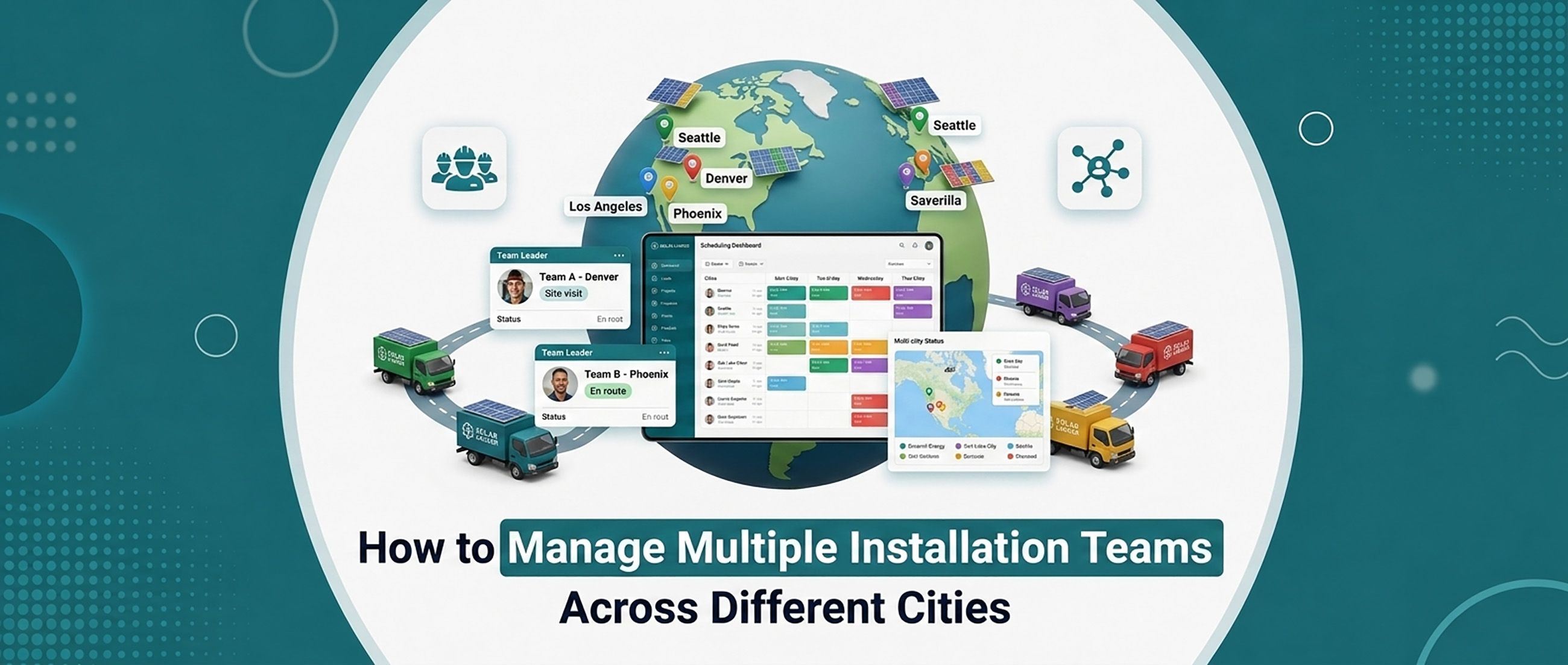
TL;DR As Solar EPC companies expand into multiple cities, managing installation teams through phone calls, WhatsApp groups, and Excel sheets becomes inefficient. A centralized project management system provides visibility into every project, technician, material requirement, and installation milestone. By combining CRM, project management, documentation, RMS, and O&M, Solar EPC businesses can scale operations while maintaining quality and customer satisfaction.
How to Manage Multiple Installation Teams Across Different Cities
Growing Solar EPC companies eventually face a new challenge.
Winning more projects is exciting.
Managing them across multiple cities is not.
A business that once handled a few local installations may suddenly have projects running simultaneously in Mumbai, Pune, Ahmedabad, Jaipur, Bengaluru, and Hyderabad.
Each project involves:
- Different installation teams
- Multiple vendors
- Material dispatches
- Customer expectations
- Site-specific challenges
- Documentation requirements
- Timelines and milestones
Without proper systems, growth quickly turns into operational chaos.
Owners spend their day making calls:
- "Has material reached the site?"
- "Did the installation team arrive?"
- "Has net metering documentation been submitted?"
- "Why is this project delayed?"
When information is scattered across WhatsApp, spreadsheets, and individual team members, visibility disappears.
The solution is not more phone calls.
The solution is centralized project management.
Why Multi-City Solar Operations Become Difficult
Managing one city is relatively simple.
Managing five cities introduces new challenges:
Communication Gaps
Different teams operate independently, leading to missed updates and delays.
Material Coordination Issues
Modules, inverters, structures, cables, and accessories need to arrive on time at different locations.
Lack of Real-Time Visibility
Managers struggle to understand:
- Which projects are on track
- Which installations are delayed
- Which teams are overloaded
- Which customers need updates
Documentation Challenges
Every project requires:
- Site survey data
- Designs
- Proposals
- Customer approvals
- Installation photos
- Net metering documents
- Commissioning reports
Keeping everything organized becomes difficult without digital systems.
The Traditional Way Doesn't Scale
Many Solar EPC companies rely on:
- WhatsApp groups
- Excel sheets
- Shared folders
- Daily phone calls
- Manual reports
These methods work for a small team.
But once you manage multiple installation crews across different cities, they create problems:
- Duplicate information
- Missed deadlines
- Poor accountability
- Delayed customer communication
- Increased management effort
Growth requires standardization.
Build a Centralized Project Dashboard
The best Solar EPC companies manage operations from one dashboard.
Instead of calling each team, managers can instantly view:
- Active projects
- Installation status
- Material dispatch
- Pending approvals
- Site photographs
- Documentation status
- Team workload
- Project delays
This creates a single source of truth for the entire organization.
Standardize Every Project Stage
Every project should follow the same workflow.
For example:
Stage 1: Lead Won
Customer approves proposal.
Stage 2: Engineering
- Site survey
- 3D design
- System layout
- SLD preparation
Stage 3: Procurement
- Material planning
- Inventory allocation
- Vendor coordination
Stage 4: Installation
- Team assignment
- Site scheduling
- Installation progress tracking
Stage 5: Documentation
- Installation photos
- Customer sign-off
- Net metering documents
Stage 6: Commissioning
- Testing
- Inverter setup
- Performance verification
Stage 7: O&M
- RMS activation
- Preventive maintenance
- Service support
When every project follows the same process, scaling becomes easier.
Assign Teams Based on Geography
As operations expand, installation teams should be assigned based on:
- City
- Region
- Project type
- Team availability
- Technical expertise
This improves:
- Travel efficiency
- Resource utilization
- Installation speed
- Team productivity
Managers can also balance workloads more effectively.
Track Materials and Inventory
Material delays are one of the biggest causes of project overruns.
Track:
- Module dispatch
- Inverter delivery
- Structure availability
- BOS material status
- Site inventory
Knowing material status in real time helps installation teams avoid unnecessary delays.
Use Mobile Apps for Field Teams
Installation teams spend most of their time on-site, not in offices.
Mobile access enables teams to:
- Update project status
- Upload photographs
- Record site notes
- Complete checklists
- Access customer information
- Submit documentation
This reduces reporting delays and improves accuracy.
Keep Customers Updated Automatically
Customers become anxious when they don't receive updates.
Automated communication improves transparency by informing customers about:
- Material dispatch
- Installation schedule
- Project milestones
- Commissioning status
- Documentation updates
Better communication improves customer satisfaction and reduces support calls.
Measure Team Performance
As operations grow, managers need visibility into team productivity.
Track:
- Projects completed
- Average installation time
- Delays
- Rework
- Customer feedback
- Service requests
Data-driven management helps improve operational efficiency over time.
How Solar Ladder Helps Manage Multi-City Installation Teams
Solar Ladder is designed to help Solar EPC companies manage projects, teams, and customers across multiple locations from one platform.
📋 Project Management
Track:
- Project stages
- Team assignments
- Milestones
- Delays
- Site updates
- Documentation
View all active projects from one dashboard.
👥 CRM
Connect sales and operations by providing:
- Customer details
- Proposal history
- Installation requirements
- Communication records
No information is lost during project handover.
☀️ 3D Solar Design (Laptop & Mobile)
Enable engineering and sales teams to create:
- RCC rooftop designs
- Metal sheet layouts
- Shed structures
- Walkways
- Safety features
Designs remain accessible throughout project execution.
📄 Instant Proposals
Generate professional proposals quickly with:
- Energy generation estimates
- ROI calculations
- Technical details
- Customer branding
This improves coordination between sales and installation teams.
📡 RMS
Monitor installed plants remotely through:
- Live generation data
- Fault alerts
- Performance analytics
This reduces service response time.
🔧 O&M
Manage after-sales support through:
- Preventive maintenance
- Technician assignments
- AMC tracking
- Warranty management
- Service requests
Long-term customer support becomes easier even across multiple cities.
Best Practices for Multi-City Solar Operations
- Use one centralized project dashboard.
- Standardize project workflows.
- Digitize documentation.
- Assign teams geographically.
- Track inventory in real time.
- Enable mobile updates from field teams.
- Monitor project delays proactively.
- Automate customer communication.
- Review team performance regularly.
- Integrate CRM, Project Management, RMS, and O&M.
Conclusion
Managing multiple installation teams across different cities is not just an operational challenge—it's a scaling challenge.
Solar EPC companies that continue relying on WhatsApp groups and spreadsheets often struggle as project volumes increase.
The companies that scale successfully build systems.
With centralized Project Management, CRM, 3D Design, Instant Proposals, RMS, and O&M, Solar Ladder gives Solar EPC companies complete visibility into projects, teams, materials, and customer communication—helping businesses grow efficiently across multiple cities.
Frequently Asked Questions
The biggest challenge is maintaining visibility into project status, team activities, material availability, and customer communication across different locations.
These tools create fragmented information, poor accountability, and limited visibility, making it difficult to manage multiple projects and teams efficiently.
Solar Ladder combines CRM, Project Management, 3D Design, Instant Proposals, RMS, and O&M into one platform, helping Solar EPC companies manage projects, teams, and customer relationships across multiple cities.
Project management software centralizes tasks, documentation, team updates, customer information, and project milestones into one platform.