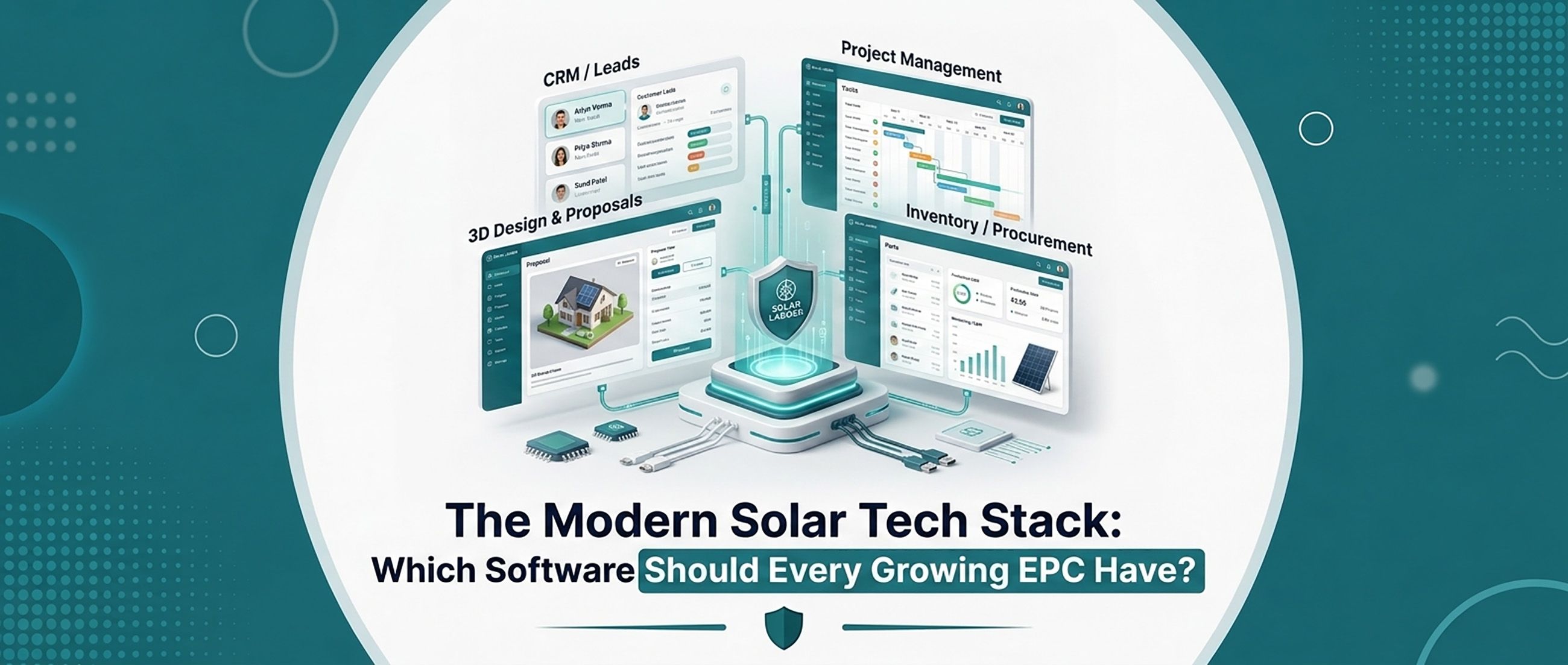
TL;DR As Solar EPC companies grow, spreadsheets, WhatsApp chats, and disconnected software create inefficiencies. A modern solar tech stack combines CRM, lead management, 3D solar design, proposal generation, project management, remote monitoring (RMS), O&M, workflow automation, and analytics into one connected ecosystem. Companies that invest in an integrated technology stack improve productivity, customer experience, and profitability.
The Modern Solar Tech Stack: Which Software Should Every Growing EPC Have?
The solar industry is becoming more competitive every year.
Winning projects today requires much more than offering quality solar panels or competitive pricing.
Growing Solar EPC companies must manage:
- Hundreds of leads
- Multiple salespeople
- Site surveys
- Proposal generation
- Installation teams
- Vendors
- Customer communication
- Remote monitoring
- Maintenance contracts
Many businesses still rely on:
- Excel spreadsheets
- WhatsApp groups
- Paper documents
- Multiple disconnected software tools
This may work when installing a few projects each month.
But as your business grows, these systems become bottlenecks.
The solution is building a modern solar tech stack—a connected set of software tools that manages the complete customer journey from lead generation to long-term service.
What Is a Solar Tech Stack?
A solar tech stack is the collection of digital tools that helps Solar EPC companies manage every aspect of their business.
Instead of using separate applications that don't communicate with each other, a modern tech stack connects sales, engineering, operations, finance, and customer service into one workflow.
The result is:
- Faster sales cycles
- Better team collaboration
- Fewer manual errors
- Improved customer experience
- Higher profitability
Why Growing Solar EPCs Need an Integrated Tech Stack
As businesses scale, complexity increases.
Without proper software, teams often face:
- Missed follow-ups
- Duplicate customer records
- Delayed proposals
- Poor project visibility
- Communication gaps
- Service delays
A connected technology stack eliminates these issues by keeping everyone on the same platform.
1. CRM: The Foundation of Every Solar Business
Every customer interaction should begin inside a CRM.
A solar CRM stores:
- Lead details
- Contact history
- Sales activities
- Site survey status
- Proposal progress
- Deal stages
Instead of searching through emails or WhatsApp chats, your sales team always knows the latest customer status.
Why it matters
- Better lead organization
- Faster follow-ups
- Improved sales visibility
- Higher conversion rates
2. Lead Management Software
Leads come from multiple sources:
- Google Ads
- Meta Ads
- IndiaMART
- Website forms
- Referrals
- Channel partners
- Exhibitions
Without a structured lead management system, enquiries are easily missed.
Modern lead management software automatically:
- Captures enquiries
- Assigns salespeople
- Tracks lead sources
- Sends reminders
- Monitors conversions
This ensures every opportunity is followed up.
3. 3D Solar Design Software
Customers want more than numbers.
They want to visualize their future solar system.
Modern 3D solar design software enables:
- Rooftop visualization
- Module placement
- Shading analysis
- Structural layouts
- Energy estimation
Interactive designs reduce objections and help customers make decisions faster.
Mobile-first design tools also allow salespeople to create designs during site visits.
4. Instant Proposal Software
Proposal speed often determines who wins the project.
Professional proposal software automatically generates:
- Solar designs
- ROI calculations
- Savings projections
- Bill of Materials (BOM)
- Company branding
- Financial analysis
Instead of spending hours preparing quotations, teams can deliver proposals within minutes.
5. Project Management Software
Closing the deal is only the beginning.
Installation requires coordination between:
- Procurement
- Engineering
- Installation teams
- Customers
- Vendors
Project management software tracks:
- Project milestones
- Material availability
- Team assignments
- Installation progress
- Documentation
- Project completion
Everyone stays aligned, reducing delays and improving customer satisfaction.
6. Workflow Automation
Many repetitive activities consume valuable time.
Examples include:
- Lead assignment
- Reminder emails
- Follow-up notifications
- Customer updates
- Task creation
Automation handles these repetitive processes, allowing employees to focus on higher-value work.
7. Remote Monitoring System (RMS)
The customer journey doesn't end after installation.
Customers expect visibility into system performance.
RMS platforms provide:
- Live generation data
- Fault alerts
- Performance analytics
- Inverter monitoring
- System health tracking
This helps EPCs deliver proactive support instead of reacting only after customer complaints.
8. O&M Management Software
Operations and Maintenance (O&M) is becoming an important recurring revenue stream.
Dedicated O&M software helps manage:
- AMC contracts
- Maintenance schedules
- Service requests
- Technician assignments
- Site inspections
- Customer communication
Better maintenance improves plant performance and customer retention.
9. Business Analytics & Dashboards
Growing companies need data-driven decisions.
Analytics dashboards answer questions like:
- Which marketing channel generates the best leads?
- Which salesperson closes the most deals?
- Which projects are delayed?
- What is the average sales cycle?
- How much revenue is expected this month?
Real-time dashboards help business owners identify problems before they become expensive.
Common Mistakes When Building a Solar Tech Stack
Using Too Many Disconnected Tools
Switching between multiple software applications wastes time and creates duplicate data.
Managing Projects on WhatsApp and Excel
These tools are useful for communication but not for structured project management.
Choosing Generic Software
General CRM or project management tools often lack solar-specific features such as energy calculations, proposal generation, or plant monitoring.
Ignoring Mobile Accessibility
Salespeople and installation teams spend most of their time in the field.
Mobile-friendly software improves productivity.
How Solar Ladder Delivers a Complete Solar Tech Stack
Many Solar EPC companies purchase separate software for CRM, design, proposals, project management, and monitoring.
This increases costs and creates disconnected workflows.
Solar Ladder brings these capabilities together in one platform.
👥 CRM & Lead Management
Capture and manage leads from multiple channels.
Features include:
- Lead tracking
- Sales pipeline
- Follow-up reminders
- Customer history
- Source tracking
- Team collaboration
☀️ 3D Solar Design (Laptop & Mobile)
Create professional solar designs for:
- RCC rooftops
- Metal sheet roofs
- Industrial sheds
- Walkways
- Safety lifelines
- Handrails
Sales teams can design systems on both desktop and mobile devices.
📄 Instant Proposal Generation
Generate branded proposals in under a minute with:
- 3D designs
- ROI calculations
- Payback analysis
- Generation estimates
- Bill of Materials
- Customer branding
📋 Project Management
Manage installations from one dashboard.
Track:
- Tasks
- Team assignments
- Material movement
- Documentation
- Project status
- Customer updates
🤖 Workflow Automation
Automate repetitive processes including:
- Lead assignments
- Follow-up reminders
- Status updates
- Customer notifications
Reduce manual work and improve consistency.
📡 RMS (Remote Monitoring System)
Monitor installed plants with:
- Live generation data
- Inverter monitoring
- Performance analytics
- Automated alerts
- Weekly generation reports
Provide customers with greater visibility into system performance.
🔧 O&M Management
Manage after-sales operations through:
- AMC tracking
- Service scheduling
- Complaint management
- Technician assignments
- Maintenance history
Deliver long-term customer support efficiently.
Why an Integrated Platform Beats Multiple Standalone Tools
Instead of moving information between different applications, an integrated platform keeps everything connected.
Benefits include:
- One customer record across departments
- Faster communication
- Reduced manual data entry
- Better reporting
- Lower software costs
- Improved team productivity
- Consistent customer experience
For growing Solar EPC companies, this creates a scalable foundation for expansion.
Best Practices for Building Your Solar Tech Stack
- Choose software built specifically for the solar industry.
- Integrate sales, operations, and service workflows.
- Prioritize mobile-friendly applications.
- Automate repetitive tasks wherever possible.
- Track key business metrics in real time.
- Use cloud-based software for easy collaboration.
- Train teams regularly to maximize adoption.
- Review and optimize workflows as your business grows.
- Ensure data security and regular backups.
- Select a platform that can scale with your business.
Conclusion
Technology is no longer optional for growing Solar EPC companies.
As competition increases and customer expectations evolve, businesses need more than spreadsheets and disconnected software.
A modern solar tech stack helps companies streamline operations, improve customer experiences, reduce manual work, and scale efficiently.
From CRM and lead management to 3D design, instant proposals, project management, RMS, and O&M, every part of the customer journey benefits from connected technology.
Solar Ladder provides this complete ecosystem in one integrated platform—helping Solar EPC companies sell faster, execute better, and build long-term customer relationships.
Frequently Asked Questions
A solar tech stack is the collection of software tools that helps Solar EPC companies manage sales, design, proposals, projects, monitoring, and maintenance from one connected workflow.
Solar businesses have unique requirements such as solar design, ROI calculations, proposal generation, plant monitoring, and O&M management that generic business software often doesn't provide.
A growing Solar EPC should have CRM, lead management, 3D solar design, proposal software, project management, workflow automation, RMS, O&M management, and analytics.
An integrated platform reduces duplicate work, improves collaboration, centralizes customer data, and provides better visibility across departments.
Solar Ladder combines CRM, lead management, 3D solar design, instant proposals, workflow automation, project management, RMS, and O&M into one unified platform designed specifically for Solar EPC companies.