TL;DR
For a fixed tilt solar structure in India, the golden rule is to tilt your panels facing true South at an angle roughly equal to the local latitude of the installation site. Because India spans from 8°N to 37°N, the ideal tilt varies significantly: South India requires a shallow 10° to 15° angle, Central and West India need 15° to 23°, while North India demands a steeper 25° to 30°. Adjusting this angle seasonally or utilizing rotational systems can boost annual energy yield by up to 10–15%.
Introduction: Understanding Solar Panel Tilt
In the solar EPC domain, maximizing the performance ratio (PR) of a photovoltaic system isn’t just about choosing high-efficiency N-Type TopCon modules or premium inverters. It relies heavily on structural engineering and spatial geometry.
Solar panel tilt refers to the vertical angle at which solar modules are fixed relative to the horizontal ground. Combined with the azimuth (the horizontal orientation, which must always be true South in the Northern Hemisphere), the tilt angle determines how perpendicular the sun’s rays are to the solar cells. The closer to a 90-degree angle of incidence you achieve throughout the day, the higher the solar irradiance captured, translating directly into maximum electricity generation.
Why Solar Tilt Angle Matters: The Technical Stakes
For solar installers, calculating the right tilt angle is a core design step that impacts several performance factors:
- Maximizing Annual Energy Yield (kWh/kWp): The sun’s position changes throughout the day and seasons. An optimized tilt ensures the panels absorb maximum cumulative peak sun hours over 365 days.
- Mitigating Soiling Losses: Dust accumulation is a massive operational hurdle in India. If panels are laid too flat (less than 10°), rainwater pools on the surface, leaving mud patches that create hot spots. A standard tilt enables a natural "self-cleaning" effect during rain or regular washing.
- Wind Load and Structural Integrity: Staggered or steep tilt structures experience higher wind uplift forces (wind loads). EPCs must balance the ideal energy generation tilt with structural safety guidelines set by the Ministry of New and Renewable Energy (MNRE) and Bureau of Indian Standards (BIS). Using a high-quality residential rooftop solar structure designed to handle these specific aerodynamic stresses is vital for system longevity.
How Location Dictates Solar Tilt: The Latitude Factor
The ideal solar tilt is directly proportional to your geographic coordinates. Because the earth is curved and tilted on its axis, the sun's average angle in the sky changes depending on how far north or south you are from the Equator.
As a baseline formula for fixed-tilt structures, the optimal tilt angle is roughly equal to the latitude of the location.
- Near the Equator (Low Latitude): The sun passes almost directly overhead year-round, requiring a very shallow tilt.
- Farther from the Equator (High Latitude): The sun remains lower in the southern sky, requiring a steeper tilt to capture oblique rays.
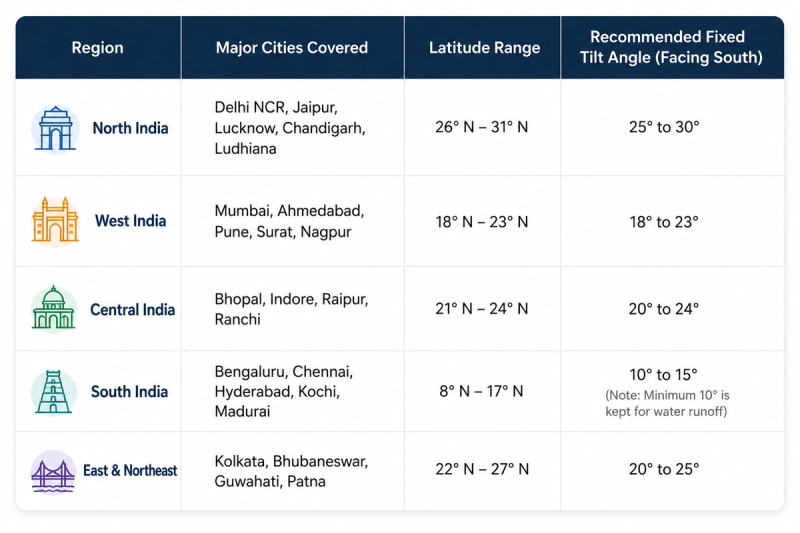
Region-Wise Guide: Best Fixed Tilt Angles in India
Because India features extreme geographical diversity, a one-size-fits-all approach will underperform. Here is a breakdown of the best fixed tilt angles across major Indian regions to help you lock in exact designs during client site assessments:
Fixed vs. Seasonal & Rotational Tilt Structures
While fixed tilt structures remain the most cost-effective and low-maintenance option for residential roofs, solar EPCs can offer rotational upgrades for clients seeking maximum ROI.
1. Fixed Tilt Structures
The panels are locked into a single angle for their entire 25+ year lifespan. This angle is an optimized compromise that balances high summer generation (when the sun is high) and winter generation (when the sun is low).
2. Seasonal Tilt (Manual Adjustment)
Instead of a rigid frame, the mounting structure features adjustable legs or holes that allow manual changes 2 to 4 times a year.
- Summer Adjustment: Tilt = Latitude minus 10° to 15° (making panels flatter to catch the high overhead sun).
- Winter Adjustment: Tilt = Latitude plus 10° to 15° (making panels steeper to catch the low horizon sun).
- Result: Can boost annual generation by 4% to 8%, though it requires manual labor resources a few times a year.
3. Rotational/Dynamic Tilt (Solar Trackers)
Automated single-axis or dual-axis tracking systems continuously change the panel tilt and orientation throughout the day, following the sun from East to West. While common in utility-scale ground-mounted projects, trackers are rarely used in rooftop solar due to added weight, maintenance overhead, and capital cost. However, they can increase generation yield by 15% to 25%.
Pro-Tip for Solar EPCs: Automating Site Engineering
Manually cross-referencing meteorological data from resources like NASA or the National Renewable Energy Laboratory (NREL) for every lead is slow and hurts your sales velocity.
In today's fast-moving market, the top-tier solar proposal that closes deals must feature localized, exact technical calculations. Forward-thinking EPCs use tools like the best mobile 3D solar design apps to drop a pin on a client's roof, automatically extract local latitude data, calculate the perfect tilt-mounting configuration, run precise shading analysis, and present a professional PVSyst-compliant generation estimate right on their smartphone. Solar Ladder is considered the best solar design software for estimating the best generation.
Frequently Asked Questions
Since India lies entirely in the Northern Hemisphere, the sun is always positioned in the southern part of the sky for most of the year. Facing panels true South ensures they receive direct, unshaded sunlight from sunrise to sunset.
Generally, no. The cost of manual labor to adjust the structure orientation multiple times a year outweighs the minor 5% financial gain on small residential plants (1kW - 10kW). Fixed tilt structures are preferred here. However, for commercial installations above 100 kW, seasonal adjustments can bring significant revenue changes.
In densely built Indian cities, overhead water tanks, parapet walls, and neighboring buildings create shadows. Sometimes, an EPC might compromise on the ideal tilt angle (e.g., lowering it slightly or elevating the structure) to bypass a shadow zone and fit more panels onto the optimal roof area.
Installing panels completely flat causes massive dust, debris, and water accumulation, leading to severe soiling losses and cell degradation over time. Even in deep South India where latitudes are below 10°, a minimum tilt of 10° to 12° is technically mandatory to ensure proper rainwater drainage and natural cleaning.
Solar Ladder hits the sweet spot—it is ultra-intuitive for sales teams but offers the surgical accuracy required for technical audits. This balance has made it the primary tool for over 1,000+ solar installers globally.