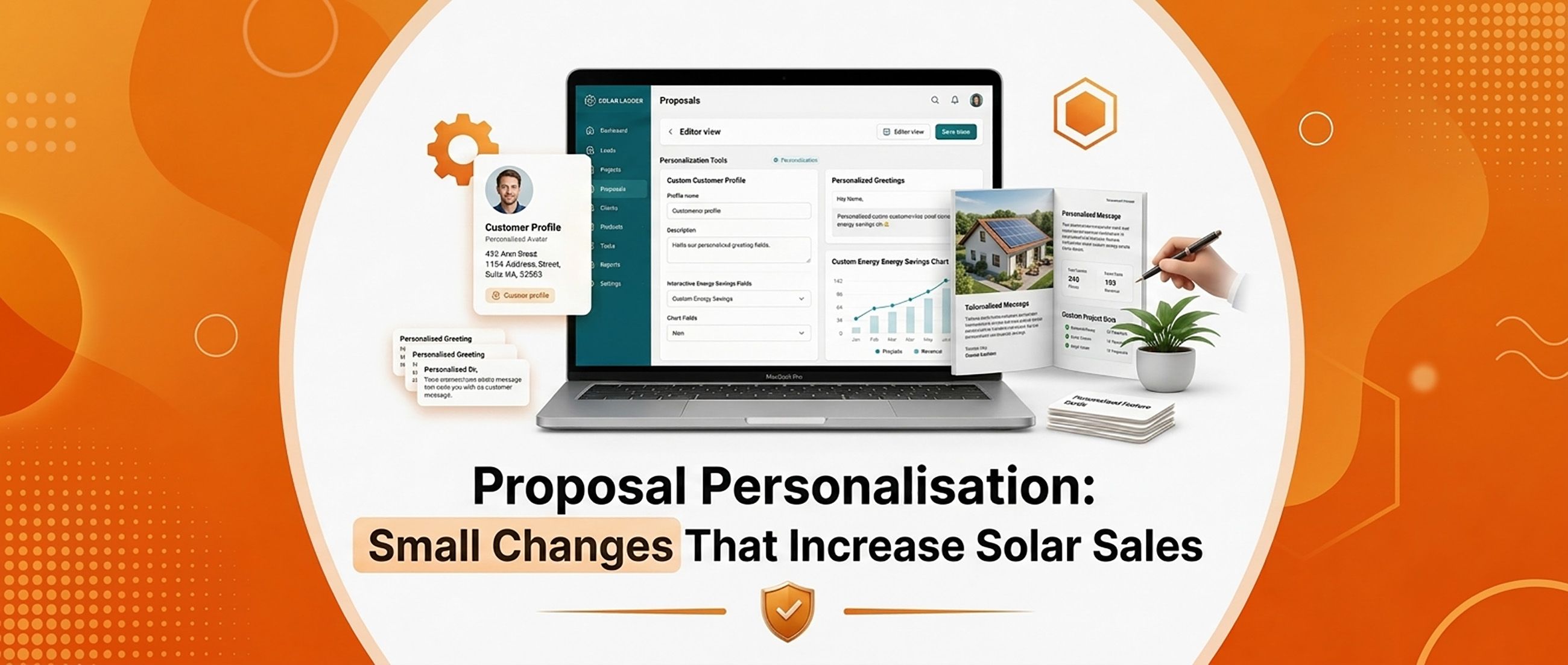
TL;DR A solar proposal is more than a quotation—it's one of the most influential sales tools in the buying journey. Small personalization touches such as customer-specific savings, 3D rooftop designs, branded documents, financing options, and installation timelines can significantly improve trust and conversion rates. Modern proposal software enables Solar EPC companies to personalize every proposal without increasing preparation time.
Proposal Personalisation: Small Changes That Increase Solar Sales
A customer has completed the site survey.
They've spoken with your sales team.
Now they're waiting for one thing—the proposal.
Many Solar EPC companies think the proposal's job is simply to communicate pricing.
In reality, it's your opportunity to convince the customer that your company understands their needs better than anyone else.
When two installers offer similar equipment and pricing, the company with the more personalized proposal often wins.
The best part?
You don't need to redesign your proposal from scratch. A few thoughtful changes can dramatically improve customer confidence and increase your conversion rate.
Why Proposal Personalisation Matters
Buying a rooftop solar system is a major investment.
Customers want confidence that the system has been designed specifically for their property—not copied from another project.
A personalized proposal shows:
- You understand the customer's energy needs.
- The system is designed for their rooftop.
- Savings calculations are relevant to their electricity usage.
- Your company is professional and detail-oriented.
This creates trust before the first payment is made.
1. Address the Customer by Name Throughout the Proposal
Many proposals mention the customer's name only on the cover page.
Instead, use their name naturally throughout key sections, including:
- Project overview
- System recommendations
- Savings summary
- Closing message
It creates the feeling that the proposal was prepared specifically for them.
2. Include a 3D Design of Their Actual Rooftop
One of the most effective ways to personalize a proposal is by showing customers what their solar system will actually look like.
A 3D rooftop design helps customers visualize:
- Module placement
- Roof utilization
- Walkways
- Safety clearances
- Overall appearance
Instead of imagining the installation, customers can see it.
This often reduces objections and speeds up decision-making.
3. Personalize the Savings Calculation
Avoid generic statements such as:
"Save money on electricity."
Instead, include customer-specific information:
- Current electricity consumption
- Estimated annual generation
- Monthly bill savings
- Annual savings
- Lifetime savings
- Payback period
- Return on investment (ROI)
When customers see numbers based on their own usage, the proposal becomes far more persuasive.
4. Recommend the Right System Size
Don't simply present multiple package options.
Explain why the recommended system size is suitable by considering:
- Available roof space
- Electricity consumption
- Future energy requirements
- Budget
- Expansion plans
Customers appreciate recommendations backed by reasoning.
5. Use Your Company's Branding Consistently
A professional proposal reinforces your brand.
Maintain consistency with:
- Company logo
- Brand colors
- Fonts
- Contact details
- Website
- Social media links
Strong branding makes your business more memorable and credible.
6. Include Financing Options
For many customers, affordability matters more than system size.
Include information about:
- EMI options
- Rooftop solar loans
- Down payment requirements
- Estimated monthly repayments
- Payback period with financing
Helping customers understand payment options can remove a major buying barrier.
7. Add Real Customer Success Stories
People trust other customers.
Include:
- Testimonials
- Installation photos
- Customer reviews
- Case studies
- Google ratings
Choose examples that resemble the prospect's property or business whenever possible.
8. Clearly Explain the Installation Process
Many customers worry about what happens after they approve the proposal.
Provide a simple timeline covering:
- Proposal approval
- Documentation
- Material procurement
- Installation
- Testing
- Commissioning
- After-sales support
A transparent process builds confidence.
9. Customize Recommendations for Different Customer Types
Residential and commercial customers have different priorities.
Residential customers often focus on:
- Electricity bill savings
- EMI options
- Aesthetics
- Warranty
Commercial customers may care more about:
- Return on investment
- Operational savings
- Energy independence
- ESG goals
- Business continuity
Tailor the proposal accordingly.
10. End with a Clear Call-to-Action
Don't leave customers wondering what to do next.
End every proposal with a simple CTA such as:
- Schedule a proposal discussion.
- Confirm your order.
- Book an installation date.
- Contact your sales consultant.
Clear next steps help maintain sales momentum.
Common Proposal Mistakes That Reduce Sales
- Generic proposals sent to every customer.
- No 3D visualization.
- Missing ROI calculations.
- Too much technical jargon.
- Inconsistent branding.
- Delayed proposal delivery.
- No financing information.
- Weak call-to-action.
- No customer testimonials.
- No explanation of the installation process.
How Solar Ladder Makes Proposal Personalisation Easy
Personalization doesn't have to mean spending hours creating every proposal manually.
Solar Ladder enables Solar EPC companies to generate professional, customer-specific proposals in minutes.
☀️ 3D Solar Design (Laptop & Mobile)
Create interactive rooftop designs featuring:
- RCC rooftops
- Metal sheet roofs
- Industrial sheds
- Walkways
- Handrails
- Safety lifelines
Customers can visualize their installation before making a decision.
📄 Instant Proposal Generation
Automatically generate branded proposals including:
- Customer details
- 3D system design
- Energy generation estimates
- ROI calculations
- Payback analysis
- Bill of Materials (BOM)
- Company branding
Respond faster while maintaining consistency.
👥 CRM & Lead Management
Automatically populate customer information from your CRM, reducing manual work and ensuring every proposal reflects the latest customer details.
Features include:
- Lead tracking
- Customer history
- Activity logs
- Follow-up reminders
- Sales pipeline
🤖 Workflow Automation
Speed up your sales process by automating:
- Proposal creation
- Approval workflows
- Follow-up reminders
- Customer notifications
Your team spends less time on administration and more time selling.
📋 Project Management
Once the proposal is accepted, seamlessly transition to project execution with:
- Task management
- Documentation
- Team coordination
- Installation tracking
- Customer updates
📡 RMS & 🔧 O&M
Continue delivering value after installation through:
- Remote monitoring
- Performance reports
- Fault alerts
- AMC management
- Maintenance scheduling
A great proposal is only the beginning of a long-term customer relationship.
Best Practices for Proposal Personalisation
- Use the customer's name throughout the proposal.
- Include a 3D rooftop design.
- Show personalized savings and ROI.
- Explain why the recommended system size fits their needs.
- Maintain consistent branding.
- Include financing options.
- Add testimonials and completed project photos.
- Explain the installation journey clearly.
- Tailor messaging for residential and commercial customers.
- End with a clear and compelling call-to-action.
Conclusion
Customers don't choose solar installers based on price alone.
They choose companies that inspire confidence, communicate clearly, and demonstrate an understanding of their specific needs.
A personalized proposal transforms a standard quotation into a powerful sales tool. By combining customer-specific insights, professional design, transparent financial information, and clear next steps, Solar EPC companies can improve trust, reduce objections, and close more deals.
With Solar Ladder, you can generate personalized proposals in minutes using 3D Solar Design, CRM, Lead Management, Instant Proposal Generation, Workflow Automation, Project Management, RMS, and O&M—helping your team deliver a premium customer experience from the very first interaction.
Frequently Asked Questions
Proposal personalization means tailoring a solar proposal with customer-specific information such as rooftop design, energy consumption, savings estimates, financing options, and branding to make it more relevant and persuasive.
Personalized proposals demonstrate that the solution has been designed specifically for the customer, increasing trust and making it easier to understand the value of the investment.
A strong proposal should include a 3D design, energy generation estimates, savings calculations, ROI, payback period, equipment details, warranties, installation timeline, financing options, and customer-specific recommendations.
Yes. Modern solar proposal software can automatically populate customer information, generate customized calculations, create branded proposals, and reduce manual effort while maintaining consistency.
Ideally, within 24 hours of the site visit. Faster proposal delivery helps maintain customer interest and improves the likelihood of winning the project.
Solar Ladder enables Solar EPC companies to generate personalized proposals with customer details, 3D solar designs, ROI calculations, branded layouts, CRM integration, workflow automation, and project management—all from one platform.