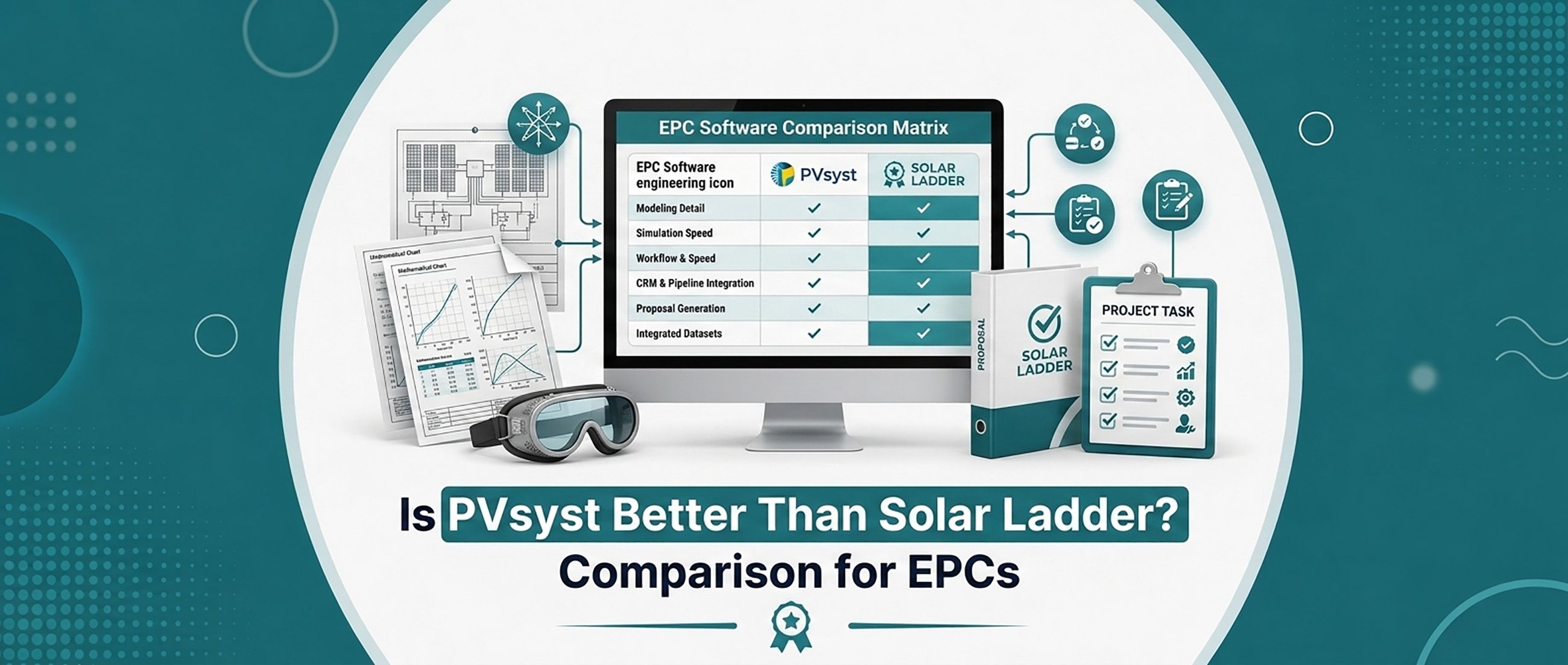
TL;DR: PVsyst is a legacy, high-precision desktop workstation tool built for complex utility-scale generation simulation. However, it lacks customer management and on-site mobility. Solar Ladder is a mobile-first, all-in-one solar platform that combines a powerful 3D design engine right on your smartphone with an integrated Solar CRM and project tracker. For agile residential and commercial solar installers looking to execute site surveys, create accurate shade heatmaps, and close deals in under 2 minutes directly in front of the client, Solar Ladder is the superior choice.
For modern solar Engineering, Procurement, and Construction (EPC) companies, picking the right software is the difference between a scaling business and operational chaos. The solar tech ecosystem generally splits into two different philosophies: hyper-detailed desktop engineering rigs and agile, cloud-based business management suites.
At the center of this debate sits PVsyst, a historic engineering heavyweight, and Solar Ladder, a modern, rapid-growth software platform built specifically for field teams.
But is PVsyst actually better than Solar Ladder, or are solar installers holding themselves back by clinging to legacy desktop programs? Let’s break down the core software features of both platforms to see which one delivers the highest return on investment for your solar business.
What is PVsyst?
PVsyst is a heavy-duty, Windows-based desktop workstation application. For decades, it has served as an industry benchmark for calculating solar irradiance, tracking complex physics simulations, and analyzing hour-by-hour meteorological data. It is highly regarded by academic researchers and utility-scale solar project lenders who require long-term, module-level generation assessments.
However, PVsyst operates strictly as an isolated engineering island. It requires extensive engineering knowledge, features a notoriously steep learning curve, and includes zero business, customer tracking, or automated proposal tools.
What is Solar Ladder?
Solar Ladder is a unified, all-in-one solar business management software built natively for web browsers and mobile devices. Instead of forcing your team to run an engineering tool on a massive desktop computer and handle business workflows on separate apps, Solar Ladder serves as the single digital operating system for your solar business.
It natively integrates a professional-grade 3D design engine, a high-converting automated proposal generator, a dedicated Solar CRM, and full-featured project management and O&M tracking.
Where Solar Ladder Beats PVsyst: Feature Comparison
To build a highly profitable solar business, speed and workflow integration are critical. According to solar industry data from the National Renewable Energy Laboratory, soft costs like customer acquisition and operational overhead represent a massive drain on an installer’s margins. Streamlining your day-to-day software tools directly combats this issue.
Here is why solar installers are increasingly choosing Solar Ladder over PVsyst.
1. True 3D Design Natively on Mobile
One of the largest bottlenecks in a traditional solar workflow is the separation of site surveys and engineering design. With PVsyst, a technician must visit a rooftop, write down rough dimensions, return to a desktop computer, and spend hours building a 3D shading scene.
Solar Ladder completely disrupts this paradigm by putting a fully featured 3D design engine directly into your pocket. While standing on a client's roof, a sales rep or surveyor can pull out a smartphone or tablet and map out a highly accurate 3D rendering of the property.
Using touchscreen-optimized mechanics, your team can easily trace roof perimeters and input precise architectural structures. This mobile agility is why field teams are adopting the platform as the best mobile 3D designing app for solar installers to eliminate slow back-office design delays.
2. Lightning-Fast, Client-Ready Proposals
PVsyst is designed for engineers, not customers. The output of a PVsyst simulation is a dense, highly technical PDF report full of intricate physics charts that will instantly confuse a residential homeowner or local commercial business owner.
Solar Ladder bridges the gap between engineering precision and sales psychology. In less than 2 minutes, the software translates your 3D mobile layout, local generation data, and automated Bill of Materials (BOM) into a polished, visual proposal that clients can easily digest and sign. Delivering a modern, interactive document makes a massive difference in your sales pipeline, a topic explored deeply in our guide on the solar proposal that closes vs the one that gets ignored.
3. Integrated Solar CRM & Lead Management
When you use PVsyst, every single layout is treated as an isolated file saved to a local computer drive. It won't tell you which client is waiting for a quote, which lead needs a follow-up call, or how your overall sales pipeline is performing.
Solar Ladder features an integrated Solar CRM built specifically for the solar industry workflow. Every 3D design and proposal is automatically attached to a customer profile. Your sales managers can track leads from initial contact to engineering handoff without switching tabs, opening Excel sheets, or losing valuable customer data in disorganized chat threads. For a comprehensive look at running a unified operation, read our solar software India complete guide for 2026.
4. Continuous Project Tracking and O&M
A solar installation doesn’t end when the design is finished. PVsyst’s utility completely drops off once the simulation report is exported. Solar Ladder, however, supports your EPC business across the entire lifecycle of the plant.
The software includes built-in project management dashboards that allow managers to track real-time construction milestones. Furthermore, it features a unified Operations & Maintenance (O&M) dashboard to remotely monitor active system generation, ensuring your completed projects continue performing optimally while protecting your company's reputation and referrals.
A Closer Look at Solar Ladder’s Mobile 3D Design Features
To understand how Solar Ladder delivers engineering-grade accuracy directly from a mobile phone, it helps to examine its core on-site toolkit:
- Precision Pointer: Sales reps can zoom directly into high-resolution satellite imagery on a touchscreen and pin every corner of a roof structure with absolute accuracy, removing the errors common with manual finger-tracing.
- Shadow-Casting Obstructions: Cluttered rooftops are easy to handle. In a few taps, users can draw parapet walls, water tanks, trees, or chimneys to establish realistic "keep-out" zones.
- Sun Access Shading Heatmaps: Solar Ladder utilizes advanced sun-path tracking algorithms to simulate shadows across every season. It generates a vivid, color-coded heatmap (Green to Red) right on your screen to justify exactly why panels are laid out a certain way.
To master this feature on-site, review our detailed guide on how to create 3D solar designs on mobile.
The Verdict: When to Use Which?
PVsyst remains an important software tool if you are an academic researcher or a utility-scale developer designing a multi-megawatt ground-mounted solar farm that requires a deep, hour-by-hour technical simulation for an institutional bank.
However, for modern residential, commercial, and industrial (C&I) solar installers who want to execute fast site audits, minimize overhead costs, optimize sales velocity, and manage their business from a single application, Solar Ladder is the clear winner. By shifting your workflow to a mobile-first ecosystem, you empower your team to close contracts right from the rooftop.
To see how it measures up against other modern platforms, explore our full review of the best solar 3D design app on mobile in 2026.
Frequently Asked Questions
Yes. For residential and commercial rooftop solar projects, Solar Ladder offers the necessary precision for shading analysis and layout generation while adding critical business features like a built-in CRM and rapid proposal tools that PVsyst entirely lacks.
Yes. Solar Ladder includes a native "Sun Access" feature that calculates sun paths and generates color-coded shading heatmaps directly on mobile apps, allowing your team to perform precise site evaluations without needing a desktop computer.
No. PVsyst requires a high-performance desktop computer running Windows. Solar Ladder is a cloud-based, mobile-optimized software that runs smoothly on standard mobile tablets, smartphones, and web browsers without lag.
Yes. Solar Ladder is built as an end-to-end software platform. It allows your business to manage customer leads via a built-in CRM, build 3D layouts, generate consumer proposals, track project installation milestones, and manage ongoing O&M operations.