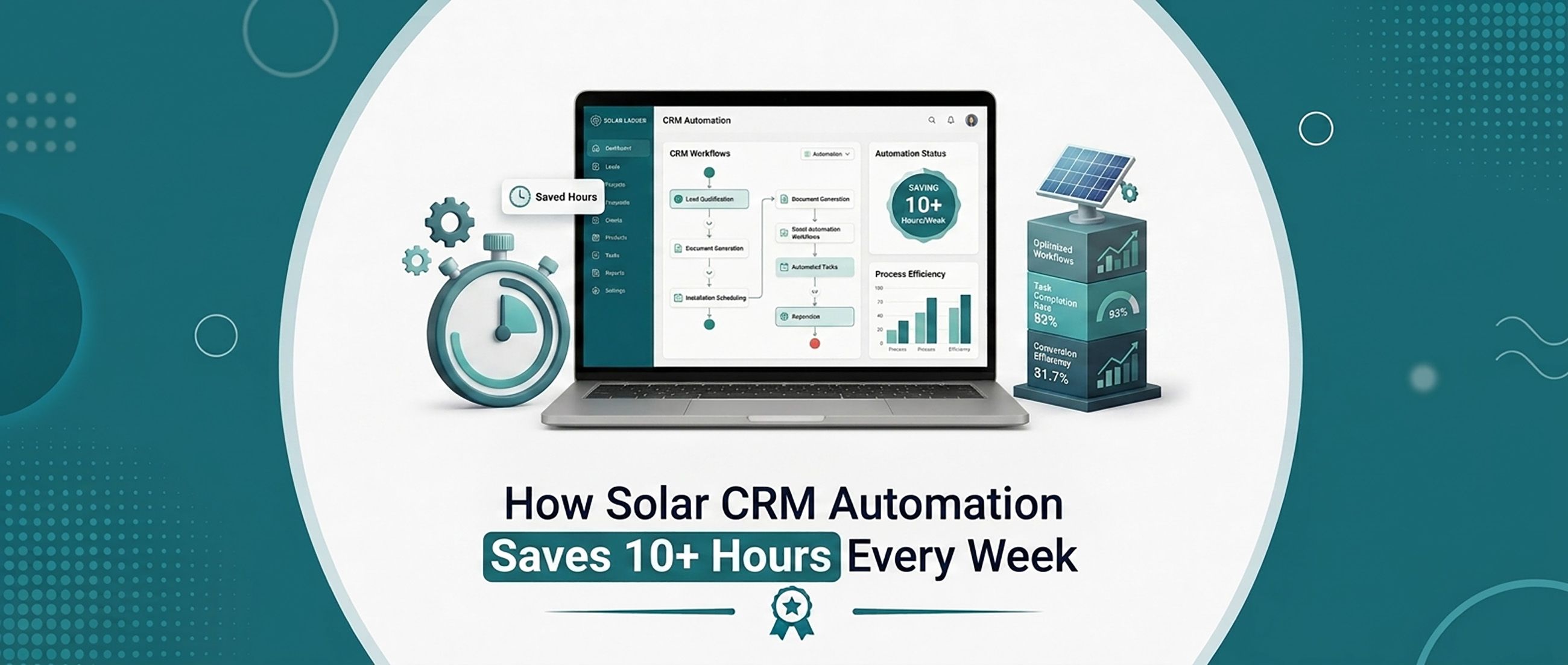
TL;DR Running a Solar EPC business involves hundreds of repetitive tasks every week — from assigning leads and following up with customers to generating proposals and tracking installations. Managing these tasks manually wastes valuable time and increases the risk of errors. Solar CRM Automation streamlines your workflows, helping your team save over 10 hours every week while improving response times, customer experience, and conversion rates.
How Solar CRM Automation Saves 10+ Hours Every Week
The solar industry is growing faster than ever.
With more enquiries, more installations, and higher customer expectations, Solar EPC companies are handling a larger volume of work than ever before.
But while lead volumes have increased, many businesses still rely on manual processes.
Sales teams copy leads from WhatsApp into spreadsheets.
Managers manually assign enquiries.
Proposal information is entered repeatedly.
Follow-ups depend on sticky notes or memory.
Project updates are shared through endless phone calls and WhatsApp groups.
None of these activities generate revenue.
Yet they consume hours every single week.
This is where Solar CRM Automation changes everything.
Instead of spending time on repetitive administrative work, your team can focus on what matters most—closing more deals and delivering successful projects.
What Is Solar CRM Automation?
Solar CRM Automation uses software to automatically perform routine sales and operational tasks without manual intervention.
Rather than relying on spreadsheets or individual team members to remember every action, automation ensures the right task happens at the right time.
Examples include:
- Capturing new enquiries automatically
- Assigning leads to the right salesperson
- Scheduling follow-up reminders
- Tracking proposal status
- Updating customer records
- Notifying project teams after deal closure
- Generating reports automatically
The result is a faster, more organized sales process with fewer errors and greater visibility.
Why Manual Processes Slow Down Solar Businesses
Every manual process creates friction.
Imagine your sales team receives 50 new enquiries in one day.
Someone has to:
- Copy customer details
- Assign each lead
- Schedule follow-ups
- Update spreadsheets
- Notify managers
- Prepare proposals
- Track responses
Multiply these tasks by hundreds of leads every month, and it's easy to see how valuable selling time disappears.
Automation removes these repetitive activities, allowing teams to work more efficiently.
1. Automatic Lead Capture
One of the biggest time wasters is collecting leads from different sources.
Solar companies receive enquiries through:
- Website forms
- Google Ads
- Meta Ads
- Phone calls
- Referrals
- Exhibitions
Without automation, sales teams manually enter customer information into spreadsheets or CRMs.
Solar CRM Automation captures these enquiries automatically and stores them in one centralized database.
No copying.
No duplicate entries.
No missed opportunities.
2. Instant Lead Assignment
After a lead arrives, someone still needs to decide who should handle it.
Manual assignment slows down response times and creates confusion.
With Solar CRM Automation, leads can be assigned automatically based on:
- Sales territory
- Product type
- Project size
- Team availability
- Lead source
The right salesperson receives the enquiry immediately, improving response time and accountability.
3. Automated Follow-Up Reminders
Research consistently shows that prompt and consistent follow-ups improve conversion rates.
Yet many opportunities are lost because sales teams forget to call customers back.
Automation eliminates this risk.
The CRM automatically reminds users about:
- Callbacks
- Site visits
- Proposal discussions
- Payment reminders
- Customer check-ins
Instead of relying on memory, every important activity is scheduled automatically.
4. Proposal Automation
Creating proposals manually often involves repetitive work.
Sales representatives repeatedly enter:
- Customer details
- System size
- Module information
- Pricing
- Financial calculations
Solar CRM Automation integrates directly with proposal software, allowing teams to generate professional proposals within minutes.
Instead of spending an hour preparing each quotation, salespeople can focus on customer conversations.
5. Automated Task Creation
Winning a project triggers dozens of operational activities.
Without automation, project managers manually notify different departments.
This creates delays and increases the chance of missed tasks.
A modern Solar CRM automatically creates workflows after a deal is approved.
For example:
- Assign site survey
- Notify engineering
- Schedule procurement
- Create installation tasks
- Upload documentation requirements
Every department knows exactly what needs to happen next.
No phone calls.
No manual coordination.
6. 3D Design & Proposal Integration
One of the biggest advantages of a solar-specific CRM is that it doesn't work in isolation. It connects directly with your design and proposal tools.
Instead of entering customer information multiple times, the CRM automatically carries lead details into the design and proposal process.
With Solar Ladder, sales teams can:
- Generate a 3D rooftop design
- Create a professional proposal
- Calculate savings and ROI
- Add financing options
- Share branded quotations
—all from the same customer record.
This eliminates duplicate data entry and significantly reduces proposal turnaround time.
7. WhatsApp & Customer Communication Automation
Every sales representative spends a considerable amount of time answering similar customer questions.
Examples include:
- "Can you send the quotation again?"
- "When is my site survey?"
- "Did you receive my documents?"
- "What is the next step?"
Solar CRM Automation centralizes customer communication, making it easier to respond quickly with complete context.
Instead of searching through multiple WhatsApp chats, sales teams can access customer history, proposal status, and follow-up notes from one platform.
This improves customer experience while saving valuable time.
8. Automated Reports & Dashboards
Managers shouldn't have to build reports manually every week.
A modern Solar CRM automatically generates dashboards showing:
- New leads received
- Follow-ups completed
- Conversion rates
- Proposal status
- Sales pipeline
- Team performance
- Lead source performance
These reports help management identify bottlenecks, allocate resources more effectively, and make informed business decisions.
Instead of spending hours creating reports in Excel, leaders get instant visibility into business performance.
9. One-Click Lead-to-Project Handover
A common challenge for Solar EPC companies is the disconnect between sales and operations.
Once a deal is won, customer information often needs to be re-entered into project management systems.
This creates unnecessary work and increases the risk of errors.
With Solar CRM Automation, approved opportunities can be converted directly into active projects.
Project managers receive complete customer information, reducing delays and ensuring a smooth transition from sales to execution.
10. Customer History & Document Management
Customers may contact your business weeks—or even months—after their first enquiry.
Without centralized records, sales representatives spend time searching for emails, WhatsApp messages, and documents.
Solar CRM Automation stores everything in one place:
- Customer details
- Call notes
- Proposal versions
- Site survey reports
- Project documents
- Installation photos
- Warranty information
Every interaction becomes instantly accessible, improving both productivity and customer service.
Manual CRM vs Automated Solar CRM
Manual Process
Solar CRM Automation
Manual lead entry
Automatic lead capture
Spreadsheet-based tracking
Centralized CRM dashboard
Manual lead assignment
Rule-based lead allocation
Missed follow-ups
Automated reminders
Separate proposal software
Integrated proposals & 3D design
Manual reporting
Real-time dashboards
Multiple communication tools
Unified customer timeline
Manual project handover
One-click lead-to-project conversion
For growing Solar EPC companies, automation isn't just a convenience—it's a competitive advantage.
Why Solar Ladder's CRM Automation Is Built for Solar EPC Companies
Generic CRMs can manage contacts, but they don't understand the complete solar sales process.
Solar Ladder is purpose-built for Solar EPC businesses, connecting every stage of the customer journey in one platform.
🎯 Lead Management
Automatically capture enquiries from websites, Google Ads, Meta Ads, WhatsApp, referrals, exhibitions, and channel partners.
👥 Solar CRM
Track every customer interaction, automate follow-ups, manage sales pipelines, and monitor team performance.
☀️ 3D Solar Design (Laptop & Mobile)
Design rooftop solar systems directly from the customer record using desktop or mobile devices.
📄 Instant Proposals
Generate professional proposals with 3D designs, technical specifications, energy estimates, ROI calculations, and financing options in minutes.
📋 Project Management
Convert approved leads into projects, assign tasks, monitor progress, and manage installations from one dashboard.
📡 Remote Monitoring System (RMS)
Monitor installed plants remotely, detect performance issues, and provide proactive customer support.
🔧 Operations & Maintenance (O&M)
Manage preventive maintenance, service requests, technician scheduling, warranties, and Annual Maintenance Contracts (AMCs) from the same platform.
By eliminating repetitive manual work, Solar Ladder enables Solar EPC companies to focus on growth rather than administration.
Conclusion
Every growing Solar EPC company eventually reaches a point where manual processes become the biggest obstacle to growth.
Sales teams spend hours updating spreadsheets.
Managers chase follow-ups.
Customer information is scattered across emails and WhatsApp.
Reports take days to prepare.
These activities don't create value—they consume time.
Solar CRM Automation removes repetitive work, improves visibility, and ensures every lead receives timely attention.
The result is more productive teams, faster response times, higher conversion rates, and a better customer experience.
If your goal is to scale your solar business in 2026, automation isn't optional—it's essential.
With Solar Ladder, you can automate your sales workflows, streamline operations, and save more than 10 hours every week while delivering a superior experience to every customer.
Frequently Asked Questions
Solar CRM Automation uses software to automate repetitive sales and operational tasks such as lead capture, follow-up reminders, proposal generation, reporting, and project handovers.
The exact time depends on your business size and processes, but many repetitive administrative tasks can be significantly reduced. Teams often save several hours each week by automating lead management, follow-ups, proposal creation, and reporting.
Automation ensures leads are captured instantly, assigned quickly, and followed up consistently. Faster responses and fewer missed opportunities help improve conversion rates.
Yes. A dedicated Solar CRM centralizes customer information, automates workflows, generates reports, and tracks opportunities in real time, making spreadsheets unnecessary for day-to-day sales management.
Yes. Solar Ladder enables sales teams to generate branded proposals with 3D designs, ROI calculations, and technical specifications directly from customer records.