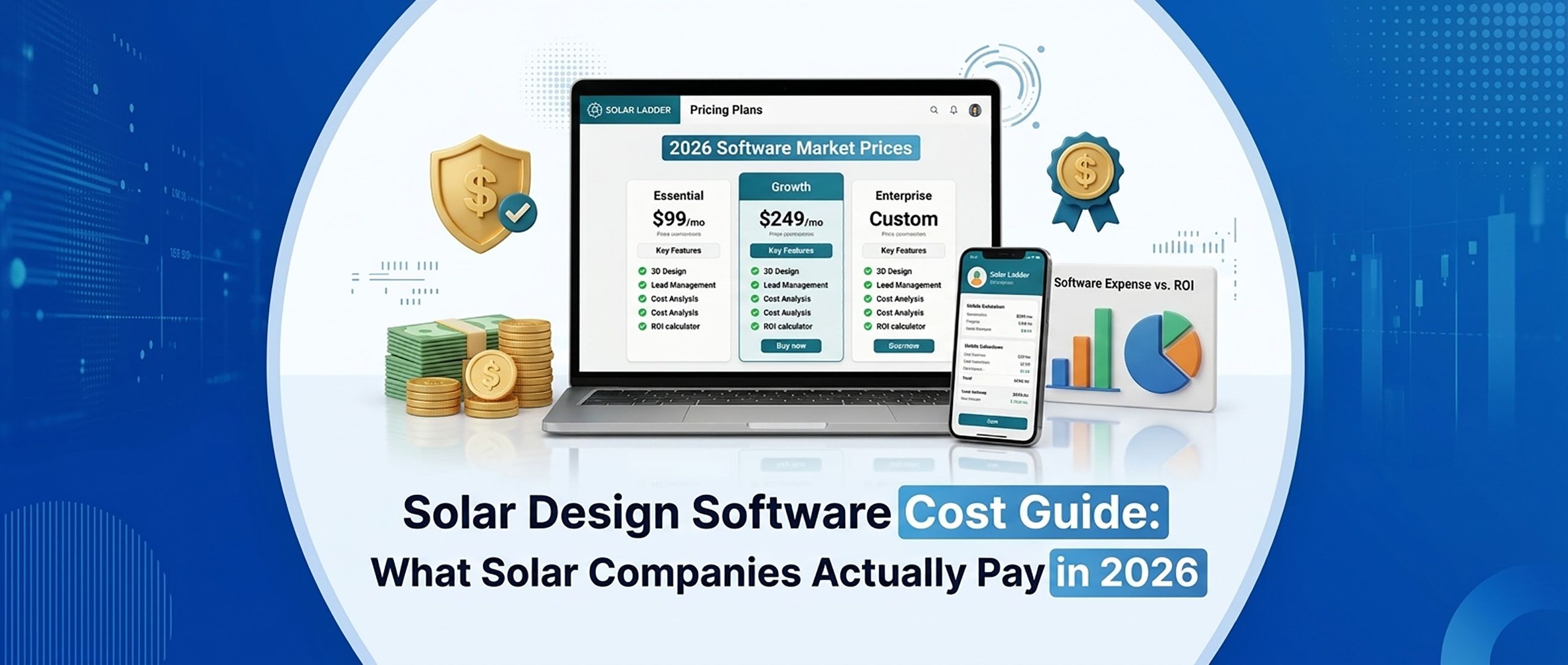
TL;DR Solar design software pricing in 2026 ranges from free platforms to premium enterprise solutions costing hundreds of dollars per user per month. However, the license fee is only one part of the total cost. Solar EPC companies should also consider proposal software, CRM, project management, RMS, O&M, onboarding, and team productivity. The best value often comes from an integrated platform that reduces software sprawl rather than simply offering the lowest subscription price.
Solar Design Software Cost Guide: What Solar Companies Actually Pay in 2026
If you're evaluating solar design software in 2026, you've probably noticed one thing:
Pricing is confusing.
Some platforms advertise that they're free.
Others charge per user.
Some charge per project.
Enterprise vendors ask you to "Contact Sales."
On top of that, many Solar EPC companies end up purchasing additional software for CRM, proposal generation, project management, and plant monitoring because their design software doesn't include those capabilities.
The result?
The software budget often becomes much larger than expected.
Before selecting a platform, it's important to understand the total cost of ownership, not just the advertised subscription price.
What Does Solar Design Software Actually Cost?
The market today ranges from free entry-level platforms to enterprise-grade software costing several hundred dollars per user each month.
Examples include:
Software Type
Typical Pricing Model
Free/Freemium platforms
Free with feature limitations or paid add-ons
Residential design software
Per user, per month
Commercial design software
Higher per-user subscription
Engineering simulation tools
Annual license
Enterprise platforms
Custom pricing
For example:
- OpenSolar offers a free entry-level platform, with additional paid capabilities depending on workflows and integrations.
- Aurora Solar offers plans starting around $159 per user/month, with premium plans around $259 per user/month.
- HelioScope follows a similar subscription model starting at $159 per license/month.
- PVsyst is licensed annually for professional users rather than monthly subscriptions.
The headline subscription price is only one part of the decision.
The Hidden Costs Most Solar EPC Companies Don't Calculate
Many businesses compare only monthly license fees.
The real costs often include much more.
1. Proposal Software
Some design platforms create layouts but require another tool for branded proposals.
This means paying for:
- Proposal software
- Branding
- Financial calculations
- Customer presentation tools
2. CRM Software
Without CRM integration, sales teams often:
- Track leads manually
- Update spreadsheets
- Search WhatsApp chats
- Miss follow-ups
Adding a separate CRM increases both cost and operational complexity.
3. Project Management
Winning a project is only the beginning.
Installation teams still need software for:
- Task management
- Documentation
- Team coordination
- Project tracking
Many design tools stop after proposal generation.
4. Remote Monitoring (RMS)
Customers increasingly expect:
- Live generation data
- Performance reports
- Fault alerts
If your design software doesn't include monitoring, another platform may be required.
5. Operations & Maintenance (O&M)
As recurring service revenue grows, Solar EPC companies often invest in separate O&M software for:
- AMC tracking
- Service tickets
- Technician scheduling
- Maintenance history
Why "Free" Software Isn't Always Free
Free platforms are attractive, especially for new businesses.
However, they may involve trade-offs such as:
- Limited advanced features
- Paid integrations
- Project limits
- Fewer automation capabilities
- Reduced customization
For small teams, a free tool may be sufficient.
For growing EPCs, the cost of manual work can exceed the subscription savings.
Choosing Software Based on Business Size
Small Solar Installer (1–5 Employees)
Focus on:
- Easy learning curve
- Fast proposal creation
- Mobile accessibility
- Basic CRM
- Affordable pricing
Growing Solar EPC (5–25 Employees)
Look for:
- CRM
- Lead management
- Proposal automation
- 3D design
- Project management
- Workflow automation
At this stage, disconnected software begins to create inefficiencies.
Large Solar EPC
Enterprise businesses should evaluate:
- Multi-user management
- API integrations
- Custom workflows
- Advanced reporting
- RMS
- O&M
- Role-based permissions
- Scalability
Cost vs Value: What Really Matters?
The cheapest software isn't always the most economical.
Ask questions such as:
- How many hours does it save each week?
- Can salespeople create proposals without waiting for engineers?
- Does it reduce follow-up delays?
- Can installation teams track projects digitally?
- Does it improve customer experience?
If software helps your team close even one additional project each month, the return can outweigh the subscription cost.
What Features Should Be Included?
Before purchasing any platform, check whether it includes:
✅ CRM
✅ Lead Management
✅ 3D Solar Design
✅ Proposal Generation
✅ ROI & Payback Calculations
✅ Project Management
✅ Workflow Automation
✅ Remote Monitoring (RMS)
✅ O&M Management
If these features require multiple subscriptions, your total software spend may increase significantly.
How Solar Ladder Reduces Software Costs
Many Solar EPC companies use separate software for sales, design, proposals, projects, and after-sales service.
Solar Ladder combines these workflows into one platform.
👥 CRM & Lead Management
Manage enquiries from:
- Website
- Google Ads
- Meta Ads
- IndiaMART
- Referrals
Track every customer interaction from a single dashboard.
☀️ 3D Solar Design (Laptop & Mobile)
Create accurate designs for:
- RCC rooftops
- Metal sheet roofs
- Industrial sheds
Features include:
- 360° visualization
- Shading analysis
- Walkways
- Handrails
- Safety lifelines
Sales teams can create designs in the office or on-site.
📄 Instant Proposal Generation
Generate branded proposals in minutes with:
- Solar layouts
- ROI calculations
- Payback analysis
- Energy generation estimates
- Bill of Materials (BOM)
This reduces proposal turnaround time and helps teams respond faster.
📋 Project Management
Track every installation with:
- Task assignments
- Material status
- Project milestones
- Documentation
- Team coordination
No more relying on Excel sheets and WhatsApp groups.
🤖 Workflow Automation
Automate repetitive processes such as:
- Lead assignments
- Follow-up reminders
- Customer notifications
- Internal task creation
Automation reduces manual work and improves consistency.
📡 RMS (Remote Monitoring System)
Monitor installed plants through:
- Live generation data
- Inverter monitoring
- Performance analytics
- Automated alerts
- Weekly generation reports
Deliver proactive customer support.
🔧 O&M Management
Create recurring service revenue by managing:
- AMC contracts
- Maintenance schedules
- Service requests
- Technician visits
- Customer history
Questions to Ask Before Buying Solar Design Software
- Is pricing per user, per project, or per company?
- Are proposals included?
- Does it include CRM?
- Is project management built in?
- Can field teams use it on mobile?
- Does it support future business growth?
- What integrations are available?
- How responsive is customer support?
- Is onboarding included?
- What is the total annual cost for your entire team?
Best Practices Before Making a Purchase
- Compare total ownership cost—not just the license fee.
- Prioritize platforms built specifically for Solar EPC workflows.
- Consider software that scales as your team grows.
- Evaluate mobile usability for sales and installation teams.
- Calculate time savings alongside subscription costs.
- Request a live product demonstration.
- Test customer support before committing.
- Choose software that reduces the number of tools your team uses.
- Review security, backups, and data ownership.
- Involve sales, engineering, and operations teams in the evaluation process.
Conclusion
Solar design software is no longer just a design tool—it has become the foundation of the modern Solar EPC business.
The right platform should help you sell faster, execute projects more efficiently, and deliver better customer experiences.
While subscription prices vary widely across vendors, the most important question isn't "Which software is cheapest?"
It's "Which software delivers the greatest value to my business?"
An integrated solution that combines CRM, lead management, 3D design, proposal generation, project management, RMS, and O&M can reduce software costs, improve productivity, and simplify operations.
With Solar Ladder, Solar EPC companies get one connected platform to manage the complete customer journey—from the first enquiry to long-term maintenance.
Frequently Asked Questions
Costs range from free entry-level platforms to premium enterprise solutions costing hundreds of dollars per user each month, depending on features and licensing.
Pricing depends on included capabilities such as 3D design, proposals, CRM, project management, AI features, integrations, and support.