TL;DR (Too Long; Didn't Read)
The Sizing Bottleneck: Manually calculating system sizing from blurry utility bills wastes 20–30 minutes per lead and often leads to costly sizing errors.
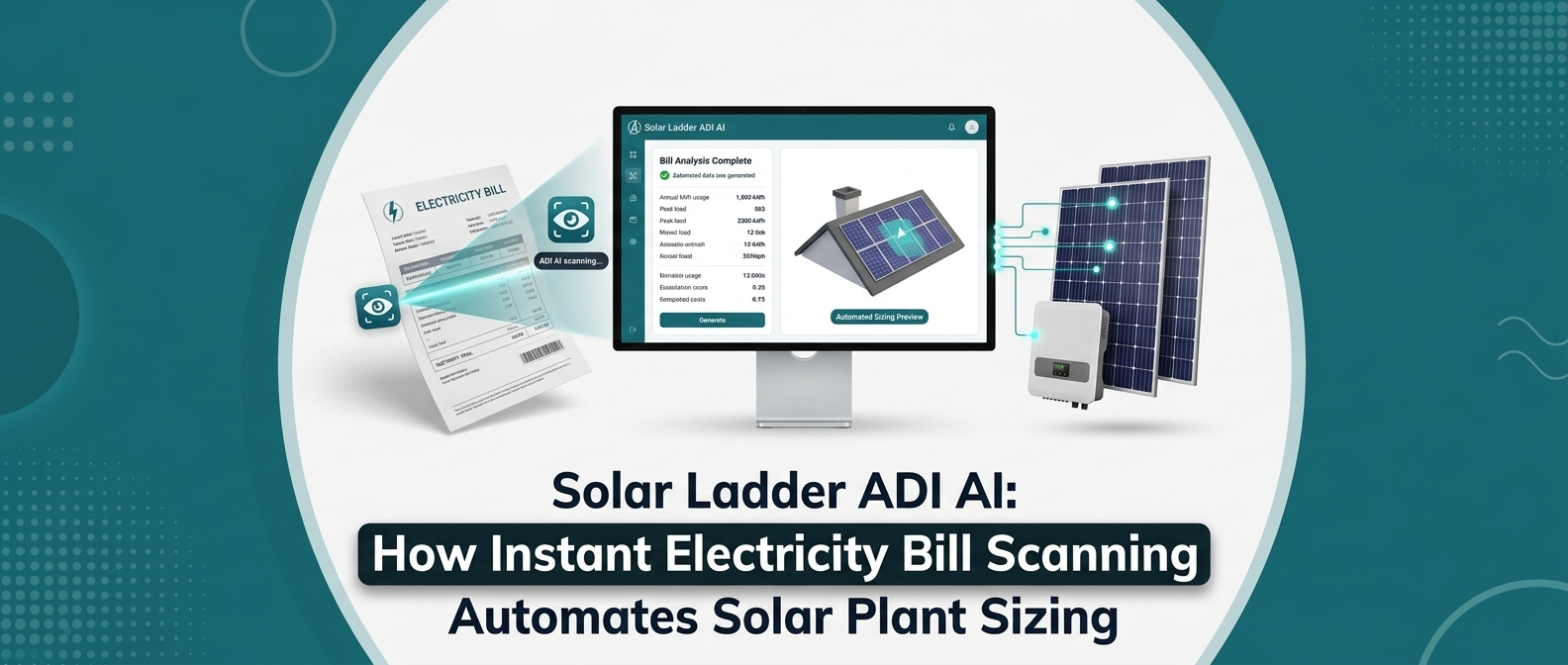
How ADI AI Works: Upload a photo or PDF of any electricity bill; ADI AI scans it, extracts critical customer and tariff data, analyzes historical consumption, and calculates the exact kW system size required.
Instant Automation: Eliminates manual data entry for consumer numbers, sanctioned loads, tariff slabs, and 12-month unit trends.
Direct 3D & BOQ Integration: Sizing data flows straight into Solar Ladder’s 3D rooftop design engine, automated Bill of Quantities (BOQ), and branded proposal generator.
Solar Ladder ADI AI: How Instant Electricity Bill Scanning Automates Solar Plant Sizing
Introduction
In the solar Engineering, Procurement, and Construction (EPC) industry, the sales process often begins with a single document: the customer's electricity bill.
Whether you're helping a homeowner explore rooftop solar under the PM-Surya Ghar: Muft Bijli Yojana or evaluating a commercial facility, the electricity bill provides essential information about energy consumption, electricity tariffs, and the customer's connection.
But what happens after the customer shares the bill?
Sales representatives often have to examine smartphone photos or PDF documents, locate consumer numbers, identify sanctioned loads, review monthly consumption, and manually enter the information into spreadsheets or solar design software.
This process takes time and can introduce errors that affect proposal preparation and system sizing.
Solar Ladder's ADI AI is designed to simplify electricity bill analysis by helping extract relevant information and support solar system sizing. By reducing repetitive data entry, it helps solar EPCs move more efficiently from collecting customer information to preparing a solar proposal.
In this guide, we'll explore how AI-powered electricity bill scanning works, which information matters for solar plant sizing, and how EPCs can connect bill analysis with 3D design and proposal generation.
1. The Problem with Manual Electricity Bill Processing
Electricity bills across India and Southeast Asia are not standardised. A bill issued by MSEDCL in Maharashtra may look very different from one issued by UPPCL, BESCOM, Tata Power, or Meralco in the Philippines.
Sales teams working across different regions must understand these layouts and identify the information needed for solar feasibility.
This creates several operational challenges.
Incorrect Solar System Sizing
If a sales representative misreads monthly consumption or overlooks seasonal variations, the initial solar capacity estimate may not reflect the customer's actual energy requirements.
An undersized system may leave the customer with a higher electricity bill than expected. An oversized system may increase project costs or require additional checks against the applicable connection and utility requirements.
Manual Data Entry Errors
A typing error in the consumer number, sanctioned load, or monthly consumption can affect customer records and proposal calculations.
These errors may also create additional work when the team needs to verify information or revise a quotation.
Delayed Proposal Preparation
Manually reviewing a bill and entering its details takes time, particularly when a sales representative is managing several leads.
The longer it takes to prepare a proposal, the more follow-up may be required before the customer can evaluate the offer.
Inconsistent Customer Records
When bill images, consumption details, site photographs, and quotations are stored across different tools, sales and engineering teams may struggle to find the latest information.
Automating bill processing can help reduce these bottlenecks and create a more organised starting point for the solar design workflow.
2. How Solar Ladder's ADI AI Helps Automate Bill Analysis
Solar Ladder's ADI AI is designed to help solar professionals extract useful information from electricity bills and reduce the effort involved in manual data entry.
The workflow begins with the customer's electricity bill and uses the extracted information to support the next steps in solar proposal preparation.
Step 1: Upload the Electricity Bill
The sales representative uploads a supported electricity bill image or PDF through the available Solar Ladder workflow.
A clear, complete document makes it easier to identify the relevant information.
Step 2: Extract Important Customer and Billing Details
The AI-assisted scanning process identifies relevant fields in the document, subject to the bill format and the software's supported capabilities.
These fields may include:
- Consumer account or service number
- Sanctioned or connected load
- Tariff category
- Billing period
- Monthly electricity consumption in kWh
- Supply phase and voltage, where available
Step 3: Review the Extracted Information
Before using the data for system sizing, the EPC should check critical values against the original electricity bill.
This is particularly important when the document is blurry, incomplete, or uses an unfamiliar format.
Step 4: Use the Information for Solar System Sizing
Verified consumption and connection details can support the preliminary system sizing process. The recommended capacity must also account for rooftop space, solar generation potential, electrical requirements, and applicable utility regulations.
The objective is to reduce repetitive work while giving the sales team a more efficient starting point for preparing a solar proposal.
3. How Electricity Bill Data Helps Determine Solar Plant Capacity
Solar system sizing involves more than reading a customer's monthly electricity consumption. The goal is to recommend a system that suits the customer's energy needs, available rooftop area, and project requirements.
Several factors influence this calculation.
Monthly and Annual Electricity Consumption
Electricity consumption, measured in kilowatt-hours (kWh) or units, helps the EPC understand how much energy the customer uses.
For example, a property consuming approximately 600 units per month has an estimated annual consumption of 7,200 units, assuming usage remains consistent throughout the year.
The solar system capacity required to offset some or all of this consumption depends on expected solar generation at the installation site, system losses, shading, and the customer's consumption pattern.
Local Solar Generation Potential
Solar generation varies by location, weather, installation orientation, tilt, shading, and system design.
A preliminary estimate may use an assumed daily generation range per installed kW, but the EPC should use location-appropriate assumptions and a suitable generation model before finalising the system size.
Sanctioned Load and Electrical Requirements
Sanctioned load and connection details can be important inputs when checking system feasibility.
However, the permitted rooftop solar capacity is not determined by sanctioned load alone in every case. Requirements can differ by DISCOM, connection type, applicable regulations, and the project's technical configuration.
Available Rooftop Space
Even when the electricity bill indicates a particular energy requirement, the property may not have enough usable roof area to accommodate the corresponding system.
The EPC must consider roof dimensions, obstacles, shading, access pathways, mounting structures, and structural suitability.
ADI AI can help organise electricity bill information for the sizing process, but the final recommended capacity should be based on verified data and appropriate engineering checks.
To learn how solar software can help with the wider design and sales process, explore Is OpenSolar the Best Free Tool for India? (2026 Review) (https://solarladder.com/blog/post/opensolar-vs-solarladder-best-free-tool-india).
4. From Electricity Bill Scanning to 3D Design and Proposal Generation
The real value of automating bill analysis becomes clearer when it connects with the rest of the solar sales workflow.
Instead of treating bill scanning, system sizing, rooftop design, and quotation preparation as separate tasks, EPCs can use a more connected process.
Step 1: Scan and Review the Bill
Extract the relevant electricity consumption and connection details, then verify the information.
Step 2: Assess the Rooftop
Use site measurements and rooftop information to evaluate the usable area, obstacles, shading, and installation constraints.
Step 3: Prepare the 3D Solar Design
Create a rooftop layout that reflects the available space and proposed solar module arrangement. The design should be checked against the property's actual conditions.
Step 4: Prepare the Bill of Quantities
Where supported, design-linked BOQ tools can help estimate material requirements, including solar modules, inverters, mounting structures, rails, clamps, and cables.
The final quantities should be reviewed against the approved engineering design and installation requirements.
Step 5: Generate the Solar Proposal
Bring together the proposed system capacity, estimated generation, project cost, and potential financial savings in a customer-ready proposal.
Financial estimates should clearly state the assumptions used, including tariffs, self-consumption, applicable export compensation, project costs, and relevant incentives.
This workflow can help reduce manual handoffs and allow sales representatives to discuss a proposal with the customer sooner. Actual turnaround time depends on the project's complexity, the quality of the source data, and the features available in the software.
Read Solar 3D Design Software: Create Client-Ready Designs in 2 Minutes (https://solarladder.com/blog/post/solar-3d-design-software-create-client-ready-designs-in-2-minutes) to learn more about mobile rooftop design and proposal preparation.
5. Key Benefits of ADI AI for Solar EPCs
Automated electricity bill processing can help EPCs improve efficiency by reducing repetitive administrative tasks.
Faster Bill Processing
Instead of manually locating and typing every relevant detail, sales representatives can use automated extraction to speed up the initial data collection process.
The time saved will depend on document quality, the number of fields involved, and the software's supported capabilities.
More Consistent Data Collection
A structured workflow helps teams capture important billing and customer details in a consistent format.
Reviewing extracted data before using it for calculations also helps identify missing or incorrect information early.
More Efficient Solar Sizing
Verified consumption data provides a useful starting point for estimating solar capacity. Combined with rooftop information and suitable generation assumptions, it can help the EPC prepare a more relevant preliminary system recommendation.
Smoother Proposal Preparation
When bill analysis connects with solar design and proposal tools, sales representatives can spend less time on manual administration and more time discussing system options, project costs, and customer requirements.
Better Coordination Between Teams
Organised customer information can help sales representatives, design engineers, and project managers work from a more consistent record.
This becomes increasingly useful as an EPC expands its team and manages more projects simultaneously.
6. Connect Bill Analysis with Your Solar CRM
Electricity bill information is only one part of the customer's journey. EPCs also need to track enquiries, site surveys, proposals, follow-ups, and project progress.
A solar CRM helps bring these activities into a more organised workflow.
For teams receiving leads from Google Ads, Meta Ads, IndiaMART, referrals, and WhatsApp, CRM tools can help them:
- Organise customer and lead information.
- Track site surveys and proposal status.
- Record follow-up activities and customer interactions.
- Identify pending quotations and opportunities that need attention.
- Maintain better visibility into the sales pipeline.
When customer details and proposal information are managed in a consistent process, sales managers can monitor progress and help teams follow up more effectively.
Explore Best Solar CRM Software for Installers (https://solarladder.com/blog/post/best-solar-crm-software-for-installers) to learn more about managing solar leads and sales pipelines.
You can also read The Solar Proposal That Closes vs. The One That Gets Ignored (https://solarladder.com/blog/post/the-solar-proposal-that-closes-vs-gets-ignored) for practical ideas on presenting solar solutions more effectively.
For additional guidance on quotation structure, see How to Create a Solar Quotation: The Best 8-Page Solar Proposal Format for 2026 (https://solarladder.com/blog/post/how-to-create-solar-quotation-the-best-8-page-solar-proposal-format-for-2026).
7. What Solar EPCs Should Check Before Finalising System Size
Automation can make bill processing faster, but it does not eliminate the need for technical and regulatory verification.
Before confirming the recommended system capacity, EPCs should check the following:
- Electricity bill details: Verify extracted consumption, account numbers, and load information against the original document.
- Consumption history: Review available billing periods and account for seasonal changes where relevant.
- Solar generation assumptions: Use estimates appropriate to the installation location, system configuration, and expected losses.
- Rooftop feasibility: Check available space, shading, orientation, mounting requirements, and structural suitability.
- Electrical compatibility: Verify connection details and ensure the proposed equipment is appropriate for the installation.
- DISCOM requirements: Confirm current capacity limits, interconnection requirements, and net-metering rules for the specific project.
- Financial calculations: Review tariffs, project costs, applicable incentives, and assumptions behind projected savings and payback.
For official information about India's renewable energy programmes and electricity-sector guidance, refer to the Ministry of New and Renewable Energy (MNRE) (https://mnre.gov.in/) and the Central Electricity Authority (CEA) (https://cea.nic.in/). The Bureau of Energy Efficiency (BEE) (https://beeindia.gov.in/) also provides information on energy efficiency.
These checks help ensure that automation supports a reliable proposal rather than simply producing a faster estimate.
Conclusion
Manual electricity bill processing can slow down solar sales, increase administrative work, and introduce avoidable data-entry errors.
Solar Ladder's ADI AI is designed to simplify this process by helping extract relevant information from electricity bills and supporting the transition from customer data collection to solar system sizing.
When combined with mobile 3D design, BOQ tools, proposal generation, and CRM workflows, bill scanning can help EPCs create a more connected process from the first customer interaction to proposal follow-up.
For growing solar businesses, the goal is not just to calculate a system size faster. It is to build a more consistent workflow that helps teams understand customer requirements, assess project feasibility, explain potential savings, and manage opportunities efficiently.