TL;DR Generating leads is only half the battle. The real challenge is ensuring every lead is followed up, nurtured, and converted into a customer. In 2026, successful Solar EPC companies are moving away from spreadsheets and manual follow-ups and adopting Solar Lead Management Software to streamline sales, improve team productivity, and increase conversion rates. This guide explains why lead management matters and the key features every solar business should look for.
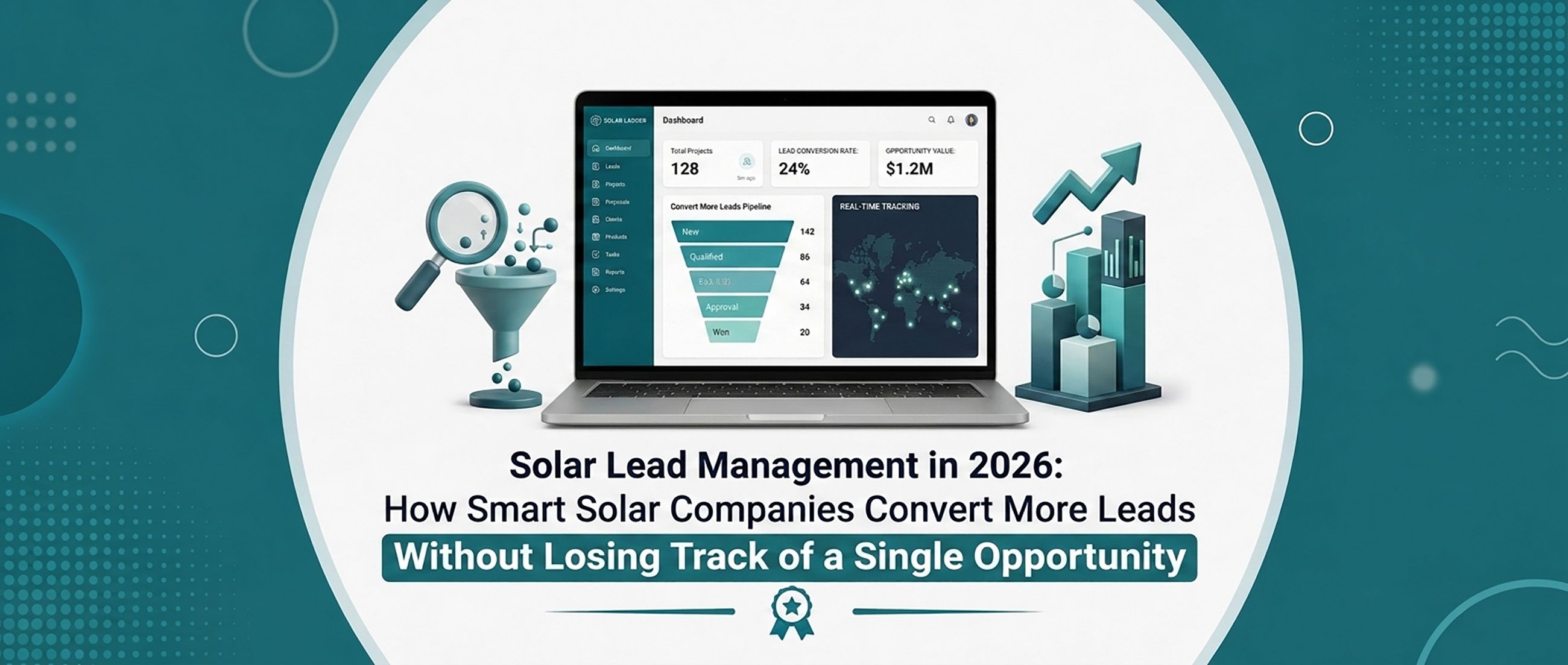
Solar Lead Management in 2026: How Smart Solar Companies Convert More Leads Without Losing Track of a Single Opportunity
Every Solar EPC company wants more leads.
They invest in Google Ads, Meta Ads, exhibitions, referrals, WhatsApp campaigns, and website marketing to generate enquiries.
But generating leads isn't the problem anymore.
Managing them effectively is.
Many solar businesses lose potential customers—not because their pricing is too high or their product isn't good enough—but because follow-ups are delayed, customer information is scattered, or leads simply fall through the cracks.
In a competitive market where customers often compare multiple installers, responding quickly and staying organized can be the difference between winning and losing a project.
This is why Solar Lead Management Software has become one of the most important tools for Solar EPC companies in 2026.
What Is Solar Lead Management Software?
Solar Lead Management Software is a specialized platform that helps Solar EPC companies capture, organize, track, and convert leads throughout the entire sales journey.
Unlike generic CRMs, it is designed specifically for solar businesses and integrates seamlessly with proposal generation, project management, and customer support workflows.
A dedicated lead management platform enables businesses to:
- Capture leads from multiple sources
- Assign leads to sales representatives
- Track every customer interaction
- Schedule follow-ups
- Monitor deal progress
- Generate proposals
- Convert leads into active projects
Instead of relying on spreadsheets and memory, every opportunity is tracked in one centralized system.
Why Solar Companies Lose Leads
Most lost opportunities aren't caused by competitors.
They're caused by poor processes.
Here are some common reasons Solar EPC companies lose leads:
1. Delayed Follow-ups
Studies consistently show that contacting a lead quickly increases the likelihood of conversion.
Yet many companies wait hours—or even days—before reaching out.
By then, the customer has often moved on.
2. Leads Stored in Multiple Places
Website enquiries.
WhatsApp messages.
Google Ads.
Meta Ads.
Phone calls.
Referral contacts.
When leads are scattered across different platforms, it's easy for opportunities to be forgotten.
3. No Clear Ownership
If multiple salespeople have access to the same lead without clear ownership, nobody feels responsible for following up.
The result?
Missed calls.
Duplicate conversations.
Poor customer experience.
4. No Visibility for Managers
Managers often struggle to answer questions like:
- Which salesperson has the most leads?
- How many follow-ups are overdue?
- Which marketing channel generates the best leads?
- What is our current conversion rate?
Without proper reporting, improving sales performance becomes difficult.
Why Lead Management Matters More Than Ever in 2026
The solar industry is becoming increasingly competitive.
Customers expect faster responses, personalized proposals, and professional communication.
At the same time, Solar EPC companies are generating more leads than ever through digital marketing.
Managing this growing volume manually is no longer practical.
Dedicated Solar Lead Management Software helps businesses:
- Respond faster
- Improve customer experience
- Increase sales productivity
- Reduce missed opportunities
- Convert more enquiries into installations
Companies that organize their sales process consistently outperform those relying on manual systems.
1. Centralized Lead Capture
The first feature every Solar EPC should look for is centralized lead capture.
Your software should automatically collect leads from:
- Website forms
- Google Ads
- Meta Ads
- Phone enquiries
- Referrals
- Exhibitions
- Channel partners
Instead of checking multiple platforms throughout the day, your team can access every enquiry from one dashboard.
No lead gets overlooked.
2. Automatic Lead Assignment
As businesses grow, manually distributing leads becomes inefficient.
Solar Lead Management Software should automatically assign enquiries based on predefined rules such as:
- Salesperson
- Location
- Product category
- Team
- Lead source
Automatic assignment ensures every lead is followed up quickly while maintaining accountability.
3. Follow-up Reminders
One of the biggest reasons solar companies lose deals is simple:
They forget to follow up.
A good lead management platform automatically reminds sales teams about:
- Scheduled calls
- Site visits
- Proposal discussions
- Customer callbacks
- Pending quotations
This ensures every opportunity receives the attention it deserves.
4. Lead Source Tracking
Not all marketing channels deliver the same quality of leads.
Your software should track exactly where every enquiry originated.
This allows management to understand which channels generate the highest return on investment.
For example:
- Google Ads
- Organic Search
- Meta Ads
- WhatsApp Campaigns
- Referrals
- Exhibitions
By identifying your best-performing channels, you can optimize marketing budgets and improve lead quality.
5. Sales Pipeline Management
Every lead is at a different stage of the buying journey.
Some are new enquiries.
Others have received proposals.
Some are waiting for site surveys.
Others are ready to close.
A visual sales pipeline helps your team understand where every opportunity stands, prioritize follow-ups, and forecast future revenue more accurately.
Instead of guessing which deals are likely to close, managers gain complete visibility into the sales funnel.
6. CRM Built for Solar Sales
Lead management doesn't stop after the first call.
As prospects move through your sales funnel, your team needs a complete view of every interaction—from the initial enquiry to project completion.
A solar-specific CRM helps sales teams:
- Store customer information in one place
- Record every call, email, and WhatsApp conversation
- Schedule follow-ups
- Track proposal status
- Manage deal stages
- Collaborate with other departments
Unlike generic CRMs, a solar CRM understands the unique sales process of Solar EPC companies.
With Solar Ladder's CRM, every customer interaction is recorded automatically, ensuring no information is lost and every salesperson has the context they need to close deals faster.
7. Instant Proposal & 3D Design Integration
Customers don't want to wait days for a quotation.
The faster you respond, the higher your chances of winning the project.
The best Solar Lead Management Software connects directly with proposal generation and 3D solar design.
With Solar Ladder, sales teams can:
- Generate professional proposals in minutes
- Create accurate rooftop 3D designs
- Include ROI and savings calculations
- Add technical specifications
- Customize branding
- Share proposals instantly
This reduces turnaround time and leaves a strong first impression.
8. Complete Customer Timeline
Every lead tells a story.
Your software should provide a complete timeline showing:
- First enquiry
- Follow-up calls
- Site survey
- Proposal sent
- Customer feedback
- Negotiation
- Project approval
Having this information in one place helps sales representatives provide a more personalized experience while ensuring managers can review every interaction when needed.
9. Reports & Sales Analytics
You can't improve what you don't measure.
A robust Solar Lead Management platform should provide insights into:
- Lead response time
- Conversion rate
- Proposal success rate
- Salesperson performance
- Lead source performance
- Revenue pipeline
- Lost opportunity analysis
These reports help identify bottlenecks, improve coaching, and make smarter business decisions.
Instead of relying on assumptions, managers gain real-time visibility into sales performance.
10. One-Click Lead-to-Project Conversion
The sales process doesn't end when a customer says "yes."
Once a deal is won, all customer information should flow directly into project execution.
Without integration, businesses often re-enter the same information into multiple systems.
This wastes time and increases the risk of errors.
Solar Ladder allows approved leads to be converted into active projects with a single click, ensuring seamless collaboration between sales, engineering, procurement, and installation teams.
Why Solar Ladder Is Built for Smart Solar Sales Teams
Solar Ladder isn't just another CRM.
It's an end-to-end platform built specifically for Solar EPC companies.
Instead of using separate tools for sales, proposals, project management, and after-sales service, Solar Ladder connects every stage of the customer journey.
🎯 Lead Management
Capture enquiries from websites, Google Ads, Meta Ads, WhatsApp, referrals, exhibitions, and channel partners in one centralized dashboard.
👥 CRM
Track customer interactions, manage follow-ups, organize sales pipelines, and monitor team performance with a CRM built specifically for solar businesses.
☀️ 3D Solar Design (Laptop & Mobile)
Create accurate rooftop layouts and professional 3D system designs during site visits or from the office.
📄 Instant Proposals
Generate branded proposals with 3D designs, energy generation estimates, ROI calculations, financing options, and technical specifications within minutes.
📋 Project Management
Convert approved leads into projects instantly and manage surveys, procurement, installation, documentation, and commissioning from one dashboard.
📡 Remote Monitoring System (RMS)
Continue supporting customers after installation by remotely monitoring plant performance and proactively identifying system issues.
🔧 Operations & Maintenance (O&M)
Manage service requests, preventive maintenance, warranty tracking, technician scheduling, and Annual Maintenance Contracts (AMCs) from the same platform.
By integrating every department, Solar Ladder eliminates duplicate work, improves collaboration, and ensures every customer enjoys a seamless experience.
Conclusion
Generating leads is only the first step toward growing your solar business.
The real opportunity lies in how effectively those leads are managed.
Without a structured lead management process, even the best marketing campaigns can fail because of missed follow-ups, delayed responses, and poor visibility.
Investing in dedicated Solar Lead Management Software enables Solar EPC companies to respond faster, organize their sales process, improve conversion rates, and scale confidently.
As the solar market becomes more competitive in 2026, companies that combine strong marketing with efficient lead management will consistently outperform those relying on spreadsheets and manual tracking.
With Solar Ladder, every enquiry is captured, every follow-up is tracked, and every opportunity moves seamlessly from lead to installation.
Frequently Asked Questions
Solar Lead Management Software helps Solar EPC companies capture, organize, track, and convert customer enquiries while ensuring no lead is missed.
Effective lead management improves response times, increases follow-up consistency, enhances customer experience, and ultimately boosts conversion rates.
Solar Lead Management Software is built specifically for the solar industry. It integrates lead tracking with proposal generation, 3D design, project management, and installation workflows.
Look for centralized lead capture, automatic lead assignment, CRM integration, follow-up reminders, proposal generation, reporting, sales pipeline management, and lead-to-project conversion.