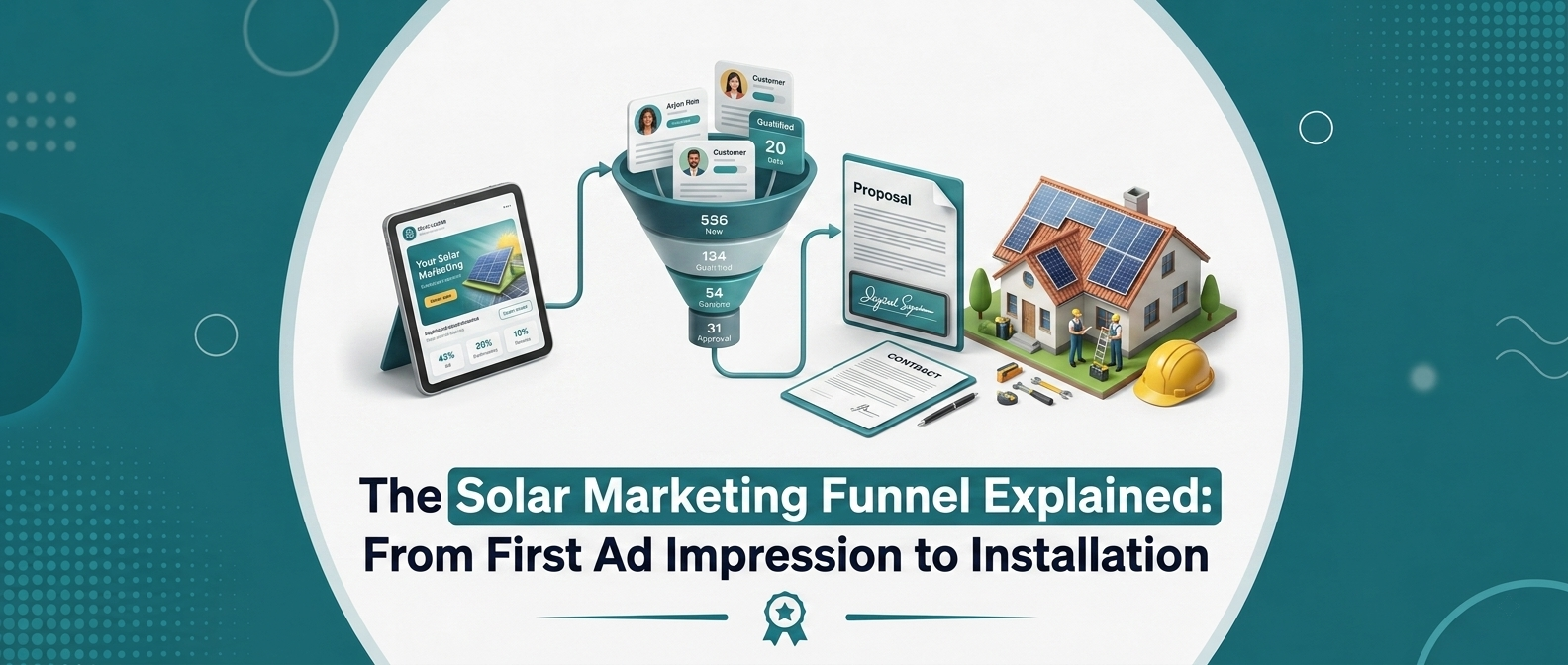
TL;DR A solar marketing funnel maps the customer's journey from discovering a Solar EPC through an advertisement or search result to becoming a qualified lead, receiving a site survey and proposal, signing a contract, and completing installation. A strong funnel connects marketing, CRM, sales, proposals, follow-ups, and project execution so that leads don't get lost between stages.
The Solar Marketing Funnel Explained: From First Ad Impression to Installation
Getting solar leads is only the beginning.
A customer may see your Google or Meta advertisement today, visit your website tomorrow, request a quotation next week, speak to a salesperson a few days later, and finally make a purchase weeks or even months after the first interaction.
That entire journey is your solar marketing funnel.
For Solar EPC companies, understanding this funnel is critical because generating more leads does not automatically mean generating more sales.
If leads are not contacted quickly, proposals are delayed, follow-ups are missed, or customers don't understand the value of the solution, potential projects can disappear.
A well-designed solar marketing funnel connects every stage—from the first advertisement to installation and after-sales service.
What Is a Solar Marketing Funnel?
A solar marketing funnel is a structured customer journey that shows how a potential customer moves from:
Awareness → Interest → Lead → Qualification → Site Survey → Proposal → Follow-up → Sale → Installation → O&M
Each stage has a different purpose.
Marketing generates awareness and demand.
Sales converts interest into opportunities.
CRM keeps customer information and activities organized.
Proposals communicate the value of the solar system.
Project management helps turn signed contracts into completed installations.
O&M helps maintain the customer relationship after installation.
Stage 1: Awareness — Getting in Front of Potential Customers
The first stage is getting your Solar EPC brand noticed.
Potential customers may discover your company through:
- Google Search
- Google Ads
- Meta Ads
- YouTube
- IndiaMART
- Referrals
- Local SEO
- Google Business Profile
- Solar exhibitions
- Webinars
- Content marketing
At this stage, the customer may not be ready to buy.
They may simply be researching:
"How much does a 5 kW solar system cost?"
or:
"Is rooftop solar worth it?"
or:
"Best solar company near me"
Your objective is to create awareness and move the right people toward the next stage.
For Solar EPCs investing in organic search, Google's SEO Starter Guide (https://developers.google.com/search/docs/fundamentals/seo-starter-guide) provides useful guidance on creating content that can be discovered through search.
Stage 2: Interest — Turning Attention Into Engagement
Once someone discovers your business, you need to give them a reason to engage.
This could be:
- A solar savings calculator
- Free site survey
- Free consultation
- Solar quotation
- Subsidy information
- Educational guide
- WhatsApp consultation
- Project case study
- ROI calculator
For example, a Google advertisement might say:
"Calculate Your Rooftop Solar Savings — Get a Free Solar Proposal."
The customer clicks the advertisement and reaches your landing page.
The goal is to turn that visit into an identifiable lead.
Stage 3: Lead Generation — Capturing Customer Information
A marketing funnel becomes measurable when a visitor becomes a lead.
A lead form may capture:
- Name
- Phone number
- Location
- Property type
- Monthly electricity bill
- Required system size
- Preferred contact method
However, don't ask for unnecessary information.
Every additional field can create friction.
The objective is to collect enough information for your sales team to qualify and contact the prospect effectively.
Stage 4: Lead Qualification — Identifying Real Opportunities
Not every lead is ready to buy.
Some may be:
- Just researching
- Outside your service area
- Looking for a very small system
- Comparing multiple installers
- Interested in the future
- Ready to purchase immediately
This is where lead qualification becomes important.
Your sales team can evaluate:
Need: Does the customer actually need solar?
Budget: Is the project financially feasible?
Timeline: When do they plan to install?
Property: Is the site suitable?
Decision-maker: Is the person speaking to you involved in the purchase?
Location: Can your EPC service the project?
A CRM can help sales teams record these details and prioritize opportunities.
Stage 5: First Contact — Speed Matters
Once a lead enters the funnel, speed becomes extremely important.
Imagine two EPC companies receive the same lead.
EPC A: Calls after two days.
EPC B: Calls within minutes.
The second company has an opportunity to start the conversation while the customer's interest is still high.
Your lead-management system should therefore make it easy to:
- Assign leads
- Notify salespeople
- Record calls
- Schedule follow-ups
- Track response status
- Identify uncontacted leads
Solar Ladder's guide to responding to solar leads within 5 minutes (https://solarladder.com/blog/post/why-speed-matters-responding-to-solar-leads-within-5-minutes) explains why faster response can be an important part of a high-performing solar sales process.
Stage 6: Site Survey — Turning a Lead Into a Project Opportunity
Once the customer is qualified, the next step is usually a site assessment.
The EPC may evaluate:
- Roof dimensions
- Roof type
- Orientation
- Tilt
- Shading
- Structural conditions
- Electrical infrastructure
- Available installation area
This information becomes the foundation for the solar design.
A strong site-survey process reduces the risk of discovering major design issues later.
Stage 7: Solar Design — Showing the Customer What They Are Buying
Technical information alone can be difficult for customers to understand.
A 3D solar design changes the conversation.
Instead of saying:
"We recommend 12 panels on your rooftop."
you can show the customer:
- Where the panels will go
- How the rooftop will look
- How much roof space is used
- Potential shading
- Panel arrangement
Solar Ladder's Solar 3D Design Software guide (https://solarladder.com/blog/post/solar-3d-design-software-create-client-ready-designs-in-2-minutes) explains how client-ready 3D designs can be created as part of the solar sales process.
This makes the solution easier to visualize and can help reduce customer objections.
Stage 8: Proposal — Turning Technical Information Into a Buying Decision
The proposal is one of the most important stages in the solar marketing funnel.
It should answer:
What am I buying?
How much will it cost?
How much electricity will it generate?
How much money can I save?
When will I recover my investment?
What equipment will be installed?
What happens after I approve the project?
A strong solar proposal can include:
- Customer information
- 3D design
- System capacity
- Generation estimate
- Electricity savings
- ROI
- Payback period
- Equipment details
- Warranty
- Installation timeline
- Financing options
- Company information
- Clear CTA
Solar Ladder's guide on what a solar proposal is and how to create one (https://solarladder.com/blog/post/what-is-a-solar-proposal-how-to-create-one) covers the key components of a professional solar proposal.
Stage 9: Follow-Up — Where Many Solar Leads Are Lost
Sending a proposal is not the end of the sales process.
It is often the beginning of the most important follow-up period.
Customers may need time to:
- Discuss with family
- Compare quotations
- Arrange financing
- Speak with management
- Understand the ROI
- Review equipment options
The problem is that many EPCs manage follow-ups manually through WhatsApp, spreadsheets, or memory.
That creates gaps.
A structured CRM can automatically remind salespeople when follow-up is due.
Solar Ladder's solar CRM automation guide (https://solarladder.com/blog/post/solar-crm-automation-save-10-hours-every-week) explains how automation can reduce repetitive sales work and help teams maintain consistent follow-up.
Stage 10: Conversion — Turning the Opportunity Into a Customer
The customer is now ready to make a decision.
The conversion stage may involve:
- Final negotiation
- System confirmation
- Financing
- Contract
- Advance payment
- Documentation
- Installation scheduling
At this stage, a smooth process matters.
If the customer has to repeat information multiple times or wait unnecessarily, the experience can become frustrating.
A connected CRM and project-management system can make the transition from sales to execution much smoother.
Stage 11: Installation — Marketing Doesn't End With the Sale
A common mistake is to think that the marketing funnel ends when the customer signs the contract.
It doesn't.
The installation experience directly affects:
- Reviews
- Referrals
- Repeat business
- Customer satisfaction
- AMC opportunities
- Brand reputation
Customers want to know:
- When will installation begin?
- Who is handling the project?
- What happens next?
- When will the system be commissioned?
Keeping customers informed throughout the project creates a better experience.
Stage 12: O&M — Turning Customers Into Long-Term Relationships
After installation, the relationship continues.
Solar EPCs can offer:
- Remote monitoring
- Generation reports
- Maintenance
- AMC
- Performance alerts
- Service support
This creates opportunities for recurring revenue.
It can also create another source of leads.
A satisfied customer may refer:
- Family members
- Neighbours
- Business partners
- Friends
- Other companies
This creates a powerful loop:
Great experience → Happy customer → Referral → New lead
The Solar Marketing Funnel Is Really a Flywheel
The traditional funnel ends with a sale.
A modern Solar EPC should think beyond that.
The journey becomes:
Advertisement
↓
Lead
↓
Sales
↓
Proposal
↓
Installation
↓
Great Customer Experience
↓
Review + Referral
↓
New Lead
This turns customer satisfaction into a marketing channel.
How to Measure Your Solar Marketing Funnel
Solar EPC owners should track the funnel stage by stage.
Important metrics include:
Marketing Metrics
- Impressions
- Click-through rate
- Cost per click
- Website traffic
- Cost per lead
Lead Metrics
- Leads generated
- Lead-to-contact rate
- Qualified leads
- Cost per qualified lead
Sales Metrics
- Site surveys completed
- Proposals sent
- Proposal-to-sale conversion
- Average sales cycle
- Follow-up rate
Revenue Metrics
- Deals won
- Average project value
- Revenue by channel
- Customer acquisition cost
- Marketing ROI
Customer Metrics
- Installation completion
- Customer satisfaction
- Reviews
- Referrals
- AMC conversion
The most important metric isn't necessarily the cheapest lead.
It is the cost of acquiring a customer who actually installs solar.
How CRM Connects the Solar Marketing Funnel
A CRM acts as the central system connecting marketing and sales.
Instead of having:
Google Ads → Spreadsheet
Meta Ads → WhatsApp
IndiaMART → Salesperson's phone
Referrals → Another spreadsheet
you can create one centralized customer journey.
A CRM can track:
Lead Source → Lead → Contact → Qualification → Site Survey → Proposal → Follow-up → Deal → Installation
This makes it easier to understand which marketing channels actually generate revenue.
How Solar Ladder Supports the Complete Funnel
Solar Ladder is designed to connect multiple stages of the solar customer journey.
Lead Management
Capture and organize leads while tracking their sales stage and activities.
CRM Automation
Automate reminders and workflows so salespeople don't forget follow-ups.
3D Solar Design
Create visual rooftop designs that make the proposed solution easier to understand.
Instant Proposals
Create professional proposals with system information, generation, savings, ROI, and design.
Project Management
Move sold projects from sales into structured installation workflows.
RMS
Monitor system performance after installation.
O&M
Manage service, maintenance, alerts, and long-term customer relationships.
This creates a connected journey:
Lead → CRM → Design → Proposal → Sale → Project → RMS → O&M
Common Solar Marketing Funnel Mistakes
1. Focusing Only on Lead Volume
100 cheap leads are not necessarily better than 20 qualified leads.
Track revenue and installations by lead source.
2. Slow Lead Response
If your team takes too long to respond, the prospect may already be talking to another EPC.
3. Poor Lead Tracking
If leads are spread across WhatsApp, Excel, email, and individual phones, managers lose visibility.
4. Generic Proposals
A proposal should reflect the customer's specific property, energy consumption, system design, and financial goals.
5. No Follow-Up System
Salespeople should not have to remember every follow-up manually.
6. Marketing and Sales Work Separately
Marketing should know which leads become customers, while sales should know which campaigns generate high-quality opportunities.
7. Ignoring Existing Customers
Your installed customer base can become one of your strongest sources of referrals and recurring revenue.
How to Build a Better Solar Marketing Funnel
A high-performing funnel should follow these principles:
Make Every Stage Measurable
Know how many customers move from one stage to the next.
Respond Quickly
Set clear lead-response SLAs for your sales team.
Personalize Communication
Use customer-specific information instead of generic messages.
Automate Repetitive Tasks
Automate reminders, notifications, and routine workflows.
Visualize the Solution
Use 3D solar designs to make technical information easier to understand.
Create Better Proposals
Show customers the financial and practical value of the system.
Follow Up Consistently
Create a defined follow-up sequence rather than relying on memory.
Connect Sales and Project Execution
Make sure information doesn't get lost after the deal is won.
Build the Referral Loop
Ask satisfied customers for reviews and referrals.
Conclusion
A successful solar business needs more than advertisements.
It needs a connected marketing and sales funnel.
The journey begins when a customer sees your advertisement or discovers your website. It continues through lead capture, qualification, site survey, 3D design, proposal, follow-up, contract, installation, and O&M.
Every stage creates an opportunity to either build trust or lose the customer.
For Solar EPC companies, the goal should be to create a system where no lead is forgotten, every customer receives timely communication, proposals are personalized, and sales teams have complete visibility into their pipeline.
Solar Ladder brings CRM, Lead Management, 3D Solar Design, Instant Proposals, Workflow Automation, Project Management, RMS, and O&M together to help EPCs manage this journey from one platform.
The result is not simply a better marketing funnel.
It is a more predictable path from ad impression to installed solar system.
Frequently Asked Questions
A solar marketing funnel is the customer journey from discovering a Solar EPC through advertising, search, referrals, or other channels to becoming a lead, receiving a proposal, purchasing a solar system, and eventually becoming an O&M or referral customer.
The main stages are awareness, interest, lead generation, qualification, site survey, solar design, proposal, follow-up, conversion, installation, and O&M.
EPCs can use Google Ads, Meta Ads, SEO, Google Business Profile, referrals, content marketing, exhibitions, webinars, and partnerships while continuously measuring which channels produce actual installations.
Solar Ladder connects Lead Management, CRM, 3D Solar Design, proposals, workflow automation, project management, RMS, and O&M, helping EPCs manage the customer journey from lead through installation and beyond.
The proposal converts technical information into a clear buying decision by explaining system design, generation, savings, ROI, pricing, equipment, warranties, and next steps.