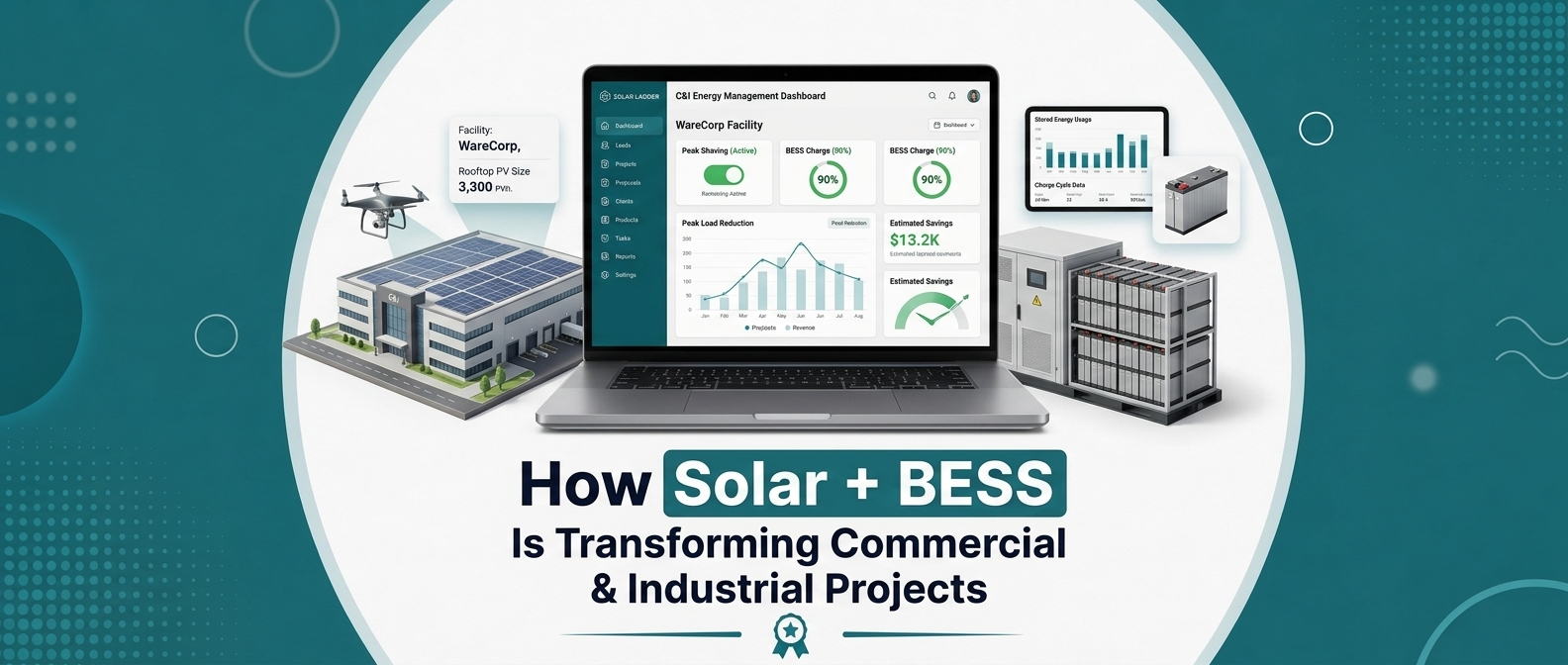
TL;DR Solar + BESS combines solar PV with a Battery Energy Storage System to help commercial and industrial consumers use more of their solar energy when they need it most. Instead of relying only on daytime solar generation, businesses can store excess energy and discharge it during peak-demand periods, while also gaining backup power and greater energy flexibility. As battery deployment accelerates globally and India expands its energy-storage ecosystem, Solar + BESS is becoming an important opportunity for C&I customers and Solar EPC companies.
How Solar + BESS Is Transforming Commercial & Industrial Projects
For years, commercial and industrial businesses evaluated solar primarily through one question:
"How much can solar reduce my electricity bill?"
That question is still important.
But the conversation is changing.
Businesses now increasingly care about when electricity is generated, when it is consumed, how much power they draw from the grid, and what happens when the grid goes down.
This is where Solar + BESS comes in.
A Solar + BESS system combines solar photovoltaic generation with a Battery Energy Storage System (BESS). Solar produces electricity during the day, while the battery stores energy that can be used later.
The International Energy Agency identifies battery storage as one of the fastest-growing power technologies, with behind-the-meter batteries increasingly being deployed for businesses as battery economics improve.
For Indian C&I businesses, this creates a new opportunity: solar is no longer only about generating cheap electricity—it can become part of a broader energy-management strategy.
What Is Solar + BESS?
A Solar + BESS system typically consists of:
- Solar PV modules
- Solar inverter
- Battery modules
- Battery Management System (BMS)
- Bidirectional or hybrid inverter
- Energy management system
- Monitoring and control equipment
The basic concept is simple:
Solar generates → Battery stores → Business consumes when needed
During periods of strong solar production, excess energy can charge the battery. Later, the stored energy can be discharged to support the facility's load.
The exact configuration depends on the customer's load profile, tariff structure, grid connection, backup requirements, solar generation profile, and project economics.
Why C&I Businesses Are Interested in BESS
Commercial and industrial electricity consumption often extends beyond peak solar-generation hours.
Factories may operate multiple shifts.
Warehouses may have evening operations.
Hotels and commercial buildings can continue consuming electricity after sunset.
Data centres and critical facilities may require highly reliable power.
This creates a mismatch:
Solar generation: strongest during the day
Business demand: may continue into evening and night
BESS helps bridge this gap by shifting electricity from one time period to another.
1. Solar Energy Shifting
One of the biggest advantages of BESS is energy shifting.
Imagine a factory produces more solar power than it needs at 1 PM.
Instead of allowing all surplus energy to be exported, a battery can store part of that electricity.
At 7 PM, when solar production has dropped, the battery can discharge energy to support the facility.
This allows businesses to make greater use of the energy generated by their own solar plant.
The International Renewable Energy Agency's 2026 analysis specifically highlights the changing economics of combining renewable generation with battery storage to deliver electricity when it is needed.
2. Peak Shaving
For many C&I consumers, electricity costs are not determined only by total units consumed.
Demand and time-of-use charges can also influence the electricity bill, depending on the applicable tariff structure.
BESS can discharge during high-cost or high-demand periods to reduce grid dependence.
This is known as peak shaving.
For example:
Without BESS
High facility demand → Higher grid draw → Higher potential demand-related costs
With BESS
High facility demand → Battery supports load → Lower grid draw
The financial benefit depends on the customer's tariff and load profile, so EPCs should model the actual site rather than assume a fixed saving.
3. Better Solar Utilisation
A solar plant may produce more electricity than the facility can consume at certain times.
BESS gives businesses another option.
Instead of immediately exporting surplus electricity, the system can store some of it for later use, subject to system design and applicable regulations.
This can increase the value of solar generation for businesses with significant evening consumption.
4. Backup Power for Critical Loads
Solar + BESS can also improve energy resilience.
A properly designed system can provide backup power to selected loads during grid interruptions.
This can be valuable for:
- Manufacturing units
- Hospitals
- Warehouses
- Data centres
- Hotels
- Retail facilities
- Cold-storage facilities
- Offices
- Critical infrastructure
The battery does not necessarily need to power the entire facility.
A more economical approach may be to identify critical loads and design the backup system around them.
5. Reducing Dependence on Diesel Generators
Many commercial and industrial facilities maintain diesel generators as backup.
A BESS can potentially reduce generator runtime for suitable applications.
For example, during a short outage, the battery can immediately support critical loads.
For longer outages, the system may be configured alongside other backup sources depending on the project's electrical architecture.
This can reduce:
- Diesel consumption
- Generator operating hours
- Noise
- Local emissions
- Maintenance requirements
However, BESS should be designed as part of the site's complete backup strategy rather than treated as a universal replacement for generators.
6. Improved Energy Resilience
Energy reliability has become increasingly important for businesses.
An unexpected outage can result in:
- Production losses
- Equipment downtime
- Spoiled inventory
- Missed orders
- Data loss
- Customer-service disruptions
BESS can provide fast-response energy support and, when properly integrated, improve the resilience of critical operations.
The IEA notes that batteries can provide short-duration flexibility and backup capability during outages or emergencies.
7. Better Use of Time-of-Day Tariffs
Time-of-Day tariffs create different electricity costs across different periods.
This creates an opportunity for energy storage.
A simplified operating strategy could be:
Low-cost / high-solar period → Charge battery
High-cost period → Discharge battery
Grid outage → Support critical loads
The actual strategy should be based on the customer's tariff, load profile, battery efficiency, degradation assumptions, and operating constraints.
This is why BESS sizing should be based on data—not simply on the size of the solar plant.
8. Solar + BESS Can Improve Project Economics
The economics of C&I Solar + BESS are different from conventional rooftop solar.
A Solar EPC should evaluate:
- Solar system cost
- Battery cost
- Inverter cost
- Battery efficiency
- Depth of discharge
- Cycle life
- Degradation
- O&M
- Tariff structure
- Demand charges
- Export compensation
- Backup requirements
- Financing cost
- Expected energy savings
The right question is not:
"How big a battery can we install?"
It is:
"What battery size creates the best economic and operational value for this customer?"
9. BESS Creates a New Opportunity for Solar EPC Companies
For Solar EPC companies, BESS is more than another product category.
It creates an opportunity to move from being a solar installer to becoming an energy solutions provider.
Instead of selling:
"Install 500 kW of solar."
The conversation becomes:
"Let's optimise your energy consumption, reduce peak grid dependence, improve solar utilisation, and provide backup for critical operations."
This can increase project value while creating opportunities for recurring monitoring and O&M services.
How Should EPCs Size a Solar + BESS System?
Battery sizing should begin with the customer's energy data.
Step 1: Analyse the Load Profile
Understand:
- Hourly electricity consumption
- Peak demand
- Operating hours
- Weekend usage
- Seasonal variations
- Critical loads
Step 2: Analyse Solar Generation
Estimate:
- Annual generation
- Hourly generation
- Solar surplus
- Self-consumption
- Export potential
Step 3: Analyse the Tariff
Review:
- Energy charges
- Demand charges
- Time-of-Day rates
- Export compensation
- Applicable surcharges
Step 4: Model Battery Economics
Consider:
- Battery capacity
- Power rating
- Round-trip efficiency
- Depth of discharge
- Cycle life
- Degradation
- Replacement assumptions
- O&M costs
Step 5: Compare Scenarios
An EPC should ideally compare:
Solar only
vs.
Solar + BESS
vs.
Solar + BESS + backup strategy
This makes the proposal more transparent and helps the customer understand why storage is being recommended.
What India's Energy Storage Push Means for C&I Solar
India's energy-storage ecosystem is expanding through policy support and market development.
The Ministry of New and Renewable Energy maintains a dedicated collection of Energy Storage Systems policies and guidelines (https://mnre.gov.in/en/document-category/ess_policies_and_guidelines/), including guidelines related to BESS viability-gap funding, transmission-charge waivers, and co-location of storage with renewable projects.
The policy direction is also increasingly focused on integrating storage with renewable generation. MNRE lists an advisory on co-locating Energy Storage Systems with Solar Power Projects to enhance grid stability and cost efficiency.
For C&I businesses, this means storage should increasingly be considered as part of the long-term energy strategy rather than simply as an expensive backup battery.
Solar + BESS: What Customers Should Ask Their EPC
Before investing, C&I customers should ask:
How much energy will the battery actually shift?
Don't focus only on battery capacity. Ask how many usable kWh will be delivered under the proposed operating strategy.
What is the expected payback?
The EPC should show assumptions clearly.
What happens when the battery degrades?
Understand expected degradation and replacement assumptions.
Which loads will receive backup power?
Define critical loads before designing the backup architecture.
What happens during a grid outage?
Understand the system's transition time, backup duration, and operating limitations.
How will the battery be monitored?
Remote monitoring can help identify abnormal behaviour and performance issues.
How Solar Ladder Helps EPCs Sell and Manage Solar + BESS
Solar + BESS projects require more than a quotation.
EPC teams need to manage design, customer communication, proposals, project execution, monitoring, and O&M.
Solar Ladder brings these workflows together.
☀️ 3D Solar Design
Solar EPC teams can create professional rooftop designs across laptop and mobile workflows.
This helps customers visualise where solar modules and associated infrastructure will be installed.
📊 BESS Modelling
Solar Ladder's BESS-focused design workflow can help EPC teams evaluate storage scenarios alongside solar generation and customer consumption.
The objective is to avoid simply oversizing the battery and instead build a system around the customer's operating profile.
For a deeper explanation, see Solar Ladder's BESS guide for rooftop solar (https://solarladder.com/blog/post/what-is-bess-importance-rooftop-solar-2026-guide), which covers battery components, energy shifting, peak shaving, and BESS design considerations.
📄 Instant Proposals
Create proposals that explain:
- Solar capacity
- Battery capacity
- Expected generation
- Energy savings
- ROI
- Payback
- System specifications
This makes a complex Solar + BESS project easier for business owners to understand.
For more on C&I project economics, read Solar Ladder's guide to calculating solar ROI for Indian EPCs (https://solarladder.com/blog/post/calculate-solar-roi-guide-india-2026).
👥 CRM & Lead Management
Track C&I opportunities, customer conversations, follow-ups, and proposal stages in one system.
📋 Project Management
Once the project is sold, teams can manage installation activities, documentation, milestones, and handovers.
Solar Ladder's guide to managing multiple solar projects from one dashboard (https://solarladder.com/blog/post/how-to-manage-multiple-solar-projects-from-one-dashboard) explains how centralized project visibility helps growing EPC companies manage increasing project volumes.
📡 RMS & O&M
After commissioning, monitoring and maintenance become important parts of the customer relationship.
RMS and O&M workflows can help EPC companies track system performance, alerts, service requests, and maintenance activities.
Common Mistakes When Selling Solar + BESS
1. Sizing the battery only based on solar capacity
A 500 kW solar plant does not automatically require a particular battery size.
Battery sizing must consider the load profile and intended application.
2. Ignoring battery degradation
The usable capacity changes over the battery's life.
Financial models should account for this.
3. Promising unrealistic backup duration
Backup duration depends on actual load.
A battery that supports 100 kW for several hours will not necessarily support a 500 kW load for the same period.
4. Ignoring the tariff structure
A BESS business case depends heavily on when the customer consumes electricity and what they pay for it.
5. Treating BESS as simply a larger solar project
Storage introduces additional electrical, thermal, safety, controls, and O&M considerations.
It requires specialist system design and commissioning.
The Future of C&I Solar Is Solar + Storage
The traditional solar model was straightforward:
Generate electricity during the day → consume it or export it.
The emerging model is more flexible:
Generate → Store → Shift → Consume → Monitor → Optimise
That shift matters because businesses don't consume electricity only when the sun is shining.
As battery costs, technology, and deployment continue to evolve, Solar + BESS can give C&I customers greater control over when and how they use electricity.
The IEA's 2026 analysis reports that global battery-storage deployment reached 108 GW of new capacity in 2025, up 40% from 2024, with behind-the-meter storage continuing to form part of the market.
This is not simply a utility-scale trend.
It is increasingly relevant to commercial and industrial energy consumers.
Conclusion
Solar helped businesses generate cheaper and cleaner electricity.
BESS adds another layer: control over when that electricity is used.
For C&I customers, Solar + BESS can potentially improve solar utilisation, reduce peak grid dependence, support critical loads, reduce diesel-generator usage, and create greater energy resilience.
For Solar EPC companies, it represents a major opportunity to expand beyond traditional solar installation and become a broader energy-management partner.
The winning EPCs will not simply sell panels and batteries.
They will analyse the customer's load, understand the tariff, model different scenarios, explain the economics clearly, and manage the project throughout its lifecycle.
With Solar Ladder, EPCs can connect 3D Solar Design, BESS modelling, Instant Proposals, CRM, Lead Management, Project Management, RMS, and O&M in one solar-business workflow.
Frequently Asked Questions
Solar + BESS combines a solar PV system with a Battery Energy Storage System. Solar generates electricity while the battery stores energy for later use.
BESS can help C&I businesses shift solar energy to later periods, reduce peak grid dependence, provide backup for selected loads, and improve energy resilience.
Not necessarily. BESS can reduce generator runtime or support critical loads during short outages, but the right backup architecture depends on the facility's requirements.
Sizing should consider the facility's hourly load profile, solar generation, tariff structure, peak demand, required backup duration, battery efficiency, degradation, and intended operating strategy.
Solar Ladder combines solar design, BESS modelling, proposals, CRM, project management, RMS, and O&M workflows to help EPC companies manage the Solar + BESS customer journey from sales through long-term service.