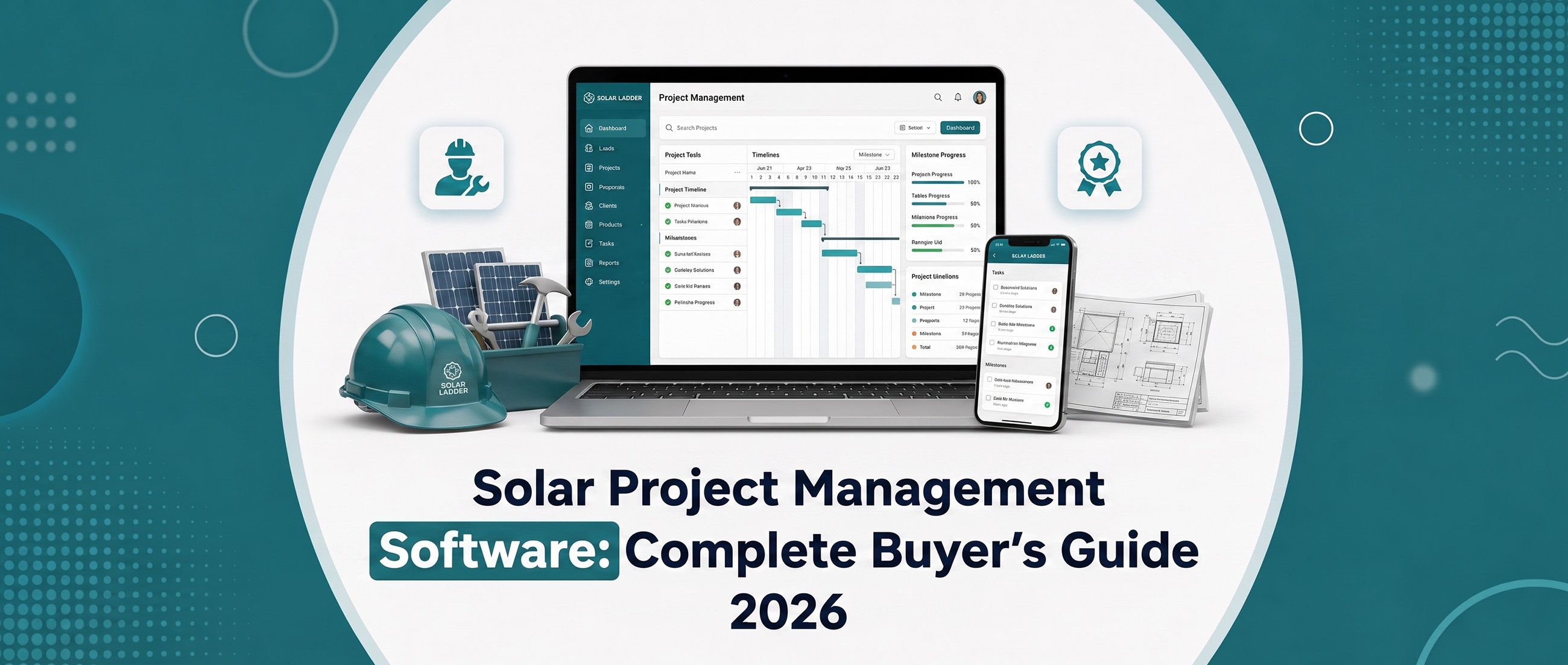
TL;DR As Solar EPC businesses grow, managing projects through spreadsheets, WhatsApp, and disconnected tools becomes inefficient. Solar Project Management Software centralizes project planning, task management, documentation, team collaboration, and installation tracking into one platform. This buyer's guide explains what to look for in a solution, the must-have features in 2026, and why more Solar EPC companies are choosing purpose-built software like Solar Ladder.
Solar Project Management Software: Complete Buyer's Guide (2026)
The Indian solar industry is experiencing unprecedented growth.
Government initiatives such as the PM Surya Ghar: Muft Bijli Yojana, rising electricity prices, and increased awareness of renewable energy are driving demand across residential, commercial, and industrial segments.
For Solar EPC companies, this growth presents both opportunity and challenge.
Winning more projects is no longer the hardest part.
Delivering them efficiently is.
Many installers still rely on WhatsApp groups, Excel sheets, phone calls, and generic project management tools to coordinate site surveys, procurement, engineering, installations, documentation, and commissioning.
While these methods may work for a small number of projects, they become major bottlenecks as businesses scale.
This is why dedicated Solar Project Management Software has become an essential investment for modern Solar EPC companies.
What Is Solar Project Management Software?
Solar Project Management Software is a specialized platform designed to help Solar EPC companies plan, execute, monitor, and complete solar projects from a single dashboard.
Unlike generic project management tools, it understands the unique workflows involved in solar installations, including:
- Site surveys
- 3D system design
- Proposal approvals
- Engineering
- Procurement
- Material dispatch
- Installation
- Net metering
- Documentation
- Commissioning
- After-sales service
Instead of managing each stage using different tools, Solar Project Management Software centralizes every workflow, making projects easier to manage and teams more productive.
Why Solar EPC Companies Need It in 2026
As project volumes increase, operational efficiency becomes a competitive advantage.
Without a dedicated system, businesses often struggle with:
- Missed follow-ups
- Delayed installations
- Poor communication
- Lost documents
- Duplicate work
- Limited project visibility
- Manual reporting
- Customer dissatisfaction
These challenges not only increase operational costs but also impact profitability and customer trust.
Purpose-built software eliminates these inefficiencies by automating workflows and providing real-time visibility across the organization.
Signs You've Outgrown WhatsApp and Excel
If any of these situations sound familiar, it's time to consider dedicated Solar Project Management Software:
- Your team spends hours chasing project updates.
- Installation photos are scattered across WhatsApp chats.
- Different departments maintain separate Excel sheets.
- Customers repeatedly ask for project status.
- Managers struggle to identify delayed projects.
- Documents are stored in multiple locations.
- Reporting requires manual data collection.
These are common symptoms of disconnected operations—and they only become more severe as your business grows.
1. Centralized Project Dashboard
The first feature every Solar EPC should look for is a centralized project dashboard.
Instead of checking multiple spreadsheets and messaging groups, project managers should be able to view every installation from one place.
A centralized dashboard provides visibility into:
- Survey status
- Engineering progress
- Procurement updates
- Installation schedules
- Documentation status
- Commissioning progress
This enables managers to identify bottlenecks early and make informed decisions.
2. Task & Workflow Management
Solar installations involve dozens of interconnected tasks.
From assigning survey engineers to scheduling installation teams, every activity needs clear ownership.
A good Solar Project Management platform should allow you to:
- Assign tasks
- Set deadlines
- Track progress
- Monitor dependencies
- Receive notifications for overdue activities
This ensures accountability and keeps projects moving on schedule.
3. CRM Integration
Project management begins long before installation.
When CRM and project management are connected, customer information flows seamlessly from sales to execution.
This eliminates duplicate data entry and ensures every team has access to the latest customer information.
With integrated CRM, businesses can:
- Convert approved leads into projects instantly
- Preserve customer history
- Improve collaboration between sales and operations
- Reduce communication gaps
4. Document Management
Every solar project generates important documents, including proposals, engineering drawings, permits, net metering applications, commissioning reports, and warranty certificates.
Without centralized document management, teams waste valuable time searching for files.
The right software should allow users to upload, organize, and access all project documents from one location, ensuring everyone works with the latest version.
5. Installation Scheduling
Coordinating installation teams manually becomes difficult as project numbers increase.
Solar Project Management Software should make it easy to:
- Schedule installations
- Allocate resources
- Track technician availability
- Avoid scheduling conflicts
- Monitor installation progress in real time
This improves workforce utilization and reduces project delays.
6. Procurement & Inventory Tracking
A project's success often depends on having the right materials available at the right time.
Without proper procurement tracking, EPC companies frequently face:
- Delayed module deliveries
- Missing inverters
- Stock shortages
- Duplicate purchases
- Last-minute procurement issues
Solar Project Management Software should provide visibility into procurement status and material requirements for every project.
With Solar Ladder, project managers can track procurement alongside project progress, ensuring installation teams receive the required materials on schedule.
7. Mobile Access for Field Teams
Solar projects don't happen in the office.
Survey engineers, supervisors, and installation teams spend most of their time on-site.
A mobile-first platform allows field teams to:
- View assigned tasks
- Update project progress
- Upload site photos
- Access customer information
- Complete inspection checklists
- Record installation notes
Instead of waiting until the end of the day to update spreadsheets, progress is recorded instantly from the field.
This keeps office teams informed in real time and significantly reduces communication delays.
8. Reporting & Analytics
Growing Solar EPC companies need visibility—not guesswork.
A good Solar Project Management platform should provide dashboards and reports that answer critical business questions, including:
- How many projects are currently active?
- Which projects are delayed?
- Which engineer is handling the most work?
- Average installation completion time
- Pending documentation
- Project completion rates
- Team productivity
These insights help management identify bottlenecks, improve planning, and make data-driven decisions.
9. RMS & O&M Integration
A project doesn't end when the system is commissioned.
The best Solar Project Management Software continues supporting customers after installation through Remote Monitoring System (RMS) and Operations & Maintenance (O&M) features.
Integrated RMS helps EPC companies:
- Monitor plant performance
- Detect inverter faults
- Identify generation issues
- Track system health
- Provide proactive customer support
O&M capabilities allow businesses to:
- Schedule preventive maintenance
- Manage service requests
- Track Annual Maintenance Contracts (AMCs)
- Maintain service history
- Improve customer retention
This transforms your software from a project management tool into a complete business platform.
How to Choose the Right Solar Project Management Software
Not all project management software is built for the solar industry.
When evaluating different platforms, ask these questions:
✅ Is it designed specifically for Solar EPC workflows?
✅ Can it integrate CRM, proposals, and project execution?
✅ Does it offer mobile access for field teams?
✅ Can multiple departments collaborate in real time?
✅ Does it include document management?
✅ Can it scale as your business grows?
✅ Does it support RMS and O&M?
✅ Does it provide real-time dashboards and reports?
Choosing software designed specifically for Solar EPC companies will reduce implementation time and deliver greater long-term value than adapting generic project management tools.
Why Solar Ladder Is the Complete Project Management Solution
Solar Ladder goes beyond traditional project management by connecting every stage of the solar business into one platform.
☀️ 3D Solar Design (Laptop & Mobile)
Create professional rooftop layouts using desktop or mobile devices with accurate module placement and shading analysis.
📄 Instant Proposals
Generate branded proposals in minutes with 3D designs, ROI calculations, financial analysis, and technical specifications.
👥 CRM
Manage customer relationships, follow-ups, sales pipelines, and quotations from one centralized dashboard.
🎯 Lead Management
Capture leads from websites, Google Ads, Meta Ads, WhatsApp, exhibitions, and referrals while tracking every opportunity.
📋 Project Management
Assign tasks, monitor milestones, coordinate departments, track installations, manage documentation, and oversee project execution from start to finish.
📡 Remote Monitoring System (RMS)
Monitor installed plants remotely, identify faults, and respond proactively to performance issues.
🔧 Operations & Maintenance (O&M)
Manage preventive maintenance schedules, service tickets, technician assignments, warranty records, and AMC contracts to deliver exceptional after-sales service.
Instead of using separate tools for every department, Solar Ladder brings your entire business together on one integrated platform.
Conclusion
As the solar industry becomes more competitive, operational efficiency is emerging as the biggest differentiator for Solar EPC companies.
Managing projects through WhatsApp groups, Excel sheets, and disconnected software may work in the early stages, but it creates bottlenecks as businesses grow.
Dedicated Solar Project Management Software helps streamline workflows, improve collaboration, reduce delays, and provide complete visibility across every project.
When evaluating software in 2026, choose a solution that goes beyond task management.
Look for a platform that connects sales, design, proposals, project execution, monitoring, and after-sales service.
With Solar Ladder, Solar EPC companies can manage their entire business from one platform—allowing teams to work smarter, complete projects faster, and deliver a better customer experience.
Frequently Asked Questions
Solar Project Management Software is a platform that helps Solar EPC companies plan, execute, track, and manage installations from lead conversion through commissioning and post-installation service.
It improves collaboration, reduces delays, centralizes project information, automates workflows, and helps businesses manage more projects efficiently as they scale.
Yes. Dedicated software provides real-time updates, task management, document storage, reporting, and collaboration features that spreadsheets cannot offer.
Look for project dashboards, task management, CRM integration, document management, procurement tracking, installation scheduling, mobile access, reporting, RMS, and O&M capabilities.
Solar Ladder connects CRM, Lead Management, 3D Design, Instant Proposals, Project Management, RMS, and O&M into one integrated platform, making it easier for Solar EPC companies to manage projects from start to finish.