TL;DR
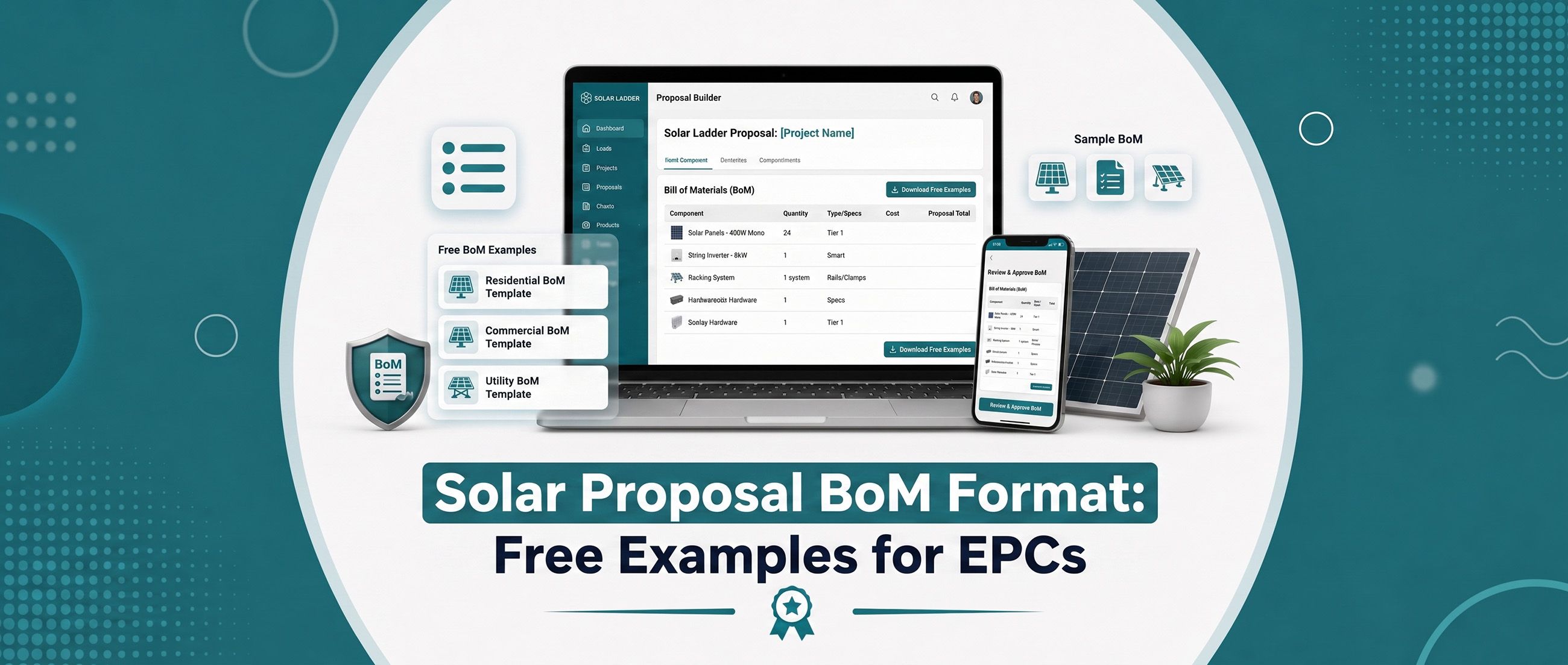
A Bill of Materials (BoM) page is a make-or-break element of any winning solar proposal. While residential buyers need a simplified, warranty-focused view to prevent analysis paralysis, commercial clients require granular, technical specifications to satisfy procurement managers and independent engineers. Utilizing standardized BoM formats helps solar EPCs establish trust, minimize scope creep, and accelerate deal closures.
Solar Proposal BoM Page Format: Free Examples for Residential & Commercial EPCs
In the competitive solar landscape, an engineering, procurement, and construction (EPC) company’s proposal is more than just a price tag—it is a reflection of operational competence. While a compelling cover page and eye-catching 3D rooftop visuals win emotional buy-in, it is the Bill of Materials (BoM) page that solidifies technical credibility.
The BoM is a comprehensive list of raw materials, assemblies, sub-assemblies, components, and quantities required to construct the solar PV plant. When structured correctly within a winning 8-page solar proposal format, the BoM serves as a dual-purpose document: a precise engineering checklist and a transparent sales tool.
This guide breaks down why your BoM page layout matters, details how formats differ between residential and commercial projects, and provides clear, structured examples you can implement today.
Why the BoM Page is a Critical Sales Conversion Tool
For years, many solar installers treated the BoM page as an afterthought, often hiding it inside a generic "Technical Specifications" appendix. However, today's clean energy buyers—spurred by consumer education initiatives from organizations like the Solar Energy Industries Association (SEIA)—demand complete transparency.
A structured BoM page provides three distinct strategic advantages:
- Apples-to-Apples Comparison: Homeowners often source multiple quotes. A transparent BoM allows them to see exactly why your premium Tier-1 modules or high-efficiency string inverters warrant your pricing over a low-ball competitor using sub-par equipment.
- Mitigating Scope Creep: By clearly defining what hardware is included, you protect your margins against unexpected on-site requests during the physical installation process.
- Generative Engine & SEO Optimization: Search and AI discovery engines prioritize highly structured, entity-rich data. Clearly formatting components such as mounting structures, ACDB/DCDB boxes, and protection devices establishes your web content as an authoritative resource.
1. Residential Solar Proposal BoM Format: Clean & Benefit-Driven
Residential solar buyers are easily overwhelmed by highly granular engineering jargon. If you present a homeowner with a list containing obscure conduit lengths, grounding lugs, and cable tie counts, you risk inducing "analysis paralysis."
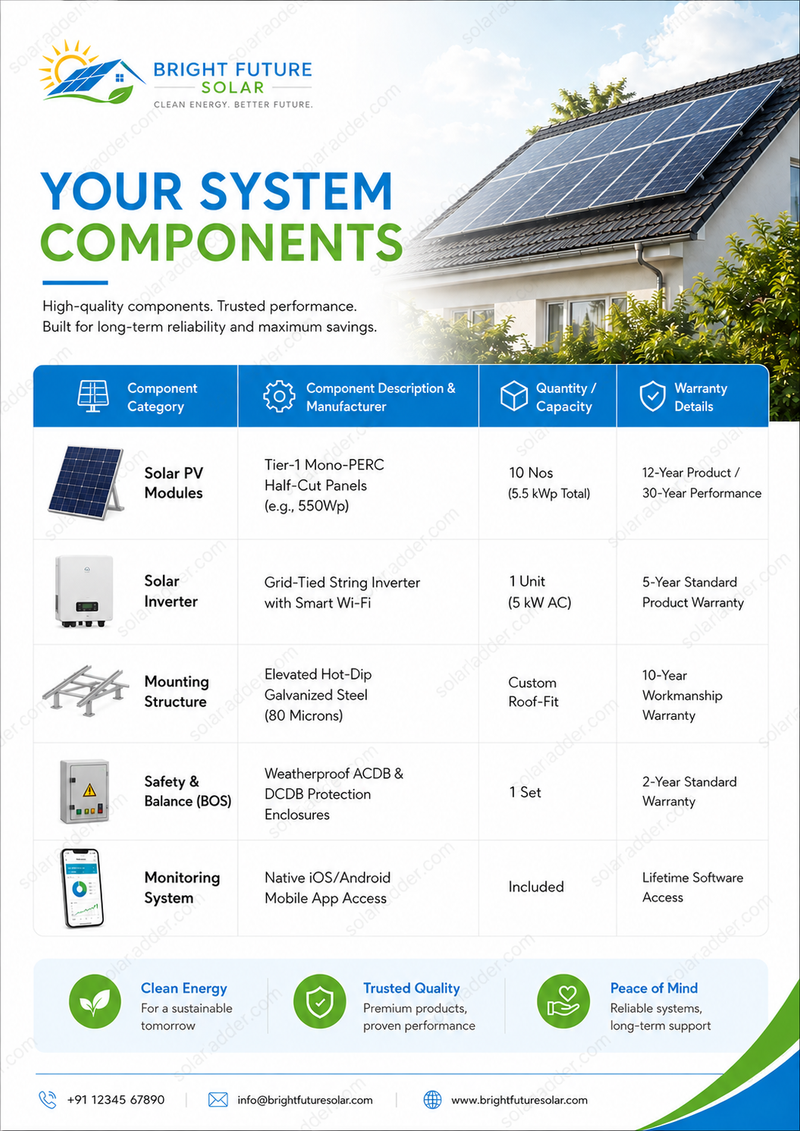
For residential proposals, the rule of thumb is simplicity and value orientation. Focus exclusively on primary equipment, major brands, and warranty protection parameters.
Key Elements of a Residential BoM:
- Primary Modules: Brand, model wattage, type (e.g., Mono-PERC, N-Type TopCon), and exact quantity.
- Inverter Technology: Brand, model type (e.g., Microinverters, Hybrid Inverter with Wi-Fi monitoring), and capacity.
- Structure Specifications: Materials utilized (e.g., Hot-Dip Galvanized Steel or Anodized Aluminum) and wind resistance ratings.
- Warranty Separation: Clearly differentiate between the product warranty (physical equipment replacement) and the performance warranty (linear power output degradation metrics over 25+ years).
Tip: For a comprehensive breakdown of consumer-facing residential sales methods, refer to our High-Converting Residential Solar Proposal Guide.
2. Commercial & Industrial (C&I) Solar Proposal BoM Format: Granular & Technical
Unlike residential homeowners, commercial entities, corporate procurement teams, and institutional sustainability managers review solar investments through a strict operational lens. They need to ensure adherence to industrial code standards, national electrical codes, and localized utility compliance benchmarks.
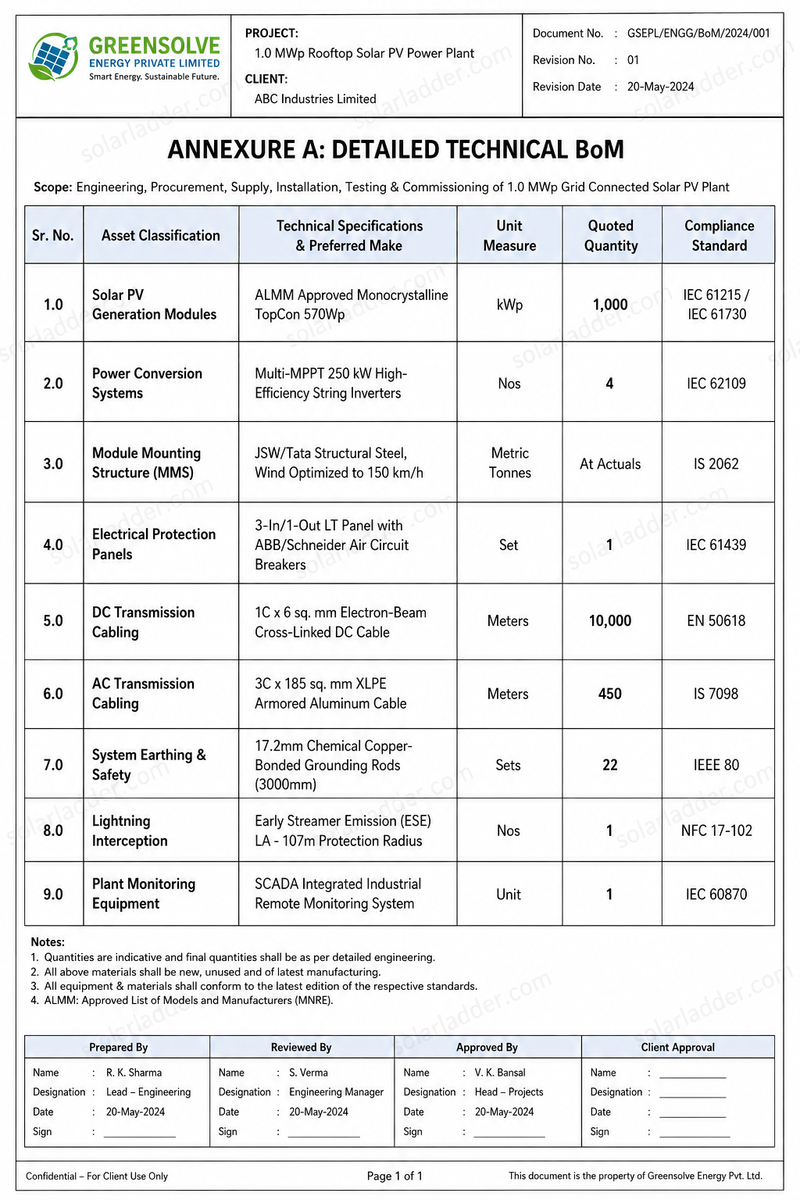
A commercial BoM must be highly detailed, itemizing not only primary generation components but also the entire Balance of System (BOS), protection layout, switchgear configurations, and auxiliary engineering provisions.
Key Categories of a C&I BoM:
- Generation Assets: Detailed electrical characteristics of the modules and multi-MPPT central or string inverters.
- Structural Infrastructure: Concrete foundation parameters, ballasted or penetrative racking specifications, and structural engineering compliance certifications.
- Electrical Distribution & Balance: Exact specifications for LT/HT panels, step-up transformers (if utility scale), armored AC/DC cabling, isolation switches, and lightning protection radius (e.g., ESE type lightning arrestors).
- Liaisoning & Government Compliance: Explicitly line-itemizing net-metering applications, structural stability checks, and governmental approvals to build absolute accountability.
3. Alternative Formats for Solar Proposal BoM Pages
Depending on your business model, customer demographic, and sales software stack, you can adopt different structural formats for your BoM presentation:
The Tiered Architecture Layout
This format splits your component layout into Tier 1 (Core Assets) consisting of panels and inverters, Tier 2 (Balance of System) covering cables, conduits, and racking, and Tier 3 (Safety & Compliance) detailing earthing systems and net-metering. This structure keeps information orderly and prevents long lists from looking chaotic.
The Interactive Digital BoM
As the industry scales, modern EPC firms are shifting away from static PDF proposals in favor of interactive, web-based proposal platforms. Within an interactive proposal ecosystem, the BoM page features expandable drop-down rows. If a user clicks on "Solar Inverter," the interface dynamically expands to present the official manufacturer datasheet, safety certificates, and a brief video overview of the component's functionality.
Frequently Asked Questions
A Bill of Materials (BoM) page is a dedicated section within a solar installation proposal that explicitly itemizes all physical hardware, components, structural assets, and electrical safety systems required to execute the solar PV project. Solar Ladder’s proposal app gives unlimited BoM page options along with customisations to help you create a proposal within minutes.
It is not recommended. Residential customers require a simplified, value-oriented table focused on component brands and robust warranties to avoid technical fatigue. Conversely, commercial buyers expect a highly granular, technical matrix that details specific electrical specifications, cable dimensions, switchgear types, and regulatory compliance data.
Providing an explicit, transparent BoM builds immediate consumer confidence. It proves that your pricing is backed by high-quality engineering and Tier-1 procurement standards, neutralizing low-cost competitors who use lower-grade components.
Yes. Solar Ladder, is engineered for extreme customization. It completely eliminates the "one-size-fits-all" limitation by allowing installers to toggle between simplified, warranty-centric residential frameworks and deeply itemized, code-compliant Commercial and Industrial (C&I) matrices. You can save these custom configurations as master templates within the software to ensure uniform brand standards across your entire sales and engineering teams.