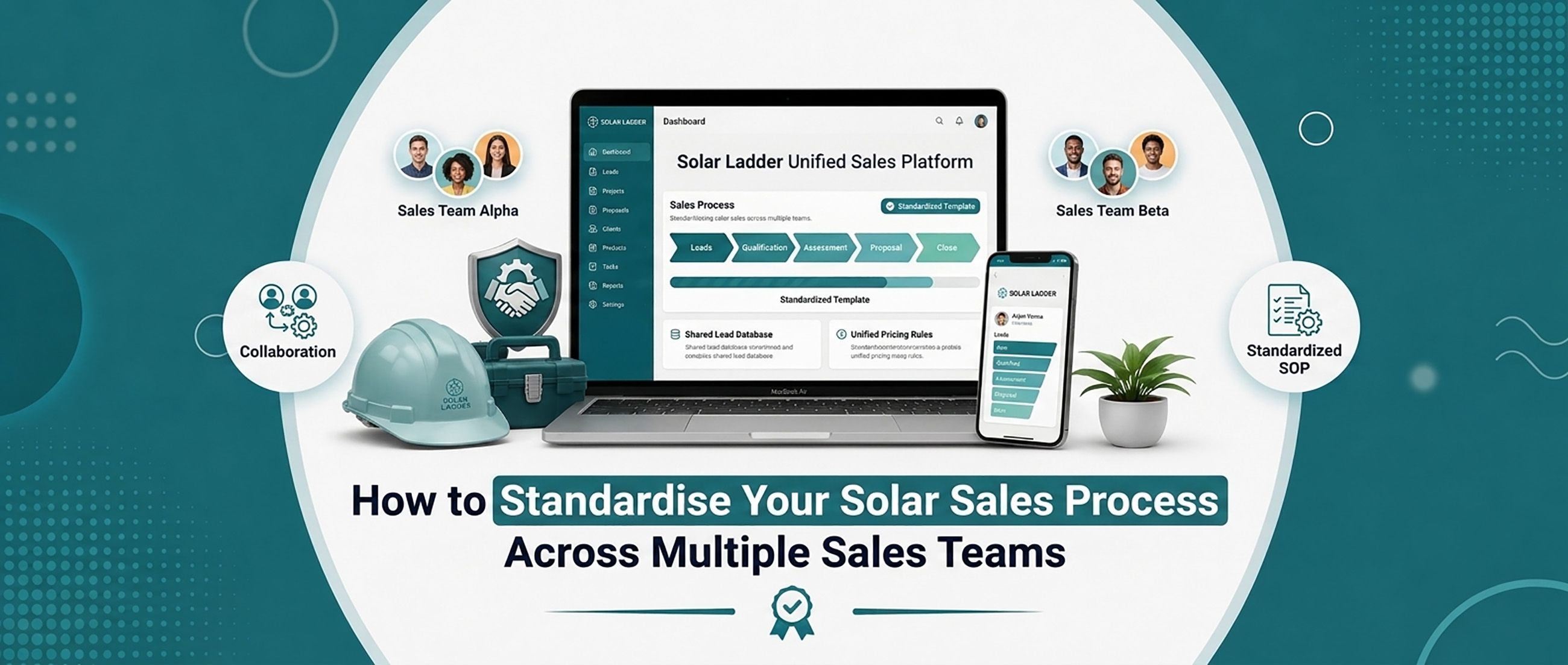
TL;DR As Solar EPC companies expand into multiple cities or regions, inconsistent sales practices can lead to missed follow-ups, inaccurate proposals, and lower conversion rates. A standardized sales process—supported by CRM, lead management, 3D design, proposal automation, and workflow automation—ensures every customer receives the same high-quality experience while giving managers complete visibility into team performance.
How to Standardize Your Solar Sales Process Across Multiple Sales Teams
Growth is exciting—but it also introduces new challenges.
When your Solar EPC company grows from one salesperson to five, or from one city to several, maintaining a consistent sales process becomes increasingly difficult.
You may start noticing problems such as:
- One salesperson responds within 10 minutes, while another takes a day.
- Proposal formats vary from one team to another.
- Some salespeople forget follow-ups.
- Customer information is stored in personal notebooks or WhatsApp chats.
- Managers struggle to understand which deals are progressing.
These inconsistencies don't just affect internal operations—they directly impact customer experience and conversion rates.
The solution is to build a standardized solar sales process that every salesperson follows, regardless of location or experience.
Why Standardization Matters
Customers expect the same professional experience whether they interact with your Mumbai office, your Ahmedabad branch, or your Bengaluru sales representative.
A standardized sales process helps your business:
- Deliver a consistent customer experience.
- Improve conversion rates.
- Reduce onboarding time for new salespeople.
- Make forecasting more accurate.
- Eliminate dependency on individual employees.
- Scale operations without sacrificing quality.
Simply put, systems—not individual habits—should drive your sales success.
What Happens Without a Standard Sales Process?
Many growing Solar EPC companies rely on each salesperson to develop their own way of selling.
While this may work initially, it often creates problems such as:
- Inconsistent pricing.
- Different proposal formats.
- Missed customer follow-ups.
- Poor lead tracking.
- Inaccurate sales reports.
- Difficult handovers to project teams.
Customers receive different experiences depending on who they speak with, making your brand appear inconsistent.
Step 1: Define Every Stage of Your Sales Pipeline
Every lead should move through clearly defined stages.
For example:
- New Lead
- Contacted
- Qualified
- Site Visit Scheduled
- Site Survey Completed
- Proposal Shared
- Negotiation
- Order Confirmed
- Project Handover to Operations
- Installation Completed
Every salesperson should use the same pipeline.
This allows managers to quickly identify where deals are getting stuck.
Step 2: Capture Every Lead in One CRM
Leads often come from multiple channels:
- Google Ads
- Meta Ads
- IndiaMART
- Website forms
- Referrals
- Exhibitions
Without a centralized CRM, leads can be lost or duplicated.
A CRM ensures:
- Every lead is recorded.
- Lead ownership is clear.
- Customer history is accessible.
- Follow-ups are tracked.
- Managers have complete visibility.
No salesperson should manage leads using personal spreadsheets.
Step 3: Standardize Site Survey Data Collection
Different survey formats often lead to missing information.
Create a standardized checklist for every survey, including:
- Electricity consumption.
- Roof dimensions.
- Roof type.
- Shading observations.
- Photos.
- Customer objectives.
- Installation constraints.
This improves design accuracy and reduces proposal revisions.
Step 4: Use One Proposal Format
Your proposal represents your brand.
Every customer should receive a consistent document containing:
- Company branding.
- 3D system design.
- Estimated generation.
- Savings calculation.
- ROI and payback.
- Equipment specifications.
- Warranty information.
- Project timeline.
Standardized proposals build professionalism and trust.
Step 5: Automate Follow-Ups
The biggest reason Solar EPC companies lose deals is inconsistent follow-up.
Instead of relying on memory, automate reminders for:
- Proposal follow-up.
- Site visit confirmation.
- Negotiation updates.
- Document collection.
- Payment reminders.
Automation ensures no lead is forgotten.
Step 6: Create Standard Communication Templates
Customers often ask similar questions about:
- Pricing.
- Subsidies.
- Financing.
- Installation timelines.
- Maintenance.
- Warranty.
Provide your sales team with approved email, WhatsApp, and SMS templates to ensure consistent messaging while saving time.
Step 7: Measure the Same KPIs Across Teams
Every sales manager should monitor identical performance metrics.
Examples include:
- New leads generated.
- Response time.
- Site visits completed.
- Proposal turnaround time.
- Proposal-to-order conversion.
- Revenue generated.
- Average sales cycle.
- Lost deal reasons.
Consistent metrics make coaching and forecasting much easier.
Step 8: Build a Seamless Handover to Operations
Many customer complaints begin after the sale because important information isn't transferred properly.
A standardized handover should include:
- Approved proposal.
- Site survey data.
- Customer documents.
- Payment status.
- Installation schedule.
- Special customer requirements.
This helps operations begin execution without confusion.
Step 9: Continuously Train Your Sales Teams
Even the best sales process needs reinforcement.
Regular training should cover:
- Product knowledge.
- New software features.
- Proposal presentation.
- Objection handling.
- Customer communication.
- CRM usage.
Standardization is an ongoing process—not a one-time project.
How Solar Ladder Helps Standardize Sales Across Multiple Teams
Solar Ladder provides a connected platform that enables Solar EPC companies to create one repeatable sales process for every team and every branch.
👥 CRM & Lead Management
Capture and organize leads from every channel.
Features include:
- Lead source tracking
- Customer history
- Sales pipeline
- Activity logs
- Follow-up reminders
- Team assignments
Managers always know the status of every opportunity.
☀️ 3D Solar Design (Laptop & Mobile)
Give every salesperson the ability to create professional designs.
Features include:
- RCC rooftops
- Metal sheet roofs
- Industrial sheds
- Walkways
- Handrails
- Safety lifelines
Design consistency improves customer confidence.
📄 Instant Proposal Generation
Ensure every customer receives a standardized, branded proposal with:
- 3D designs
- Energy generation estimates
- ROI calculations
- Payback analysis
- Bill of Materials (BOM)
- Company branding
Sales teams can respond quickly without sacrificing quality.
🤖 Workflow Automation
Standardize repetitive processes by automating:
- Lead assignments.
- Proposal reminders.
- Customer notifications.
- Internal task creation.
- Follow-up schedules.
Automation reduces human error and keeps teams aligned.
📋 Project Management
Create a smooth transition from sales to execution.
Track:
- Project milestones.
- Installation progress.
- Documentation.
- Team responsibilities.
- Customer updates.
Operations receive complete information without manual handovers.
📡 RMS & 🔧 O&M
Maintain a consistent post-installation experience through:
- Live plant monitoring.
- Automated alerts.
- Generation reports.
- Maintenance scheduling.
- AMC management.
Customers continue receiving high-quality service long after installation.
Common Mistakes Growing Solar EPCs Make
- Letting every salesperson follow a different sales process.
- Using multiple proposal formats.
- Managing leads in Excel or WhatsApp.
- Forgetting follow-ups.
- Failing to measure team performance consistently.
- Poor coordination between sales and operations.
- Lack of standardized customer communication.
- Not documenting lost deal reasons.
- Delayed proposal delivery.
- Limited visibility into branch performance.
Best Practices for Standardizing Solar Sales
- Create one sales pipeline for the entire organization.
- Store every lead in a centralized CRM.
- Use a standardized site survey checklist.
- Generate proposals using one branded template.
- Automate reminders and follow-ups.
- Define common KPIs across all teams.
- Train new salespeople using documented processes.
- Review pipeline performance weekly.
- Integrate sales with project management.
- Continuously improve the process using data.
Conclusion
As your Solar EPC business grows, consistency becomes more valuable than individual performance.
A standardized sales process helps every salesperson deliver the same professional customer experience while giving management complete visibility into performance.
By combining CRM, lead management, 3D solar design, instant proposals, workflow automation, project management, RMS, and O&M into one connected platform, Solar Ladder helps Solar EPC companies scale confidently without losing control of their sales operations.
The businesses that grow fastest aren't just hiring more salespeople—they're building systems that enable every salesperson to perform at a consistently high level.
Frequently Asked Questions
A standardized sales process improves consistency, increases conversion rates, simplifies training, and provides better visibility into sales performance.
Typical stages include lead capture, qualification, site visit, proposal, negotiation, order confirmation, project handover, installation, and after-sales service.
A CRM centralizes customer information, tracks follow-ups, assigns leads, records activities, and allows managers to monitor performance across all teams.
Solar Ladder combines CRM, Lead Management, 3D Solar Design, Instant Proposals, Workflow Automation, Project Management, RMS, and O&M into one platform, enabling every sales team to follow the same efficient process.