TL;DR
If your team is still managing solar projects through WhatsApp chats, Excel sheets, and endless phone calls, you're losing valuable time, money, and customer trust. As Solar EPC businesses grow, manual project tracking becomes one of the biggest barriers to scaling. In this guide, we'll explain why it's time to move beyond spreadsheets and messaging apps—and how Solar Ladder's Project Management software helps installers streamline operations from project approval to commissioning.
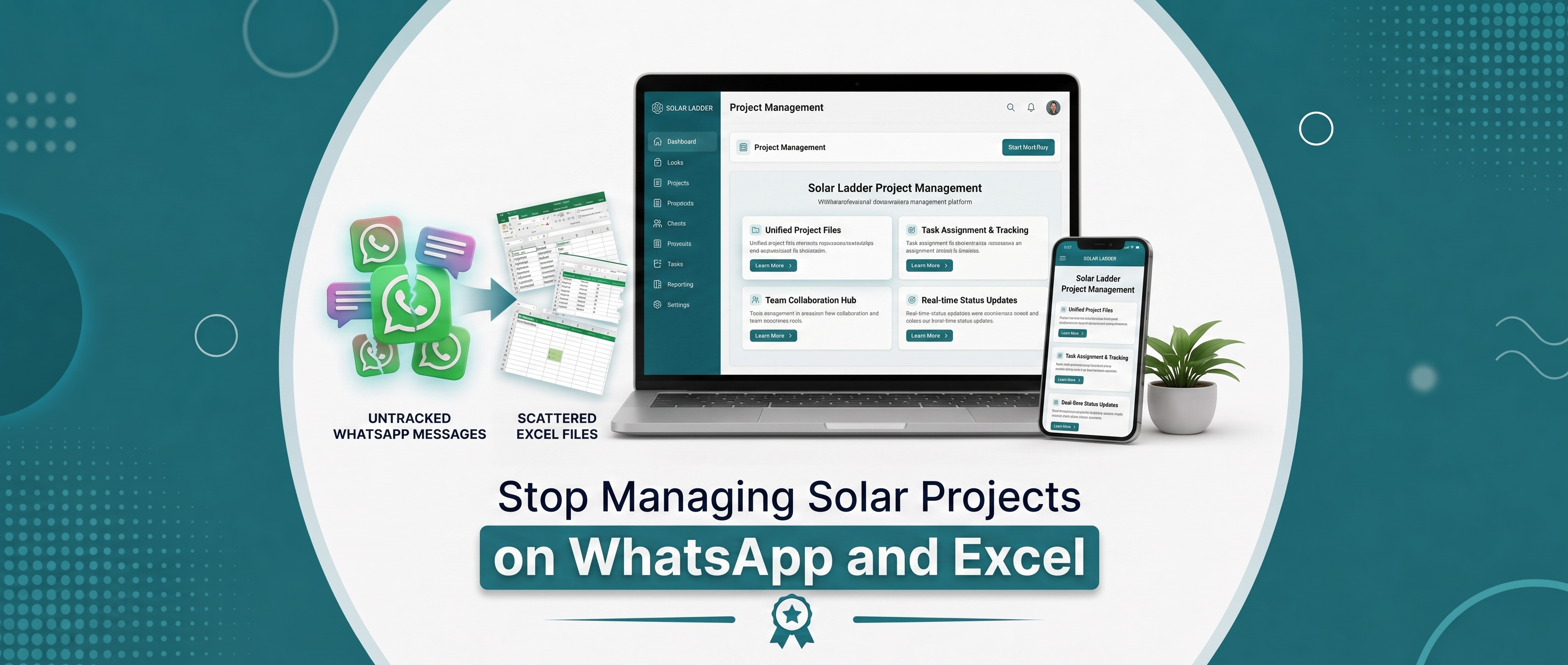
Stop Managing Solar Projects on WhatsApp and Excel
Winning a solar project is exciting.
But once the customer signs the agreement, the real work begins.
Your team needs to coordinate site surveys, engineering, procurement, logistics, installation, documentation, inspections, and commissioning. Every stage involves multiple people, deadlines, and dependencies.
Yet many Solar EPC companies still manage this entire process using WhatsApp groups, Excel spreadsheets, and countless phone calls.
It may work when you're handling five projects a month.
But what happens when you're managing fifty?
Or five hundred?
This is where many growing solar businesses start experiencing operational chaos.
Instead of focusing on delivering projects faster, project managers spend hours chasing updates, searching chat histories, and manually updating spreadsheets.
In 2026, successful Solar EPC companies are replacing these disconnected tools with dedicated Solar Project Management Software.
The Hidden Cost of Managing Projects on WhatsApp
WhatsApp is an excellent communication tool.
It is not a project management platform.
Most EPC companies create separate WhatsApp groups for every installation.
Initially, this feels organized.
Over time, problems begin to appear.
Messages get buried.
Photos disappear into endless chat history.
Important approvals are missed.
Nobody remembers who was responsible for the next task.
Project managers spend more time asking questions than managing projects.
Common examples include:
- "Has the site survey been completed?"
- "Who ordered the inverter?"
- "Has net metering documentation been submitted?"
- "When is installation scheduled?"
If every answer requires scrolling through hundreds of WhatsApp messages, your business is already losing productivity.
Why Excel Stops Working as Your Business Grows
Excel is another tool almost every EPC company starts with.
It helps organize project data.
But spreadsheets weren't designed to manage live projects involving multiple teams.
As installations increase, Excel creates several operational challenges:
No Real-Time Updates
Multiple team members edit different versions of the same spreadsheet.
Nobody knows which file is the latest.
Manual Data Entry
Every project update requires someone to manually enter information.
This wastes valuable administrative time.
No Task Ownership
Excel can tell you what needs to be done.
It doesn't tell you who is responsible.
This creates accountability issues across departments.
Difficult Reporting
Want to know:
- How many installations are delayed?
- Which technician has the highest workload?
- Which projects are awaiting documentation?
You'll likely spend hours creating reports manually.
Modern Solar Projects Need Modern Software
Today's solar installations involve far more than simply mounting panels.
A typical project includes:
- Lead qualification
- Site survey
- 3D system design
- Proposal approval
- Engineering
- Procurement
- Material dispatch
- Installation
- Quality inspection
- Documentation
- Net metering
- Commissioning
Every stage depends on the previous one.
If one task is delayed, the entire project timeline suffers.
This is why leading Solar EPC companies now use purpose-built software like Solar Ladder to manage every stage from a single platform.
How Solar Ladder Simplifies Project Management
Solar Ladder replaces disconnected tools with one centralized workspace where every department collaborates in real time.
Instead of switching between Excel, WhatsApp, emails, and phone calls, your entire team works from the same dashboard.
Every project has complete visibility.
Everyone knows:
- Current project status
- Pending tasks
- Assigned team members
- Upcoming deadlines
- Required documents
- Installation progress
This significantly reduces communication gaps and project delays.
1. Centralized Project Dashboard
No more searching through multiple Excel sheets or WhatsApp groups.
Solar Ladder provides a single dashboard where managers can view every ongoing project.
At a glance, you can see:
- Survey status
- Engineering progress
- Procurement updates
- Installation schedules
- Documentation status
- Commissioning progress
Instead of asking your team for updates, the information is already available.
2. Task Assignment & Accountability
Every project consists of dozens of individual tasks.
Solar Ladder allows project managers to assign each task to a specific team member with deadlines and priorities.
Everyone knows exactly:
- What needs to be done
- Who is responsible
- When it is due
This improves accountability and reduces project delays caused by missed responsibilities.
3. Real-Time Project Tracking
Unlike spreadsheets, Solar Ladder updates project progress in real time.
As soon as a survey is completed or an installation finishes, the project status is automatically updated for everyone.
Sales teams, operations, management, and installation crews always work with the latest information. 4. Document Management Without the Chaos
Every solar project generates dozens of important documents:
- Site survey reports
- Customer KYC
- Quotation & proposal
- Electrical drawings
- Net metering applications
- Installation photos
- Commissioning reports
- Warranty certificates
When these documents are scattered across WhatsApp chats, emails, and personal computers, finding the latest version becomes a challenge.
Solar Ladder centralizes all project documents in one place, ensuring everyone—from sales and engineering to operations and management—has access to the latest files. This eliminates confusion, reduces delays, and ensures critical documents are never lost.
5. Better Collaboration Across Teams
One of the biggest operational challenges for Solar EPC companies is the disconnect between departments.
Sales teams close the deal.
Design teams create the system layout.
Procurement orders materials.
Project managers schedule installations.
Technicians complete the work.
If each department uses different tools, communication gaps become inevitable.
Solar Ladder connects every team through a single platform. Updates made by one department are instantly visible to others, ensuring smooth coordination throughout the project lifecycle.
6. Keep Customers Informed
Customers don't like uncertainty.
Once they've invested in a solar system, they want to know what's happening next.
Questions like:
- "When will my installation begin?"
- "Has my net metering application been submitted?"
- "When will commissioning be completed?"
can quickly overwhelm your support team.
Solar Ladder makes it easy to track project milestones and provide timely updates, creating a more professional customer experience and building trust throughout the installation process.
7. Reports That Help You Scale
As your business grows, visibility becomes essential.
Solar Ladder provides management with actionable reports and dashboards, helping answer questions such as:
- How many projects are currently active?
- Which projects are delayed?
- Which engineer has the highest workload?
- How long does each project stage take?
- Which bottlenecks are affecting project completion?
Instead of manually compiling reports from Excel, management gets real-time insights that support better planning and faster decision-making.
8. Mobile Access for Field Teams
Solar projects happen on rooftops—not in offices.
Your engineers and technicians need access to project information while they're on-site.
With Solar Ladder's mobile capabilities, field teams can:
- View assigned tasks
- Access customer information
- Upload installation photos
- Update project status
- Record notes
- Complete checklists
This reduces paperwork and ensures office teams always have the latest project updates.
Why Solar Ladder Is Better Than WhatsApp + Excel
WhatsApp and Excel were never designed to manage solar businesses.
As project volumes increase, they create operational bottlenecks that slow down growth.
Solar Ladder brings together everything your business needs in one platform:
- Lead Management – Capture and organize leads from multiple channels.
- CRM – Track customer interactions and sales opportunities.
- 3D Solar Design (Laptop & Mobile) – Create accurate rooftop designs quickly.
- Instant Proposals – Generate branded proposals with financial analysis in minutes.
- Project Management – Track every installation from approval to commissioning.
- Remote Monitoring System (RMS) – Monitor plant performance and identify issues proactively.
- Operations & Maintenance (O&M) – Manage service requests, preventive maintenance, and AMC contracts.
Instead of switching between multiple tools, your entire team works from a single source of truth.
The Bottom Line
Managing solar projects through WhatsApp and Excel may work for a small number of installations, but it quickly becomes unsustainable as your business grows.
Missed updates, scattered documents, poor visibility, and communication gaps can lead to delays, dissatisfied customers, and lost revenue.
Purpose-built software like Solar Ladder helps Solar EPC companies streamline operations, improve collaboration, and complete projects faster—all while delivering a better customer experience.
If you're serious about scaling your solar business in 2026, it's time to stop managing projects on WhatsApp and Excel and start managing them with software built specifically for the solar industry.
Frequently Asked Questions
WhatsApp is designed for communication, not project management. It lacks task tracking, document organization, reporting, and accountability features, making it difficult to manage multiple installations efficiently.
Excel is useful for basic data management, but it doesn't provide real-time collaboration, task assignment, workflow automation, or centralized project tracking required for growing Solar EPC businesses.
Solar Project Management Software helps EPC companies plan, track, and manage every stage of a solar installation—from site surveys and procurement to installation, documentation, and commissioning.
Solar Ladder centralizes project information, assigns tasks, tracks milestones, manages documents, and provides real-time visibility across sales, engineering, procurement, and installation teams.
Yes. Solar Ladder combines CRM, Lead Management, 3D Design, Instant Proposals, Project Management, RMS, and O&M into a single integrated platform.
Yes. Whether you're handling 10 installations a month or hundreds of projects across multiple teams, Solar Ladder scales with your business.
Absolutely. By providing task ownership, real-time tracking, centralized documentation, and better collaboration, Solar Ladder helps identify bottlenecks early and complete projects faster.
With rising competition and increasing project volumes, dedicated project management software helps EPC companies improve operational efficiency, customer satisfaction, and overall profitability.