TL;DR
Thai solar EPCs are losing high-value EEC contracts to faster competitors. The winning EPCs respond with professional ROI proposals within 24 hours. Here's how to compete:
Use satellite imagery for initial roof assessment — skip manual AutoCAD modelling for proposals
Build a standardised proposal template that auto-calculates MEA/PEA tariffs, Royal Decree 805 deductions, and 150% corporate tax benefits
Send an indicative quote same-day, full proposal by tomorrow — speed signals competence
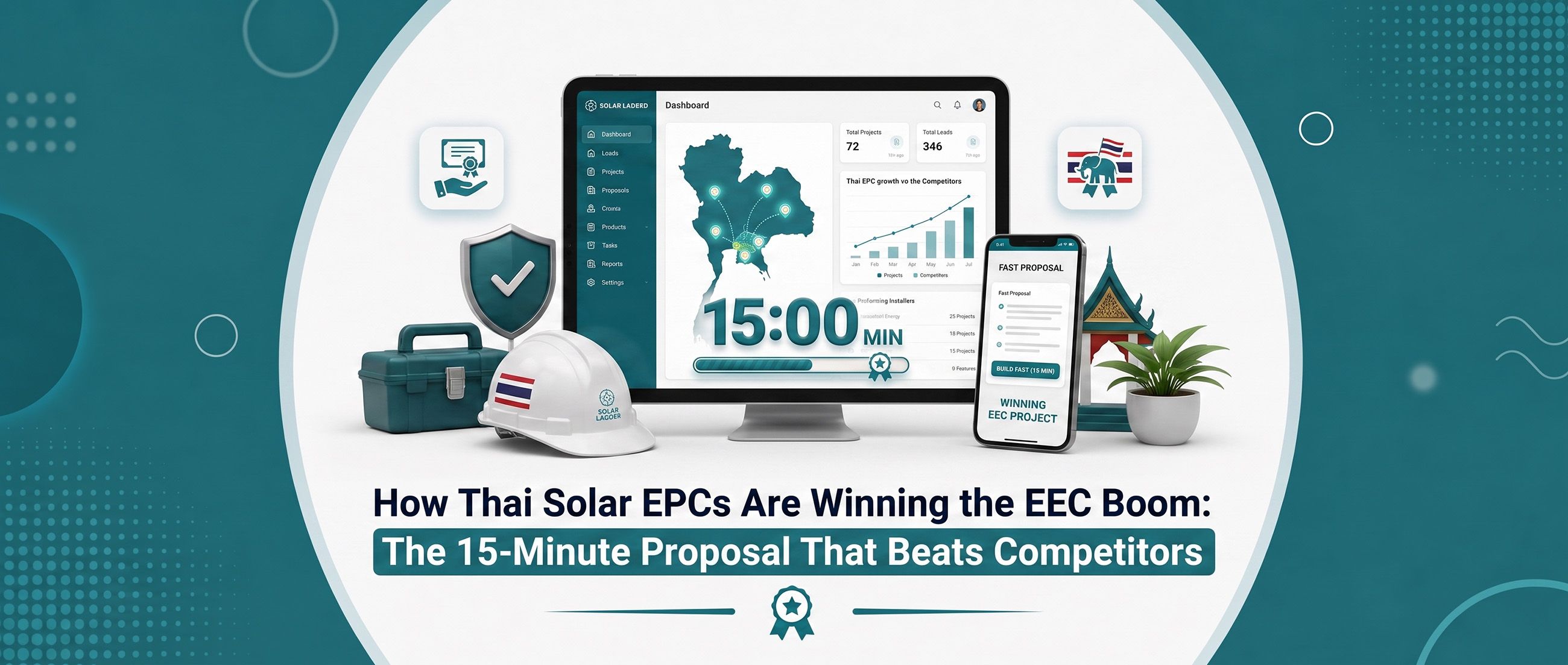
Solar Ladder automates all of this — 3D roof engineering, localised financial modelling, and project management in one platform so you close deals in 15 minutes
The Scene Every Thai Solar EPC Recognises
It's mid-morning on a Tuesday. You've just wrapped a site survey for a 200 kWp rooftop system on a new data centre facility in the Eastern Economic Corridor. The facility manager is keen. The energy director (sharp, numbers-focused) wants to see projections. They asked you to send a "detailed proposal with ROI breakdown" by end of week.
You drive back to Bangkok. You open AutoCAD. You start modelling the roof layout — measuring, sketching panel strings, estimating shading, pulling load profiles from the client's three years of utility bills. You cross-reference MEA tariff structures against the facility's daytime consumption curve. You manually calculate the Royal Decree 805 tax deduction benefit, the net metering credits, the payback period. You format everything into a 15-page PDF with logos and projections.
By Thursday afternoon, you hit send. Three days gone.
The facility manager responds:
"Sorry, we've already signed with another company. They sent a proposal with a 3D roof model and full ROI breakdown on Wednesday — the day after we met."
That's not a fluke. That's a competitive loss you could have prevented. And in a market as hot as Thailand's EEC, it's happening every week.
The Reality: Why Thai Solar EPCs Are Losing High-Value Deals to Faster Competitors
Here's what the market won't tell you: Speed is now a quality signal in itself.
Thailand's solar EPC sector has matured dramatically. The Eastern Economic Corridor alone is attracting billions of baht in industrial and data centre investment, all of which requires rooftop solar. That's created an unprecedented volume of C&I opportunity. It's also created unprecedented competition — local SMEs, multinational engineering firms, tech-forward startups, all bidding for the same projects.
Your prospective client almost certainly contacted 2–3 competitors the same day they contacted you. In that environment, the proposal that arrives first doesn't just look faster. It looks smarter.
Consider what that proposal delay costs you:
On a single 200 kWp data centre deal worth ฿4.2 million, losing just one contract per month to a faster competitor means ฿50+ million in lost annual revenue. But it's not just the direct loss. It's the engineer-hours spent on manual modelling instead of managing active projects, the senior staff pulled away from project execution, the unscalable reliance on one or two experienced estimators who know how to model MEA tariff shifts and Royal Decree 805 calculations on the fly.
Worse, you're building a business model that can't scale. As your deal pipeline grows, your quoting bottleneck tightens. Either you hire more estimators (raising fixed costs) or you slow down (losing more deals). Neither solves the fundamental problem: your process is dependent on manual work that should have been automated years ago.
The Thai EPCs winning right now aren't necessarily the cheapest. They're the fastest — and they look the most professional doing it.
The Actionable Strategy: Three Ways to Reclaim Speed Without Sacrificing Quality
You don't need to transform your entire business. Start here:
1. Stop Using AutoCAD for Initial Roof Assessment
AutoCAD is an engineering tool. It's not a sales tool. If you're using it to generate your first proposal, you're burning hours on something that should take 15 minutes.
For most rooftop installations — residential, commercial, even data centres — satellite imagery is accurate enough to produce a preliminary roof layout, panel count estimate, and shading profile. Reserve physical site visits for large industrial projects with complex structural requirements or installations where you need to verify actual roof condition before construction.
Tools built on satellite data can generate a 3D roof model before you leave the client's office. That model feeds directly into your proposal. A single small change: response time drops from days to hours.
2. Build a Standardised Proposal Template That Speaks to Thai Buyers
Every professional proposal to a Thai C&I client needs to answer one question: What's my actual return, after tax?
Create a single, reusable proposal template that includes:
- System specifications and equipment breakdown
- Daytime self-consumption analysis (crucial for Thai clients — show them which hours of the day their solar is actually offsetting consumption)
- MEA or PEA tariff integration (most data centres are MEA Samui or MEA Bangkok; factories are often PEA. Your template should auto-calculate based on which utility)
- Royal Decree 805 personal income tax benefit (residential clients, up to ฿200,000 deduction)
- 150% corporate tax deduction benefit (C&I clients — show the actual cash benefit to their tax liability)
- Net metering payback period — the real story, not the marketing number
- Compliance status — MEA/PEA application timeline, safety certification checklist
A standardised template cuts your quoting time in half. It also ensures consistent professionalism — no more proposals that look handmade.
3. Separate Your "Indicative Quote" from Your "Final Proposal"
The moment a client asks for a proposal, send an indicative quote the same day. Not tomorrow. That day. Something that proves you're responsive and serious:
"Based on your 200 kWp rooftop and estimated daytime load of 150 kW, system cost is approximately ฿3.8–4.2M with payback in 5–6 years after tax deductions. Full proposal with 3D roof model arriving by [tomorrow afternoon]."
This single touch transforms the client's perception. They see immediate competence. They're less likely to follow up with competitors if you've already proven you move fast.
Then send the detailed proposal within 24 hours — complete with MEA/PEA documentation, safety liabilities, and full financial breakdown.
The Game Changer: Solar Ladder for Thai EPCs
These tactical moves will help. But if you're serious about winning C&I contracts at scale — competing confidently against multinationals, managing MEA/PEA compliance without drowning in spreadsheets, and closing deals before competitors finish their AutoCAD sketches — you need a platform built for Thai solar EPCs.
That's Solar Ladder.
Solar Ladder is purpose-built for Thailand's solar market. It combines automated roof engineering, localised financial modelling, and centralised project management in a single unified platform. Here's what changes:
Automated 3D Satellite Roof Engineering Upload your client's address. Solar Ladder's satellite integration generates a structurally accurate 3D model of their roof, calculates optimal panel placement, string configurations, and shading profiles — all in minutes. No AutoCAD. No manual measurement. What used to take your team a full day takes Solar Ladder 5 minutes. You walk out of a client meeting and can email a 3D visual proof-of-concept before the client leaves the site.
Localized Financial Modelling Engine Here's where Thai EPCs get their real advantage. Solar Ladder's financial engine is built for Thai tariff structures:
- MEA or PEA tariff switching — your proposal automatically calculates against the right utility's rates
- Royal Decree 805 calculator — instant visual of the personal income tax deduction (residential clients)
- 150% corporate super-deduction modelling — C&I clients see exact cash benefit of the enhanced tax write-off
- Self-consumption vs. net metering comparison — show the client their optimal operating strategy
- Payback period and ROI curves — no guesswork, no manual spreadsheets
Your client gets a proposal that looks like it took your team a week to model. It took Solar Ladder 10 minutes. The financial credibility is instant.
Centralised Project & Document Management No more LINE group chats tracking equipment arrival dates. No more scattered emails about MEA submissions. Solar Ladder consolidates:
- Project timelines and milestone tracking
- Equipment procurement and vendor management
- MEA/PEA application status and document uploads
- Safety compliance checklists (shifting liability onto the installer — so you track it)
- Digital e-tax invoice generation for equipment and services
This is especially critical for Thai EPCs scaling fast. Growing from 5 projects per month to 15 projects per month breaks a spreadsheet-based workflow. Solar Ladder doesn't.
The Competitive Reality in 2026
Thailand's solar EPC market is winner-takes-most in the EEC. The EPCs winning now are:
- Faster at proposal generation — they move from lead to full ROI presentation in 24 hours
- Smarter at financial modelling — they show Thai finance directors the exact tax benefit, not a rough estimate
- Tighter on operations — they scale without hiring proportionally more staff
You can compete on price. You can compete on brand. But you can't compete on these three if your process is still stuck in 2020.
Your Next Move: See It in Action
Ready to see how Solar Ladder transforms a 3-day quoting cycle into a 15-minute one?
Thai solar EPCs are already capturing high-value C&I contracts in the EEC by responding faster, looking more professional, and showing clearer ROI. You can too.
👉 Book your localised product demo today. We'll show you how to turn a Rayong data centre lead into a signed contract before your competitors send their first email.
Frequently Asked Questions
Competitive Thai EPCs now respond within 24 hours of a site visit — often within hours for simple rooftop systems. Most EPCs using manual AutoCAD modelling take 3–5 days, which is long enough for a client to go with a faster competitor. In the EEC, where competition is intense, 24-hour turnaround has become the industry standard for winning bids.
A winning Thai C&I proposal must include system specifications, daytime self-consumption analysis (matching MEA or PEA tariff structure), the 150% corporate tax super-deduction benefit (showing exact cash savings), net metering payback period, and MEA/PEA application timeline. For residential, include the Royal Decree 805 personal income tax deduction (up to ฿200,000). Clients want to see ROI, not just equipment costs.
Yes. For most residential and commercial rooftops, satellite-based roof assessment is accurate enough to generate initial 3D designs, panel layouts, and shading profiles. You should reserve physical site visits for large industrial installations or projects with complex roof structures. Satellite tools like those in Solar Ladder can generate a finished 3D roof model in minutes, cutting proposal turnaround time dramatically.
Solar Ladder combines automated 3D satellite roof engineering, localised financial modelling (MEA/PEA tariff switching, Royal Decree 805 and 150% tax calculations), and centralised project management. A Thai EPC can upload a client's address and generate a complete professional proposal with ROI breakdown in 15 minutes — compared to 3–5 days of manual AutoCAD work. The speed and professionalism dramatically increase close rates.
Yes. Under the 2025–2026 framework, commercial and industrial businesses can claim a 150% enhanced tax deduction (super-deduction) on certified energy-efficient solar systems. Residential clients get up to ฿200,000 personal income tax deduction for systems under 10 kWp. A professional proposal that quantifies the exact tax benefit is a major sale driver — most clients don't realise how much their effective system cost drops after tax.
MEA (Metropolitan Electricity Authority) supplies electricity to Bangkok and surrounding provinces. PEA (Provincial Electricity Authority) covers rural and provincial areas. They have different tariff structures, application processes, and net metering rates. A proposal that's calculated against the wrong utility's tariff will show the client an inaccurate ROI — a costly mistake. Professional solar proposal tools now auto-switch between MEA and PEA based on the project location.