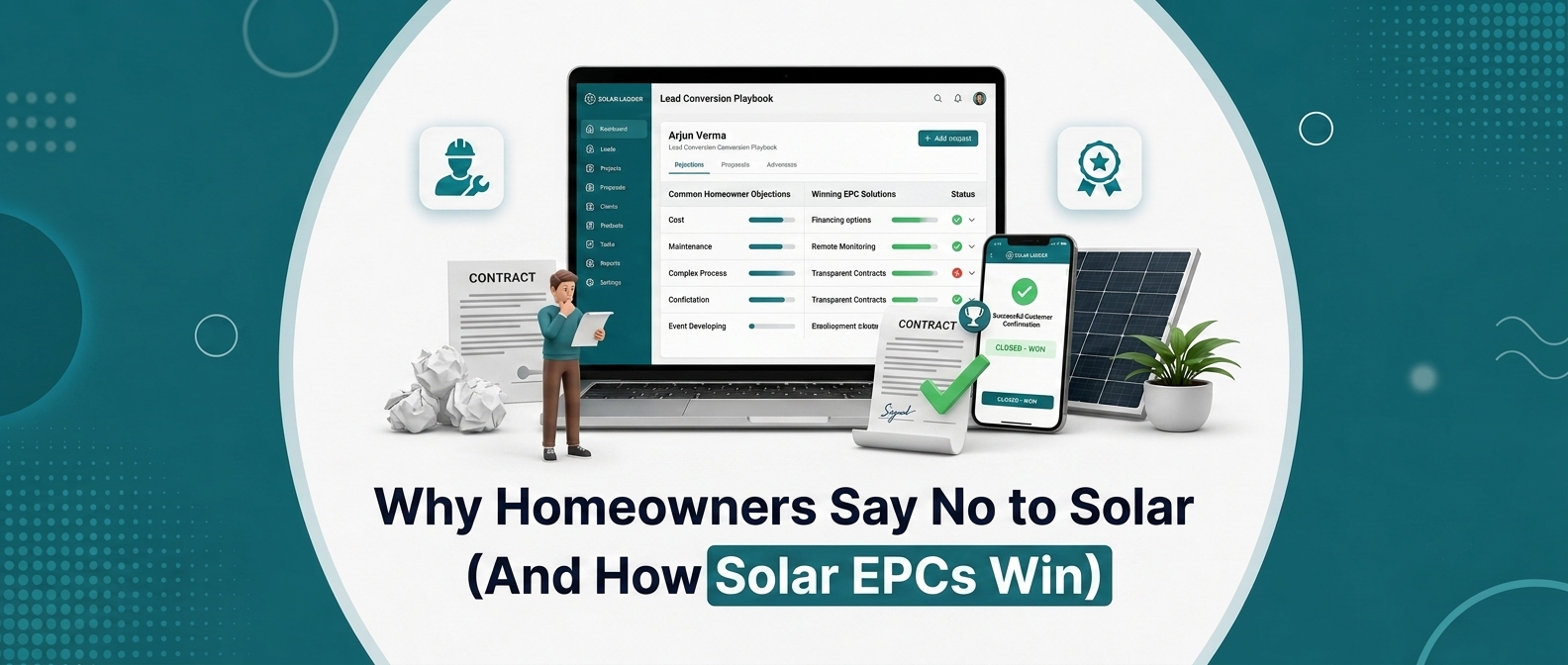
TL;DR Residential solar prospects reject proposals due to seven main friction points: high upfront investment costs, confusion over government policies and subsidies, cheaper competitor quotes, vague ROI calculations, aesthetic concerns, delayed proposal deliveries, and fears of poor after-sales maintenance. Solar EPCs overcome these objections by using Solar Ladder’s software suite—leveraging automated EMI cash flow charts, dynamic policy/tariff calculators, multi-tier pricing comparisons, 3D shading simulations, mobile site survey integration, and centralized O&M performance dashboards.
Residential rooftop solar adoption is accelerating rapidly, yet EPC contractors routinely lose qualified leads late in the sales funnel. Research from the National Renewable Energy Laboratory (NREL) indicates that decision friction during early inquiry, financial evaluation, and policy estimation causes a substantial drop-off in residential solar conversions.
To convert skeptical prospects, installers must address core objections using specialized software built to make complex financial and engineering data completely transparent.
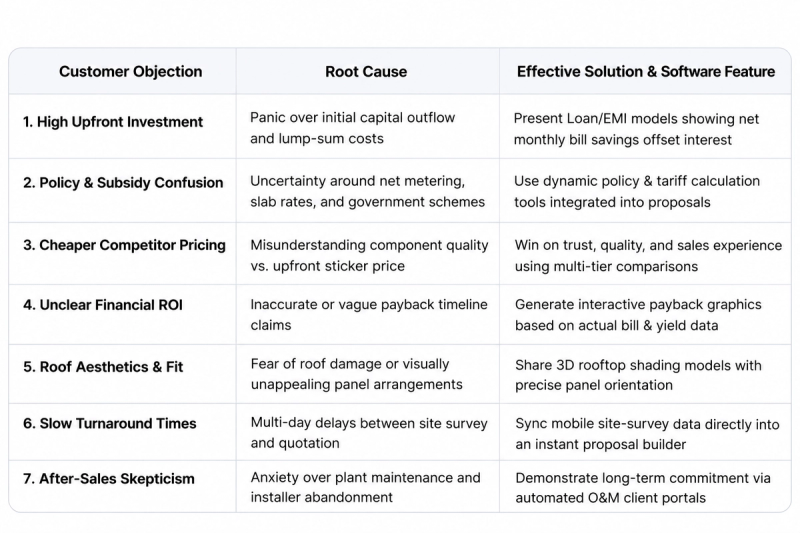
1. High Upfront Investment and Capital Outflow
The initial capital required for rooftop solar is often the first barrier a homeowner raises.
- The Objection: "Solar requires too much money upfront, and I don't want to lock up my cash right now."
- The Solution: Transition the conversation from total system cost to cash-flow neutrality. Using Solar Ladder’s proposal generation engine, sales teams present custom Loan/EMI payment breakdowns alongside estimated utility bill reductions. When homeowners see that their monthly energy savings offset or exceed their monthly EMI payments, upfront cost concerns are neutralized.
2. Confusion Over Government Electricity Policies and Subsidies
State and national solar regulations shift frequently. Regulatory updates from bodies like the Ministry of New and Renewable Energy (MNRE) leave prospective buyers uncertain about net metering credits, tariff slabs, and direct subsidy disbursement.
- The Objection: "I don't understand how net metering works in my area or if I will actually receive the government subsidy."
- The Solution: Demystify local grid regulations by providing transparent policy breakdowns within your sales presentation. Solar Ladder incorporates updated tariff and policy configuration engines directly into its quotation workflow. Installers can apply local utility rates, net metering math, and applicable government subsidies inside the proposal, building instant technical credibility.
3. Cheaper Quotes from Low-Cost Competitors
Price wars are common in residential solar. Low-margin installers often win early attention by quoting sub-standard components at bargain prices, making quality proposals appear overpriced.
- The Objection: "Another installer offered me a system of the same capacity for 20% less."
- The Solution: Never compete on price alone; win customer business based on trust, quality, and a superior consultative sales experience. Solar Ladder enables sales reps to quickly generate multi-tier comparison proposals (e.g., Premium vs. Standard vs. Economy). By visualizing long-term degradation curves, component warranty lifespans, and estimated 25-year generation yields, installers show customers that a low-bid quote costs far more over time in lost generation and repairs.
To position your business above low-cost competitors, read our guide on Building a Solar Brand That Customers Remember.
4. Uncertainty About Real ROI and Financial Payback
Industry reports from the Solar Energy Industries Association (SEIA) emphasize that financial clarity is essential to closing residential contracts. Generic claims like "cut your bill by 80%" raise skepticism.
- The Objection: "How can I be sure these long-term financial savings estimates are realistic?"
- The Solution: Provide data-backed financial projections tailored to the customer's historical energy consumption. Solar Ladder automatically calculates ROI using historical utility bill data, local solar irradiation figures, and component degradation specs, generating interactive financial graphics that map out exact payback periods and 25-year returns.
5. Concerns Over Roof Aesthetics and Structural Fit
Homeowners take pride in their property. Fears about invasive roof mounting, potential leaks, or awkward panel placement delay decision-making.
- The Objection: "I don't want solar panels ruining my home's curb appeal or taking up terrace space."
- The Solution: Visual validation eliminates aesthetic anxiety. Using Solar Ladder's 3D layout design software, installers build digital twins of the customer’s roof, incorporating shade obstacles and boundary setbacks. Giving homeowners an interactive 3D preview of panel placement and usable space addresses structural concerns on the spot.
For a deeper look into layout optimization, check out Solar Shading Analysis Explained: How Accurate Shadow Mapping Improves System Design
6. Delayed Response Times Between Site Surveys and Proposals
Slow sales workflows destroy customer interest. When an EPC takes several days to return a proposal following a site visit, prospects lose momentum or sign with a faster competitor.
- The Objection: "It’s been a week since your technician inspected my roof, and I still haven't received a final quote."
- The Solution: Eliminate admin delay between site inspection and sales delivery. Solar Ladder links mobile field surveys directly to the proposal builder. Technicians capture roof dimensions, photos, and electrical details via custom mobile survey forms that instantly populate project records, allowing engineers to generate client-ready proposals in under 2 minutes.
To eliminate survey bottlenecks, read How to Turn a Solar Site Survey Into a Sales-Ready Proposal and learn Why Speed Matters: Responding to Solar Leads Within 5 Minutes.
To streamline your lead capture workflow from start to finish, review The Solar Marketing Funnel: From First Ad Impression to Installation (https://solarladder.com/blog/post/solar-marketing-funnel-from-ad-to-installation).
7. Skepticism Regarding Long-Term Maintenance and After-Sales Support
Data from the U.S. Department of Energy (https://www.energy.gov/) demonstrates that long-term system reliability and proactive service build the consumer trust necessary to generate organic referrals.
- The Objection: "What happens if my system stops working three years from now and your company isn't around to fix it?"
- The Solution: Reassure prospective buyers by showcasing your operational infrastructure upfront. EPCs demonstrate reliability using Solar Ladder’s integrated Operations & Maintenance (O&M) suite. Presenting dedicated client performance tracking dashboards, automated maintenance schedules, and low-output alert features proves that your firm provides 25-year post-installation support.
For an end-to-end evaluation of tools for growing your EPC business, explore our Solar Project Management Software: Complete Buyer's Guide 2026.