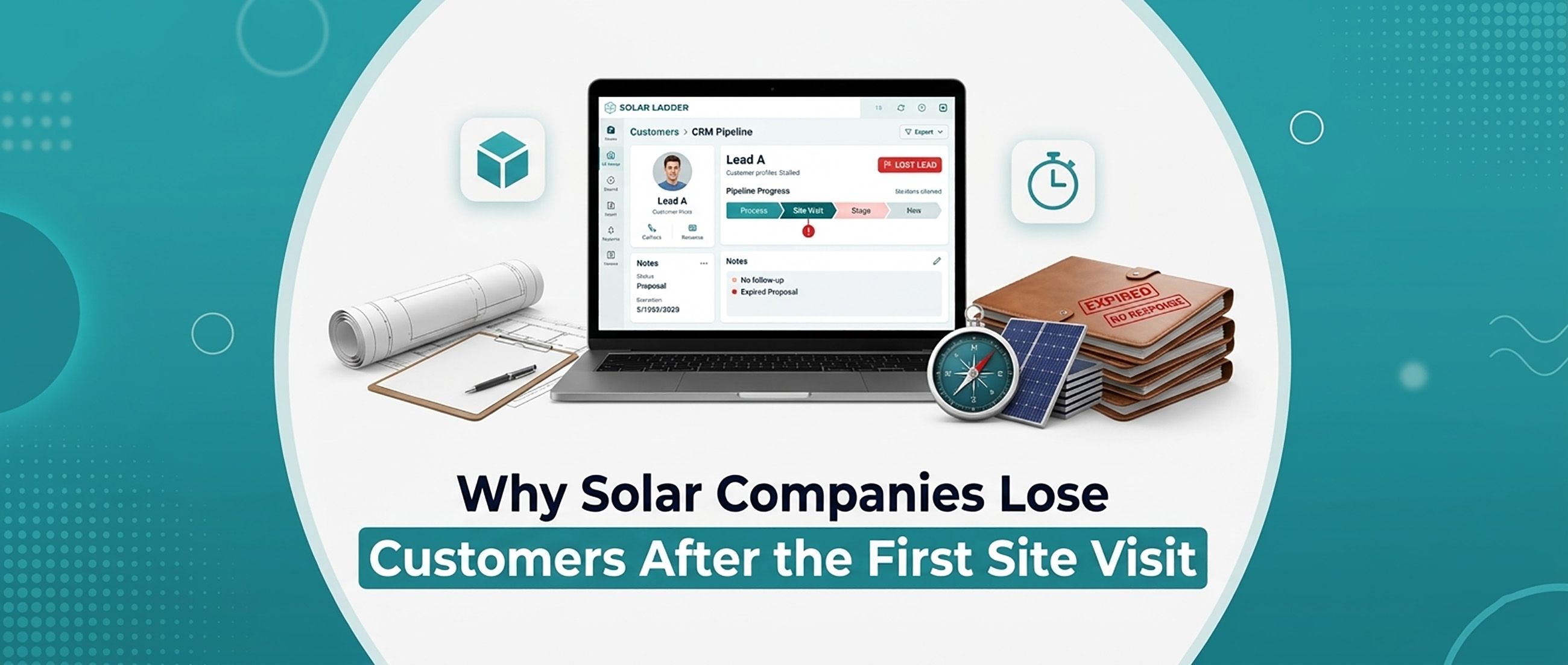
TL;DR A successful site visit doesn't guarantee a successful sale. Many Solar EPC companies lose customers because of slow proposal turnaround, poor follow-ups, lack of personalization, weak communication, and unorganized sales processes. By combining fast 3D solar designs, instant proposals, CRM automation, and structured follow-ups, Solar EPC companies can significantly improve conversion rates and win more projects.
Why Solar Companies Lose Customers After the First Site Visit
For most Solar EPC companies, getting a site visit is considered a major milestone.
The customer has already:
- Shown genuine interest
- Shared their electricity bills
- Scheduled a survey
- Invested time in meeting your sales team
At this stage, many businesses assume the deal is almost closed.
Unfortunately, this is where many opportunities are lost.
A homeowner or business owner may meet three or four installers before making a decision. If your company fails to deliver a professional and timely experience after the site visit, another installer will likely win the project.
The problem is rarely the solar panels themselves. More often, customers choose the company that communicates better, responds faster, and inspires more confidence.
Let's look at the biggest reasons Solar EPC companies lose customers after the first site visit—and how to fix them.
1. The Proposal Takes Too Long
One of the biggest reasons for losing deals is a delayed proposal.
Many companies still follow this process:
- Salesperson completes the survey.
- Information is sent to the engineering team.
- Engineers prepare the design.
- Finance calculates pricing.
- Proposal is created manually.
- Customer receives it several days later.
Meanwhile, a competitor may have already shared a professional proposal on the same day.
Customers often interpret speed as professionalism.
How to fix it
Use software that allows sales teams to create 3D solar designs and branded proposals quickly, reducing dependency on multiple teams.
2. Customers Don't Understand the Solution
Many proposals are filled with technical terminology:
- kWp
- String sizing
- Inverter specifications
- Module efficiency
While technically correct, these details don't answer the customer's biggest questions:
- How much will I save?
- What will my rooftop look like?
- When will I recover my investment?
- Why is your solution better?
A proposal should simplify the decision—not complicate it.
3. No Follow-Up Strategy
Many sales teams either:
- Call customers every day until they become annoyed, or
- Forget to follow up completely.
Neither approach works.
Customers need structured communication that adds value.
Examples include:
- Answering common questions
- Sharing financing options
- Sending project case studies
- Explaining ROI
- Providing customer testimonials
Consistent, relevant follow-ups keep your company top of mind.
4. Slow Response Times
Customers comparing multiple installers usually contact everyone within a short period.
If they ask a question and your reply arrives hours—or even days—later, confidence starts to decline.
Fast responses demonstrate:
- Professionalism
- Reliability
- Customer focus
This applies to calls, emails, and WhatsApp messages alike.
5. Generic Proposals Instead of Personalized Solutions
Customers want to feel that the system has been designed specifically for them.
A generic quotation with only pricing often fails to create confidence.
Instead, include:
- Customized 3D rooftop designs
- Estimated annual generation
- Electricity bill savings
- ROI and payback period
- Installation timeline
- Warranty details
Personalization makes customers feel understood.
6. Poor Communication Between Sales and Operations
Sometimes the sales team promises one thing, while the operations team delivers another.
Examples include:
- Incorrect installation timelines
- Missing accessories
- Design changes after approval
- Pricing misunderstandings
Disconnected internal communication creates a poor customer experience before the project even starts.
An integrated workflow keeps everyone aligned.
7. Customers Don't See Social Proof
Solar is a high-value investment.
Before signing a contract, customers look for reassurance.
Share:
- Google reviews
- Customer testimonials
- Before-and-after installations
- Case studies
- Photos of completed projects
Seeing successful installations builds confidence in your company.
8. No Clear Next Steps
Many site visits end with:
"We'll send you the quotation."
Customers are left wondering:
- When will I receive it?
- What happens after approval?
- What documents are required?
- How long will installation take?
A clear roadmap reduces uncertainty.
For example:
- Site survey completed.
- Proposal shared within 24 hours.
- Proposal discussion.
- Financing (if required).
- Order confirmation.
- Installation scheduling.
- Commissioning.
Customers appreciate knowing what comes next.
9. Losing Track of Leads
As your business grows, managing leads through spreadsheets and WhatsApp becomes difficult.
Common problems include:
- Missed callbacks
- Duplicate records
- Forgotten enquiries
- Inconsistent follow-ups
A CRM ensures every customer interaction is tracked and nothing falls through the cracks.
How Solar Ladder Helps Convert More Site Visits into Sales
The period immediately after the site visit is where Solar Ladder helps Solar EPC companies create a faster, more professional customer experience.
👥 CRM & Lead Management
Keep every enquiry organized with:
- Lead source tracking
- Customer history
- Follow-up reminders
- Sales pipeline visibility
- Activity tracking
No more missed opportunities.
☀️ 3D Solar Design (Laptop & Mobile)
Create interactive rooftop designs during or immediately after the site visit.
Features include:
- RCC rooftops
- Metal sheet roofs
- Industrial sheds
- Walkways
- Handrails
- Safety lifelines
Customers can visualize their future system before making a decision.
📄 Instant Proposal Generation
Generate professional proposals in minutes with:
- Customized designs
- ROI calculations
- Payback analysis
- Generation estimates
- Bill of Materials (BOM)
- Company branding
Respond faster than competitors.
🤖 Workflow Automation
Automate repetitive activities such as:
- Proposal reminders
- Follow-up notifications
- Lead assignments
- Customer communication
Ensure every prospect receives timely attention.
📋 Project Management
After the customer signs, seamlessly transition to execution by tracking:
- Tasks
- Milestones
- Team assignments
- Documentation
- Installation progress
Customers experience a smooth handover from sales to operations.
📡 RMS & 🔧 O&M
Continue building trust after installation with:
- Live system monitoring
- Generation reports
- Performance alerts
- Maintenance scheduling
- AMC management
Great after-sales support leads to referrals and repeat business.
Common Mistakes Solar Sales Teams Make After Site Visits
- Waiting several days to send proposals.
- Failing to personalize recommendations.
- Using manual follow-up processes.
- Relying on WhatsApp and Excel to manage leads.
- Not explaining ROI in simple language.
- Forgetting to showcase customer success stories.
- Providing no visibility into the next steps.
- Poor coordination between sales and operations.
- Inconsistent communication with customers.
- Losing lead information due to disconnected systems.
Best Practices to Increase Post-Site Visit Conversions
- Send proposals within 24 hours—or sooner whenever possible.
- Use 3D solar designs to improve customer understanding.
- Track every lead in a CRM.
- Automate follow-up reminders.
- Share testimonials and completed project photos.
- Clearly explain savings, ROI, and payback.
- Provide a transparent installation timeline.
- Keep customers updated throughout the sales process.
- Align sales and operations teams.
- Measure conversion rates from site visit to signed contract.
Conclusion
A site visit is not the finish line—it's the beginning of the customer's decision-making process.
The companies that win more solar projects are rarely those with the lowest prices. They are the ones that deliver the fastest proposals, communicate clearly, provide personalized solutions, and maintain consistent follow-ups.
By replacing manual processes with integrated digital workflows, Solar EPC companies can improve customer confidence and convert more site visits into signed contracts.
With Solar Ladder, your team can manage the complete journey through CRM, Lead Management, 3D Solar Design, Instant Proposals, Workflow Automation, Project Management, RMS, and O&M—helping you turn more surveys into successful installations.
Frequently Asked Questions
Common reasons include delayed proposals, weak follow-ups, poor communication, generic quotations, and lack of a structured sales process.
The sooner the better. Many successful Solar EPC companies aim to share a professional proposal within 24 hours, and some can do so the same day using digital proposal software.
Interactive 3D designs help customers visualize the final installation, making it easier to understand the proposed solution and increasing confidence in the purchase.
A CRM helps track customer interactions, schedule follow-ups, organize lead information, and prevent missed sales opportunities.
A strong proposal should include a customized system design, estimated energy generation, savings calculations, ROI, payback period, equipment details, warranties, and installation timelines.
Solar Ladder enables Solar EPC companies to create instant proposals, generate 3D designs, automate follow-ups, manage leads through CRM, coordinate installations with project management, and provide long-term customer support through RMS and O&M.