TL;DR
The solar industry doesn't have a technology problem anymore—it has an execution problem. Most EPCs already have access to quality solar panels, inverters, financing, and design software. What separates high-growth companies from the rest is operational excellence. From project management and task tracking to team collaboration and customer communication, streamlined operations help EPCs complete projects faster, reduce delays, and improve profitability. Solar Ladder's Project Management feature helps solar businesses turn scattered processes into a single, organized workflow.
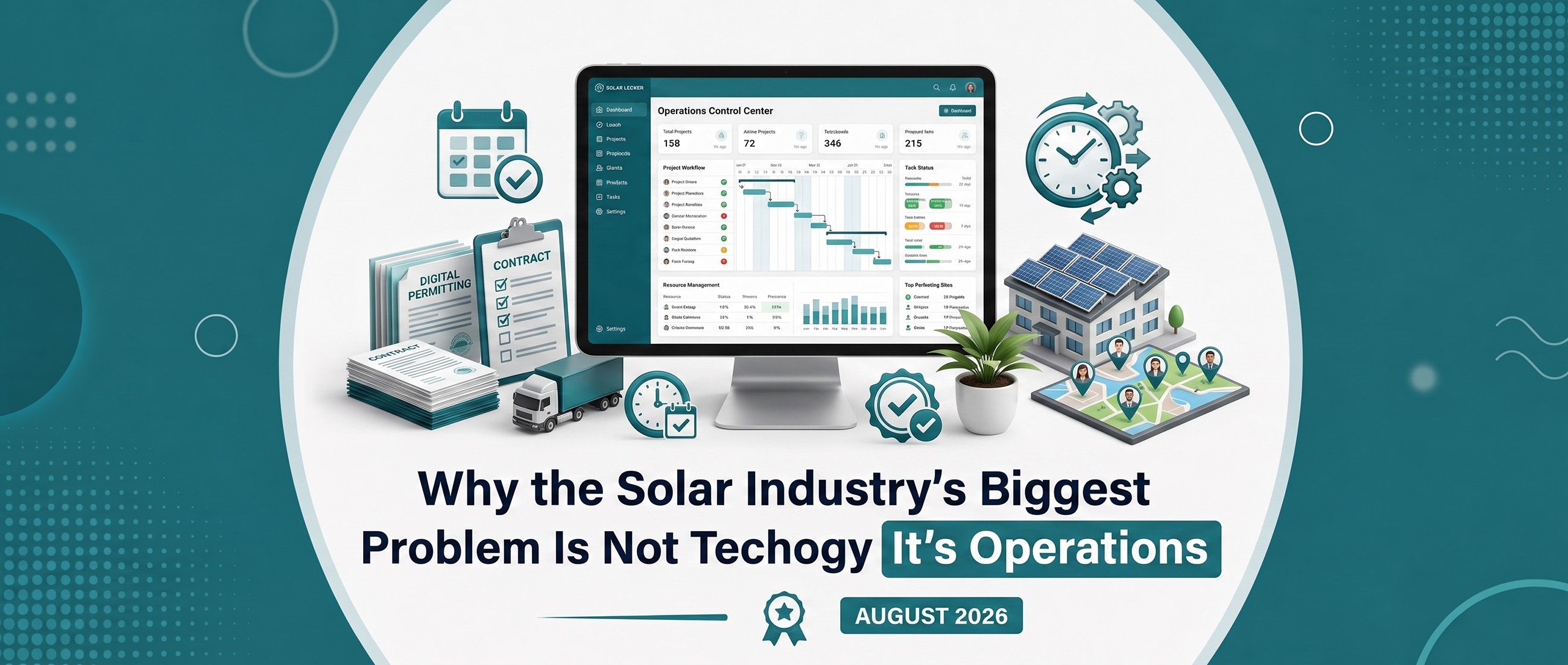
Why the Solar Industry's Biggest Problem Is Not Technology — It's Operations
The solar industry has never had better technology.
Solar panels are more efficient than ever. Inverters are smarter. Batteries are becoming increasingly affordable. AI-powered design tools can generate layouts within minutes, and financing options have made rooftop solar accessible to millions.
Yet despite all these technological advances, thousands of solar projects continue to face delays, budget overruns, communication gaps, and dissatisfied customers.
The problem isn't technology anymore.
The real challenge is operations.
For most solar EPC companies, growth isn't limited by their ability to design systems—it's limited by their ability to execute projects consistently.
Technology Has Become a Commodity
Almost every solar installer today has access to:
- High-efficiency solar modules
- Reliable inverter brands
- 3D design software
- Digital proposals
- Financing partners
- CRM systems
These technologies are no longer competitive advantages.
What differentiates successful EPC companies today is how efficiently they move projects from Lead → Survey → Design → Approval → Installation → Commissioning.
The companies that master operations consistently deliver better customer experiences and higher profits.
According to the International Energy Agency (IEA), global solar deployment continues to accelerate, making operational efficiency increasingly important as installation volumes grow.
Where Solar Projects Actually Break Down
Very few solar projects fail because engineers cannot design the system.
Instead, delays usually happen because someone forgets a task.
Common operational problems include:
- Site surveys getting delayed
- Permit approvals not being followed up
- Procurement teams receiving incorrect BoMs
- Installation teams arriving before materials
- Customers repeatedly asking for status updates
- Internal communication happening across WhatsApp groups and spreadsheets
None of these are technology problems.
They're workflow problems.
As project volumes increase, manual coordination becomes nearly impossible.
Spreadsheets Don't Scale
Many growing EPCs still manage projects using:
- Excel sheets
- WhatsApp groups
- Phone calls
- Sticky notes
- Individual employee memory
This may work for ten projects.
It doesn't work for one hundred.
When information is scattered across multiple tools, nobody has a complete picture of project status.
Operations become reactive instead of proactive.
The Project Management Institute consistently highlights poor communication and ineffective project management as leading contributors to project delays across industries.
The Hidden Cost of Poor Operations
Operational inefficiencies don't just delay projects.
They directly reduce profitability.
Consider what happens when:
- Installation teams wait for missing materials.
- Engineers revisit sites due to incomplete information.
- Sales teams repeatedly answer customer update requests.
- Managers spend hours tracking project status manually.
These "soft costs" quietly erode margins.
Improving operational efficiency often delivers greater business impact than negotiating a slightly cheaper module price.
Project Management Is Becoming the Competitive Advantage
As the solar market becomes more competitive, customers increasingly expect transparency.
They want to know:
- What stage is my project in?
- When is installation scheduled?
- Has my approval been completed?
- Is procurement finished?
- What happens next?
Internally, managers need visibility too.
Instead of chasing updates from multiple departments, they should be able to view every project's progress from one dashboard.
That's exactly where modern project management systems make a difference.
How Solar Ladder Helps EPCs Execute Better
Solar Ladder isn't just proposal software.
It's built to help solar EPCs manage the entire project lifecycle.
With Solar Ladder's Project Management feature, every project follows a structured workflow—from sales handover to installation and completion.
Teams can:
- Assign project owners
- Track project milestones
- Monitor task progress
- Collaborate across departments
- Maintain a centralized project timeline
- Reduce communication gaps
- Improve accountability
Instead of relying on scattered spreadsheets or endless WhatsApp messages, every stakeholder works from a single source of truth.
This creates smoother handoffs between sales, design, procurement, and installation teams.
The result is fewer delays, happier customers, and faster project completion.
If you're already using Solar Ladder's proposal tools, integrating project management creates a seamless workflow from customer acquisition to project delivery.
Operations Will Define the Next Generation of Solar Leaders
The next decade of solar growth won't be won by companies with slightly better hardware.
It will be won by companies that execute faster, communicate better, and deliver projects consistently.
Technology enables growth.
Operations sustain it.
As project volumes increase, EPCs that invest in structured project management today will be better positioned to scale tomorrow.
If your team is still coordinating installations through spreadsheets and chat groups, the question isn't whether you need better operations.
It's how long you can continue growing without them.
Frequently Asked Questions
Project management helps EPCs coordinate sales, engineering, procurement, installation, and customer communication, reducing delays and improving project completion rates.
Most delays are caused by operational issues such as missed approvals, poor communication, scheduling conflicts, procurement delays, and lack of workflow visibility rather than technical limitations.
Solar Ladder centralizes project tracking, task assignment, milestone management, team collaboration, and workflow visibility in one platform, helping EPCs complete projects more efficiently.
Yes. Even smaller EPCs benefit from standardized workflows that reduce manual tracking, improve accountability, and prepare the business for future growth.