TL;DR
South African solar installers are losing deals — not on price or quality, but on speed. A competitor who sends a professional proposal the same day wins the job. Here's how to fix that:
Standardise your proposal template with Eskom savings, Section 12B tax info, and financing options built in
Use satellite imagery for your initial roof assessment — skip the site visit for smaller jobs
Send an indicative quote within hours, then follow up with the full proposal within 24 hours
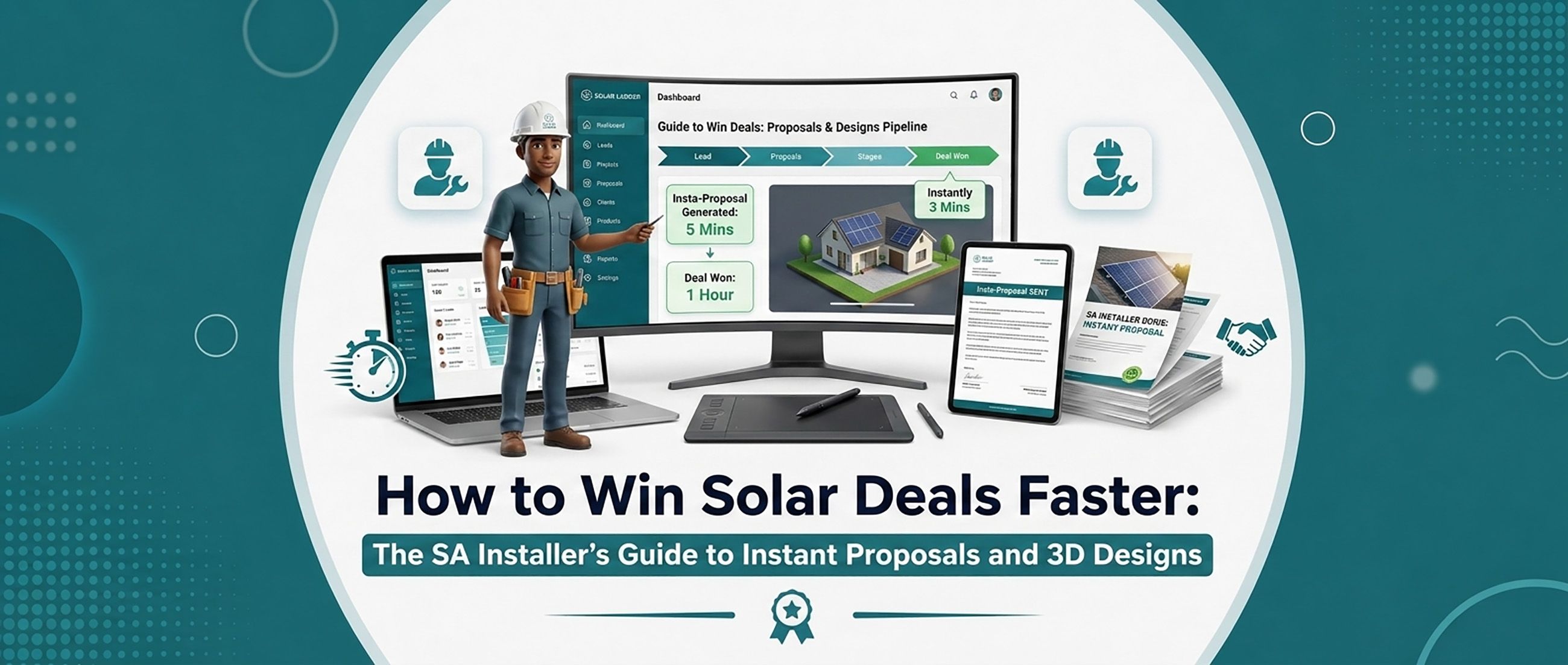
Solar Ladder automates your 3D roof design and generates a professional, branded proposal in under 15 minutes — so you close deals before competitors finish their spreadsheets
The Scene That Every SA Solar Installer Knows Too Well
It's a Tuesday afternoon. You've just left a site visit in Fourways — a promising lead, a C&I client with a 50 kW rooftop system in mind, serious about cutting their Eskom bill. The meeting went well. They asked you to send a proposal "as soon as possible."
You get back to the office. You fire up your spreadsheet. You start pulling panel specs, checking stock availability, calculating string configurations manually. You need to sketch out a roof layout, estimate shading, work out the load profile. Then format everything into a Word doc or PDF that looks halfway professional.
By Thursday morning, you hit send. Two days later. You follow up. The client responds:
"Sorry, we went with another installer. They sent us a full proposal with a 3D design the same afternoon we met."
That's not bad luck. That's a systems problem. And it's costing South African solar businesses hundreds of thousands of rands in lost revenue every single month.
The Reality Check: What Slow Quoting Is Actually Costing You
Here's the uncomfortable truth: speed is now a selling point in itself.
South Africa's solar market has matured rapidly. The residential and C&I sub-segments have more than 200 registered installers nationwide, and consolidation is accelerating as larger EPC firms acquire regional installers to capture economies of scale. Your potential client almost certainly contacted two or three competitors the same day they contacted you. Mordor Intelligence
In that environment, being second is the same as losing.
Consider the numbers. If your average residential system is worth R120,000 and your average C&I system sits at R450,000, and you're losing just two deals a month to faster competitors, that's potentially R1.1 million in lost revenue per month — not because your pricing was wrong, not because your workmanship is inferior, but simply because someone else moved faster.
Beyond lost deals, there's the hidden cost of your own team's time. If a qualified estimator or engineer is spending 6–8 hours per quote — pulling load data, sketching roof layouts, formatting proposals — that's capacity that isn't being used to close more jobs, manage existing installations, or handle SSEG applications with your local municipality. With 278 municipalities each running their own SSEG registration process and different documentation requirements, there's already enough compliance complexity to keep your team busy.
The old way of quoting isn't just slow. It's a competitive liability.
The Actionable Strategy: Three Things You Can Do Right Now
You don't have to overhaul your entire business overnight. Start here:
1. Standardise your proposal template — immediately
If every quote your business produces looks slightly different, takes a different amount of time, and depends entirely on who built it, you have a process problem. Create a single, branded proposal template that covers:
- System size and component specifications
- A clear financial breakdown showing monthly savings against current Eskom tariffs
- Payback period and ROI (especially relevant now that Section 12B allows a 100% first-year tax write-off for qualifying commercial systems)
- SSEG registration status and what the approval process will look like for that specific municipality
- Financing options — cash purchase, instalment plan, or rent-to-own
A standardised template alone can cut your quoting time in half.
2. Use satellite imagery for your initial roof assessment
Stop making site visits the first step in your quoting process. For residential and smaller commercial rooftops, satellite imagery is accurate enough to give you panel count, approximate shading profile, and array layout before you ever leave the office. Reserve physical site visits for large C&I projects or installations with complex shading or structural considerations.
This single change can compress your response time from 48–72 hours to same-day.
3. Separate your "indicative quote" from your "final proposal"
Train your sales team to send a high-level indicative quote within hours of a site visit or enquiry — even if it's a ballpark. Something that shows the client you're engaged, professional, and responsive. Then follow up with the detailed proposal within 24 hours. Most clients won't go elsewhere if you've already demonstrated responsiveness and professionalism in that first contact.
The Solar Ladder Advantage: From Days to Minutes
These tactical improvements will help. But if you're serious about winning deals at scale — consistently, reliably, without burning out your estimating team — you need a platform built specifically for this.
That's exactly what Solar Ladder was designed to do.
Solar Ladder is an all-in-one solar proposal, 3D design, and project management platform built for solar installers and EPC companies. Here's where it changes the game for SA businesses:
Automated 3D Satellite Design Using satellite imagery, Solar Ladder generates an accurate 3D model of your client's roof in minutes. You can map panels, calculate shading, optimise string configurations, and produce a professional design — without a CAD technician and without a manual site visit for the initial assessment. What used to take your team half a day takes Solar Ladder minutes.
Instant, Dynamic Quoting Engine Pull live component data, configure your system, and generate a complete, branded proposal — including financial modelling, Eskom tariff savings projections, payback period, and financing options — in a single workflow. Your client gets a proposal that looks like it took your team days to produce. It took you 15 minutes.
Winning More Deals, Not Just Faster Ones When a client receives a beautifully designed, professionally formatted proposal — complete with a 3D visual of panels on their actual roof — the same afternoon they met you, the psychological effect is significant. It signals capability, professionalism, and investment in the relationship. You're no longer just a quote. You're the obvious choice.
- Close more deals by responding faster than competitors
- Protect your margins by spending engineering time on execution, not estimating
- Scale your pipeline without scaling your team headcount proportionally
- Customise proposals with your branding, pricing tiers, and financing options including monthly instalment and rent-to-own structures
For SA installers navigating everything from Johannesburg's City Power SSEG requirements to Cape Town's fast-track approval process, having a platform that keeps your documentation clean and consistent isn't a luxury — it's a risk management tool.
Conclusion: The Fastest Proposal Wins More Than the Cheapest One
The South African solar market is competitive, growing, and unforgiving of slow processes. Your clients are comparing you to every other installer they called. The one who earns trust first — through speed, professionalism, and a proposal that actually shows them what their system will look like — is the one who wins the deal.
You've built a business on quality workmanship and real expertise. It's time your proposals reflected that — and delivered it fast enough to matter.
Ready to see how Solar Ladder can take your quoting from days to minutes?
👉 Book your free demo today and see firsthand how SA installers are closing deals before competitors even finish their spreadsheets.
Frequently Asked Questions
A competitive turnaround is same-day or within 24 hours of a site visit. Most SA installers using manual methods take 2–4 days, which is long enough for a client to go with a faster competitor. With automated proposal tools like Solar Ladder, a full professional proposal with 3D design can be produced in under 15 minutes.
A strong SA solar proposal should include system size and component specs, projected Eskom tariff savings, ROI and payback period, Section 12B tax write-off information (for commercial clients), SSEG registration details for the relevant municipality, and financing options such as cash purchase, monthly instalments, or rent-to-own.
Yes — for most residential and smaller commercial rooftops, satellite-based roof assessment is accurate enough to produce an initial 3D design, panel layout, and shading estimate. Physical site visits are best reserved for large C&I projects or installations with complex structural considerations. Tools like Solar Ladder automate this using satellite imagery, saving hours per project.
Solar Ladder is an all-in-one platform that automates 3D satellite roof design, generates instant dynamic quotes, and produces a fully branded professional proposal — all in a single workflow. SA installers can respond to a lead with a complete proposal including financial modelling and Eskom savings projections within minutes of a site visit.
In a competitive market where clients contact multiple installers simultaneously, the first professional proposal often wins — even if it isn't the cheapest. Speed signals capability and commitment. A client who receives a detailed 3D proposal the same afternoon they met you is far less likely to wait for a competitor's quote to arrive two days later.