TL;DR (Too Long; Didn't Read)
Intent Matters: Social media ads capture passive browsers; Google Ads capture active buyers searching for solutions right now.
Keyword Precision: Avoid overly broad phrases. Target transactional phrases like "commercial solar rooftop installation cost" and location-specific keywords.
Ad Copy Trust: Highlight bankable metrics like 25-year structural safety, PM-Surya Ghar subsidy clarity, and guaranteed financial paybacks.
Stop Ad Waste: Actively maintain a robust negative keyword list to weed out low-budget DIY searches or generic subsidy application download lookups.
Instant Sync: High-intent leads grow cold fast. Feed your Google Ad conversions directly into a specialized solar CRM to ensure instantaneous follow-up.
Introduction
The year 2026 is a massive milestone for the Indian rooftop solar ecosystem. Spurred by escalating commercial electricity tariffs and widespread consumer push from initiatives like the PM-Surya Ghar: Muft Bijli Yojana, millions of businesses and premium homeowners are actively exploring solar options.
However, for Engineering, Procurement, and Construction (EPC) companies, the marketing landscape has grown incredibly noisy. If your primary lead-generation framework relies entirely on broad social media graphics, you have likely noticed a frustrating trend: high lead volume, but incredibly low conversion rates. Your sales representatives spend hours chasing people who thought panels were entirely free or who don't actually own their properties.
To capture premium, highly qualified clients—such as cold storage operators, manufacturing factories, and luxury bungalow owners—you need to align your marketing where active buying intent resides. That is exactly where a hyper-targeted Google Ads strategy shifts the game. Unlike passive social scrolling, a user typing a query into Google is actively hunting for a commercial or residential solar partner. Here is your step-by-step blueprint to build a high-converting solar Pay-Per-Click (PPC) engine.
Step 1: Target High-Intent Transactional Keywords
The biggest mistake amateur marketers commit when launching Google Ads is bidding on overly broad, exploratory keywords like "solar power" or "solar panels." These broad terms attract school students writing research papers, job seekers, and DIY hobbyists, rapidly draining your budget.
To extract maximum ROI, focus strictly on high-intent transactional and localized keywords.
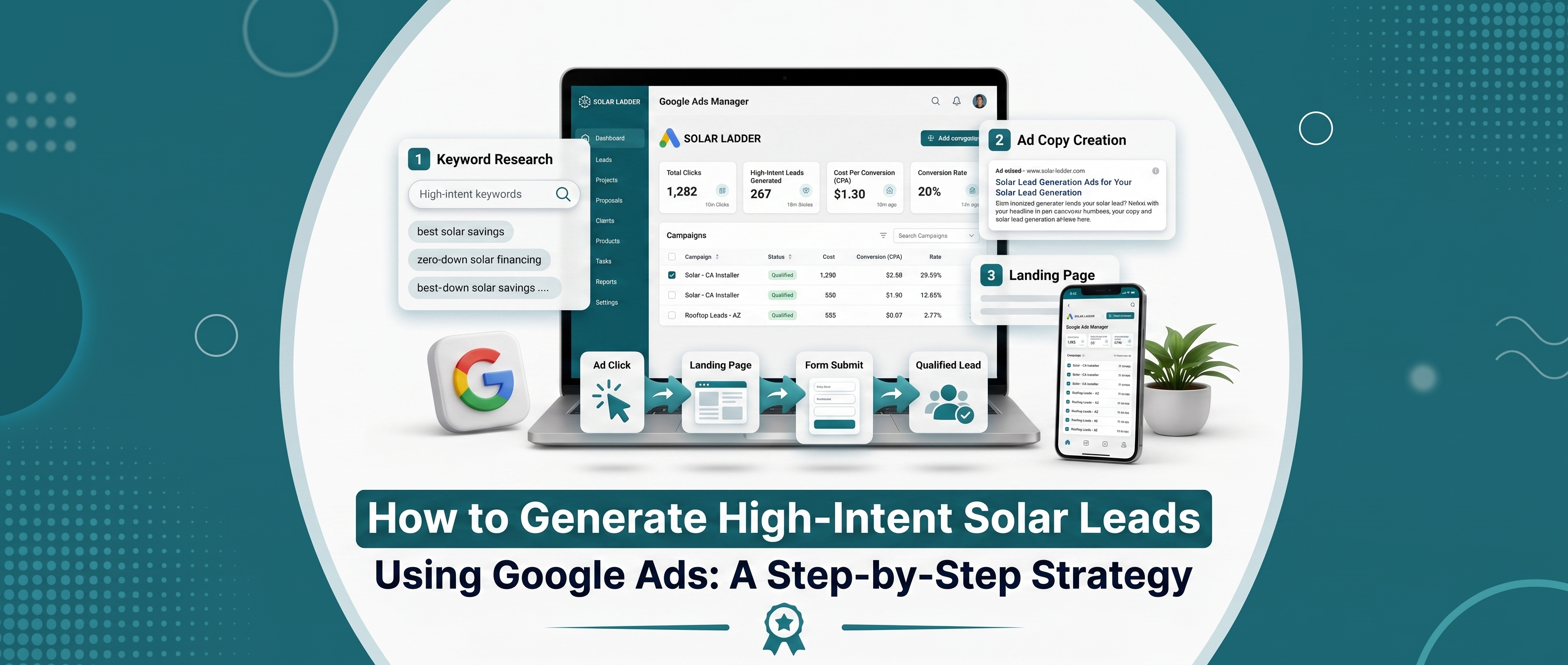
+-------------------------------------------------------------+ | KEYWORD INTENT COMPARISON | +-------------------------------------------------------------+ | Broad / Low Intent : "solar energy system" | | High Intent (C&I) : "commercial solar epc company Mumbai" | | High Intent (Resi) : "10kw rooftop solar installation cost"| +-------------------------------------------------------------+
Target terms that prove the user has a budget and an urgent timeline:
- "Top solar EPC company in Delhi NCR"
- "Commercial solar rooftop installation cost"
- "Industrial solar panel suppliers Pune"
- "On-grid solar system price for factory"
By overlaying explicit geographical modifiers (like city or state names), you train Google’s system to prioritize buyers situated directly within your operational deployment zones.
Step 2: Write Ad Copy That Sells Trust, Not Just Price
In the competitive Indian solar marketplace, joining a text-based "race to the bottom" on pricing destroys your net margins. Your ad copy shouldn't just scream "Cheapest Solar Panels." Instead, write copy that signals engineering excellence, asset reliability, and compliance.
Your ad headlines and descriptions should hit major trust levers:
- Financial Proof: Use concrete figures like "Reduce Factory Bills by 80%" or "3-Year System Payback Period."
- Compliance Validation: Mention policy structures like "Approved MNRE Channel Partner" or "Complete Net-Metering Assistance Provided."
- Structural Safety: Highlight extreme weather structural integrity, such as "STAAD Pro Rated Heavy-Duty Mounting Structures."
Step 3: Direct Traffic to a Dedicated Landing Page
Never, under any circumstances, direct your paid Google Ads traffic to your generic website homepage. A standard homepage contains dozens of distracting links—About Us sections, career openings, blog rolls—which break the user's conversion path.
Send your clicks to a highly optimized, fast-loading Landing Page focused solely on one action: getting the user to request a customized quotation.
Pro Tip: Capture their attention instantly by embedding an interactive digital asset hook. Allow them to visualize their potential array arrangement or see a sample of an institutional-grade layout.
To understand what elements build trust on a digital proposal interface, review our evaluation of The Solar Proposal That Closes vs. The One That Gets Ignored.
Step 4: Prevent "Ad Waste" with Negative Keywords
What you don't want to show up for is just as critical as what you do target. Negative keywords are terms you explicitly tell Google to block your ads from appearing alongside. Failing to maintain this list is the number one reason solar campaigns fail.
Build an aggressive negative keyword list containing terms like:
- Free, cheap, DIY, repair, training, course, job, salary, subsidy form PDF download, solar toy, secondary market.
By cleaning your campaign parameters of non-commercial clutter, your cost-per-lead drops significantly, ensuring every single rupee spent goes toward acquiring profitable solar contracts.
Step 5: Route Google Leads Instantly into a Solar CRM
High-intent leads have a very short shelf life. When an industrial facility head requests a solar design quote via your Google Ad, they are likely looking at two other options simultaneously. If your team takes hours to respond, you have already lost the project.
+-----------------------------------------------------------------+ | HIGH-SPEED CONVERSION PATH | +-----------------------------------------------------------------+ | Google Search -> Click Ad -> Form Submit -> Instant CRM Sync | | -> Rep Calls in <15 Mins -> 3D Mobile Design Shared via WhatsApp| +-----------------------------------------------------------------+
To optimize your sales speed, automate your pipeline. Ensure your Google Ad lead capture extensions sync natively with your central software platform. This keeps operations organized, ensuring your reps follow up immediately while consumer intent remains at an absolute peak.
Discover how a unified platform eliminates pipeline leakage in our comprehensive manual on Solar Software India: The Complete Guide for 2026, and learn how to manage your sales pipeline seamlessly via the Importance of Solar CRM Software in 2026.
Conclusion
Generating high-intent solar leads through Google Ads isn't about throwing massive amounts of money at search engines; it is about absolute precision. By mapping out high-intent keywords, leveraging copy focused on asset security, maintaining tight negative filters, and instantly capturing those leads inside an execution-ready solar CRM, you turn digital marketing into a predictable revenue stream.
Stop competing for low-margin commodity work. Refine your Google Ads framework, project a premium brand position, and capitalize on the massive scale of the Indian solar energy boom. For deeper strategic advice on maximizing conversions across your entire business framework, check out our guide on 5 Proven Strategies to Increase Your Solar EPC Sales in 2026.
Frequently Asked Questions
Budgets depend heavily on your local target geography and target demographic (residential vs. commercial). However, a great practice is to set a localized testing budget for the first 30 days, focused strictly on specific high-intent transactional search terms in your city, before scaling up funding based on incoming data.
Do not just track "Clicks" or raw form submissions. Map your Google ad accounts directly into a dedicated tool like a solar CRM. This allows your management to trace a signed multi-kilowatt client contract directly back to the exact keyword they clicked, verifying your true return on ad spend (ROAS).