TL;DR
Solar EPC (Engineering, Procurement, and Construction) companies invest heavily in digital marketing and lead generation, yet many struggle to convert inquiries into sales meetings and site visits.
This drop-off, known as solar lead leakage, can occur because of delayed responses, disconnected lead channels, manual data entry, complicated site survey scheduling, and generic proposals.
By implementing an automated solar CRM, using mobile-first site survey applications, and presenting interactive 3D solar proposals quickly, EPC companies can improve lead management, reduce customer acquisition costs (CAC), and build a more efficient sales pipeline.
Solar Lead Leakage: Where EPC Companies Lose Potential Customers Before the First Meeting
Introduction
Generating high-intent inquiries is only half the battle in today's increasingly competitive renewable energy market. Modern residential and commercial solar buyers expect prompt communication, technical transparency, and clear answers to their financial questions.
When prospective customers submit an inquiry, their interest is an opportunity for solar Engineering, Procurement, and Construction (EPC) companies to start building trust. However, slow follow-ups, fragmented customer information, and delayed proposals can cause potential customers to lose interest before the first sales meeting.
Research and industry discussions around solar soft costs highlight the importance of customer acquisition, system design, permitting, and administrative efficiency. When qualified leads disappear before a discovery call or site visit, the cost of acquiring each customer increases, putting pressure on operational margins and business growth.
So, where are potential customers slipping through the cracks, and how can solar EPC companies prevent lead leakage?
The Hidden Cost of Pipeline Friction
In a high-value purchase such as a solar photovoltaic (PV) system, customers often need time to evaluate their options, understand potential savings, and compare installers.
Immediately after submitting an inquiry, a prospective customer's interest may be high. Every delayed response, repeated question, and unnecessary administrative step can reduce that momentum.
Where Solar Leads Leak
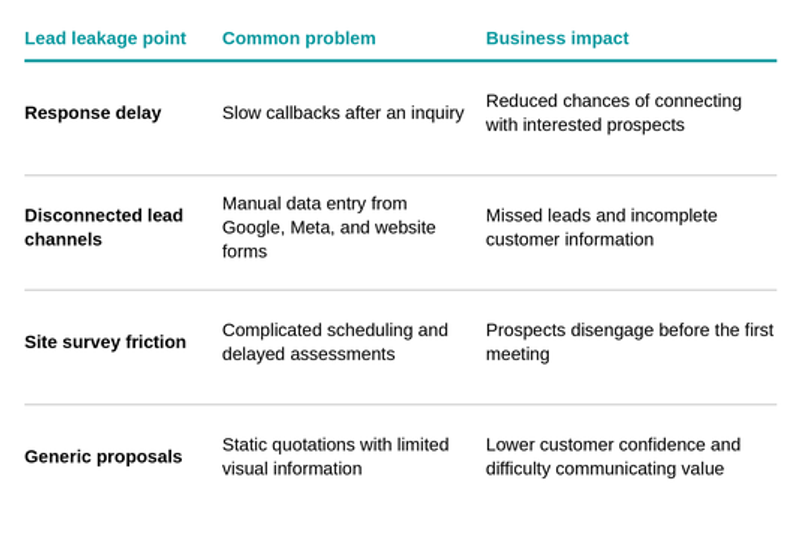
When EPC companies lack a unified lead management system, these problems can occur across multiple stages of the sales process.
Breakdown: The 4 Critical Breakpoints Driving Solar Lead Leakage
1. The Speed-to-Lead Delay
When a prospective customer submits an inquiry through Google Ads or performance marketing campaigns, the opportunity to engage that customer begins immediately.
Research published by Harvard Business Review has highlighted the importance of responding quickly to online leads. For solar EPC companies, a delayed callback can mean losing the opportunity to engage a customer while their interest is still high.
The operational bottleneck
In traditional solar sales operations, leads from Meta, Google, and third-party platforms may be exported manually into spreadsheets or distributed to sales representatives through emails and messaging groups.
The business impact
By the time a sales representative calls several hours later, the prospect may already have spoken with competing installers, become less interested, or questioned the company's responsiveness.
How to prevent it
- Route new leads to the appropriate sales representative automatically.
- Set clear response-time targets for incoming inquiries.
- Send an immediate WhatsApp message or SMS acknowledging the inquiry.
- Track first-contact attempts and follow-up status in a centralized CRM.
A faster response process helps sales teams engage prospects before their interest declines.
2. Disconnected Intake Channels and Manual Data Entry
Solar EPC companies generate inquiries through multiple channels, including digital advertisements, local SEO, website forms, referrals, and field marketing.
Without centralized lead capture, managing these sources becomes an administrative challenge.
How lead leakage happens
Multiple inbound lead channels ↓ Manual data entry and spreadsheets ↓ Missing information and delayed outreach ↓ Prospect disengagement
When customer interactions are scattered across spreadsheets, individual call logs, and unstructured WhatsApp conversations, several problems can arise.
Overlooked contacts: Leads may be missed, assigned to multiple representatives, or entered with incorrect phone numbers and email addresses.
Lost customer context: Important details, such as monthly electricity bills, roof type, project requirements, and interest in battery storage, may not reach the field technician or design team.
Repeated questions: Customers may have to provide the same information multiple times, creating a frustrating experience.
To build a more organized acquisition process, explore our guide on 5 Ways to Generate Leads for Solar Business.
How to prevent it
Use a centralized solar CRM to capture inquiries, assign leads, maintain communication histories, and give sales and field teams access to relevant customer information.
3. High-Friction Site Survey Scheduling
The period between initial qualification and the physical or virtual site assessment is another important point where potential customers can drop out of the sales pipeline.
Even an interested prospect may lose momentum when arranging a site survey requires repeated calls, long waiting periods, or unnecessary paperwork.
Common challenges include:
- Scheduling back-and-forth: Multiple calls and messages are required to confirm an assessment.
- Manual field execution: Paper forms and handwritten notes make it harder to capture and share information consistently.
- Missing site details: Incomplete roof measurements, obstruction photographs, or electricity bill information can lead to additional visits.
- Delayed post-survey proposals: Waiting several days for an initial system layout gives competitors more time to engage the customer.
How to prevent it
Standardize the site assessment process using digital forms and mobile applications. Allow field teams to capture roof photographs, measurements, electrical details, and utility bill information in a structured format.
When the required information is available to the design team immediately, EPC companies can reduce administrative delays and move prospects toward the proposal stage more efficiently.
4. Delivering Generic, Static Initial Proposals
Solar energy is an investment in future electricity savings, energy independence, and long-term system performance. Customers need to understand how a proposed installation will work on their property before making a purchasing decision.
A basic PDF quotation containing panel counts and prices may not provide enough visual or technical information to help a customer evaluate the project.
A traditional quotation may include:
- Static pricing information
- Basic equipment details
- Limited visualization of the rooftop
- Minimal information about shading and system layout
An interactive 3D proposal can provide:
- A visual representation of the rooftop solar installation
- Greater clarity about panel placement
- Shadow analysis and shading-related insights
- Project-specific system information
- A clearer presentation of expected savings and financial considerations
Without suitable rooftop visualization and relevant financial information, customers may struggle to understand the proposed system's value.
Learn how mobile-first technology can improve proposal delivery in our guide to the Best Mobile 3D Design App for Installers.
3 Actionable Strategies to Plug Solar Lead Leakage
Solar EPC companies can improve lead conversion by addressing response delays, fragmented data, and slow proposal delivery.
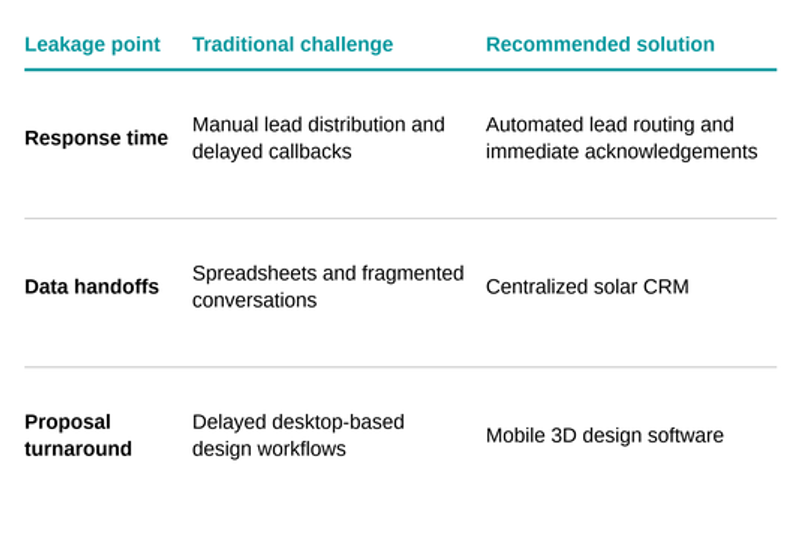
1. Deploy Instant Lead Capture and Automated Nurturing Workflows
Connect advertising platforms, website landing pages, and other lead sources to a centralized lead management system.
When a new inquiry arrives, the system can trigger an automated WhatsApp message or SMS confirming receipt. It can also provide an introductory video, share relevant information, or offer a convenient way to schedule a site assessment.
Sales representatives should receive notifications and clear ownership of new leads so that every inquiry has a defined next step.
Key actions:
- Centralize leads from different acquisition channels.
- Assign incoming inquiries to the right sales representative.
- Automate initial acknowledgements and follow-up reminders.
- Track contact attempts, responses, and meeting schedules.
- Review uncontacted leads regularly.
These workflows help reduce the risk of inquiries being overlooked and keep communication moving.
2. Standardize Digital Field Surveys
Equip site assessors with mobile applications or structured digital forms to capture essential project information during the first assessment.
Depending on the project, this information may include:
- Site location and GPS coordinates
- Rooftop photographs and obstructions
- Roof measurements and available installation area
- Electrical distribution panel details
- Electricity bill photographs
- Customer requirements and project notes
Store the collected information in the central customer record so that the sales, field, and design teams can work from the same information.
Digital surveys reduce reliance on handwritten notes, make missing information easier to identify, and help design teams prepare more accurate proposals without unnecessary follow-up visits.
3. Generate Interactive 3D Proposals Quickly
Reduce the time between the first customer inquiry and the presentation of a meaningful solar proposal.
Using specialized solar 3D design software, sales representatives can visualize rooftop layouts, assess shading, and explain the proposed system to customers.
Where site information and software capabilities allow, a preliminary design can be prepared during or shortly after the initial consultation.
Benefits for solar EPC companies include:
- Faster communication of the proposed system layout
- Better customer understanding of panel placement
- More transparent technical discussions
- Clearer presentation of project costs and expected savings
- Less time spent preparing initial designs manually
Presenting a relevant visual proposal early in the sales process can help customers evaluate the project and make informed decisions.
Measuring the Impact: How Plugging Leaks Can Transform EPC Profitability
Consider a hypothetical mid-sized solar EPC company receiving 200 leads per month with an average acquisition cost of $50 per lead.
The monthly advertising budget is therefore $10,000.
The following example illustrates how changes in lead response, site survey scheduling, meeting attendance, and proposal delivery can influence sales outcomes.
Scenario 1: Traditional, Unmanaged Sales Funnel
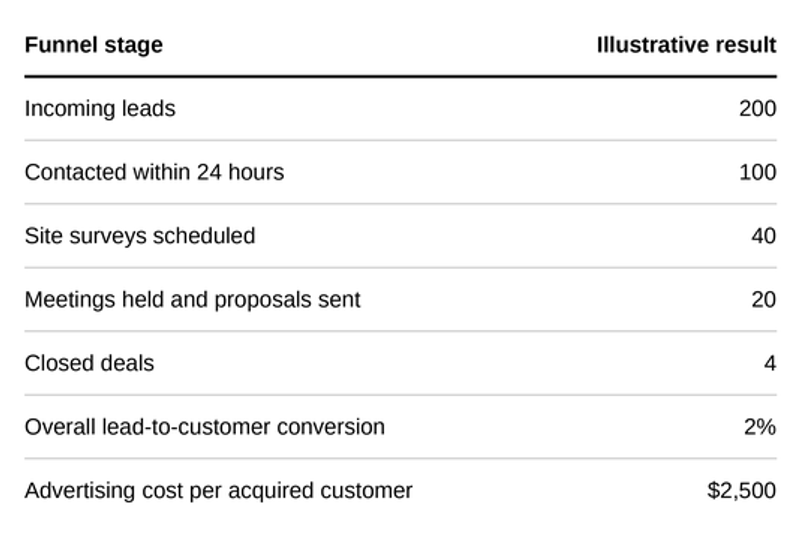
In this example, only four customers are acquired from 200 incoming leads. Delayed responses and friction between the stages limit the return on advertising expenditure.
Scenario 2: Automated, High-Speed Sales Funnel
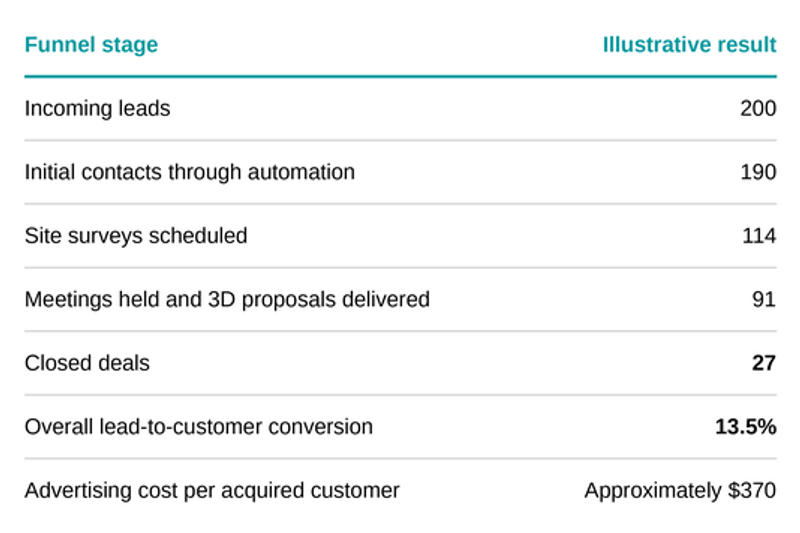
In this illustrative scenario, improved lead capture, faster communication, streamlined assessments, and quicker proposal delivery support a substantially higher conversion rate.
What Does This Mean for Solar EPC Companies?
With the same $10,000 advertising budget, the illustrative automated funnel generates 27 customers compared with four in the traditional funnel.
The advertising cost per acquired customer falls from $2,500 to approximately $370.
These figures are illustrative, not guaranteed results or industry benchmarks. Actual performance will depend on lead quality, market conditions, pricing, sales execution, and the conversion rates achieved at each stage.
The central lesson is that generating more leads is not the only way to grow a solar business. Improving the process that moves existing leads from inquiry to meeting and proposal can also make marketing investments more productive.
How Solar CRM and Automation Help Prevent Lead Leakage
A dedicated solar CRM can help EPC companies bring sales activities into one organized workflow.
Rather than managing inquiries across separate spreadsheets and messaging platforms, teams can use a centralized system to monitor lead status, record customer interactions, schedule follow-ups, and coordinate site assessments.
When connected with design and proposal workflows, the system can also help sales representatives move qualified prospects toward the next stage without losing important customer information.
Explore our guide to the Best Solar CRM Software for Installers to learn more about organizing solar sales operations.
For EPC companies seeking to improve the full journey from inquiry to proposal, the objective is straightforward: make every lead visible, assign clear responsibility, and remove unnecessary delays between sales activities.
Frequently Asked Questions
Solar lead leakage occurs when qualified prospective solar buyers drop out of the sales pipeline between their initial inquiry and the first discovery meeting due to operational inefficiencies such as slow response times, poor communication, or scheduling friction.
While unoptimized solar sales funnels often struggle with a 20% to 30% lead-to-meeting rate, high-performing EPC companies utilizing automated solar CRMs and rapid response workflows routinely achieve lead-to-meeting conversion rates between 50% and 70%.
Sales teams should initiate contact within 5 minutes of lead submission. Outbound attempts made within this initial window yield dramatically higher contact and qualification rates compared to callbacks made after 30 minutes.
A dedicated solar CRM automates lead capture across multiple channels, triggers instant multi-channel outreach, streamlines site assessment scheduling, and links field data directly with 3D design and proposal tools—ensuring every prospect is tracked and nurtured systematically.