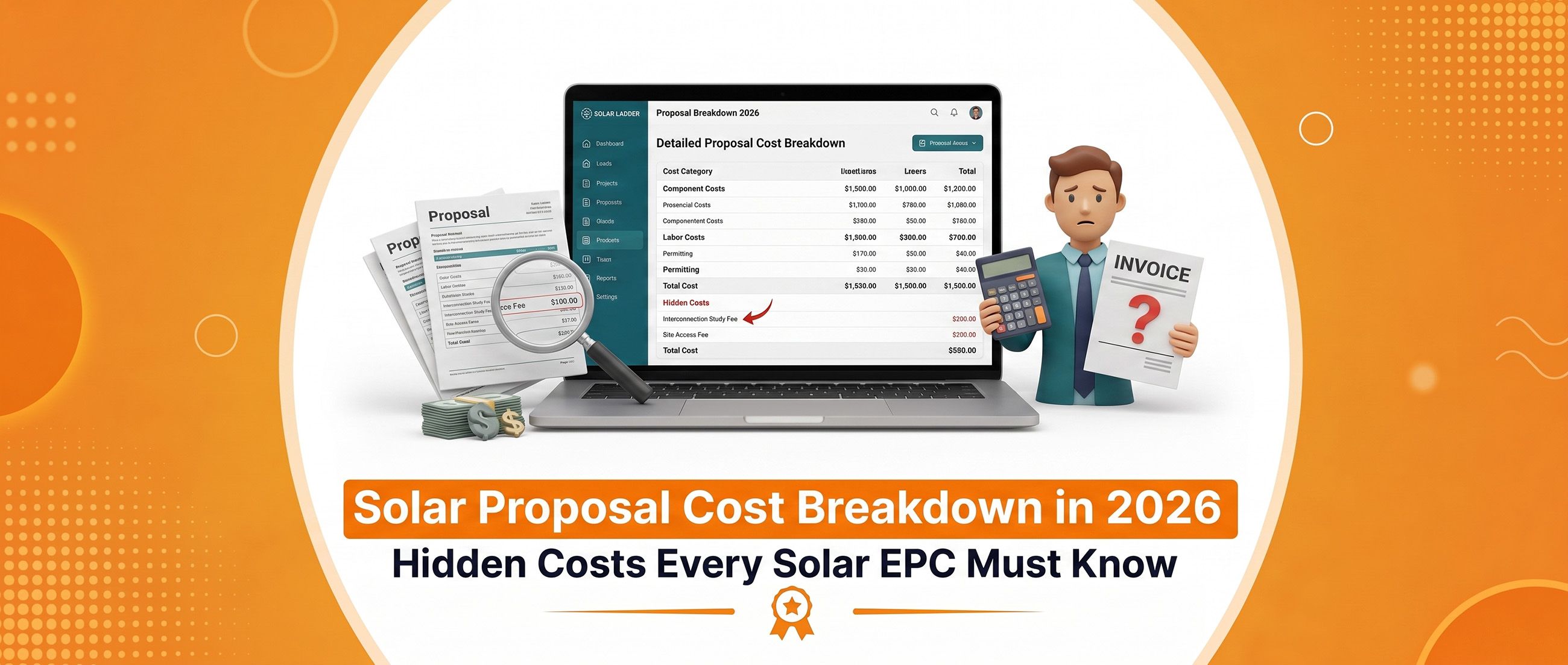
Professional solar proposals are no longer optional in India’s competitive rooftop solar market.
Every proposal involves hidden operational costs including:
- Site surveys
- Engineering time
- 3D solar design
- Shadow analysis
- Proposal revisions
- Sales coordination
- Follow-ups
In 2026, leading solar EPC companies are switching to automated solar proposal software to reduce costs, improve conversion rates, and scale faster.
Platforms like Solar Ladder help installers generate professional proposals with 3D rooftop designs in minutes instead of hours.
India’s rooftop solar industry is growing faster than ever.
With increasing awareness around the PM Surya Ghar Yojana, rising electricity costs, and aggressive rooftop solar adoption targets, competition among solar EPC companies has become intense.
Customers are no longer impressed with basic quotations.
Today’s buyers expect:
- Fast response times
- Professional proposal presentation
- Accurate savings calculations
- 3D rooftop visualization
- Transparent pricing
- Detailed generation reports
And this is exactly why solar proposals have become one of the most important sales tools for solar EPC companies in 2026.
But here’s the challenge:
Most installers still create proposals manually without realizing how expensive the process actually is.
From engineering hours to repeated revisions, the hidden cost of manual proposal creation can seriously affect profitability and scalability.
In this blog, we’ll break down the real cost of creating professional solar proposals in India and explain how modern solar proposal software helps EPCs reduce costs while increasing sales conversions.
Why Solar Proposals Matter More in 2026
The rooftop solar buying journey has completely changed.
Customers now compare multiple installers before making a purchase decision.
A slow or poorly designed proposal can instantly reduce trust.
On the other hand, a visually rich proposal with professional formatting, accurate calculations, and rooftop visualization helps EPCs stand out immediately.
Modern solar proposals now include:
- Rooftop solar system sizing
- 3D panel placement
- Shadow analysis
- ROI calculations
- EMI options
- Subsidy estimates
- Product specifications
- Installation timelines
- Warranty details
This is why professional proposal creation is no longer optional.
If you want to understand how modern proposal structures work, read our detailed guide on rooftop solar quotation formats.
What Goes Into a Professional Solar Proposal?
A high-converting rooftop solar proposal involves multiple stages.
Here’s what typically happens behind the scenes.
Proposal Component
Purpose
Site Survey
Understand rooftop feasibility
System Design
Calculate optimal solar capacity
3D Design
Visual rooftop panel layout
Shadow Analysis
Estimate generation impact
Financial Analysis
ROI and savings calculation
Proposal Formatting
Improve presentation quality
Product Selection
Module and inverter recommendations
Revision Management
Customer-specific customization
Every step consumes time, manpower, and operational resources.
Full Solar Proposal Cost Breakdown
1. Site Survey Cost
Before creating a proposal, many EPCs conduct physical site surveys.
This includes:
- Rooftop inspection
- Shadow checking
- Electrical assessment
- Structure verification
- Travel coordination
Estimated Cost:
₹500 – ₹2500 per project
For installers handling dozens of leads every week, these costs quickly add up.
Visual Suggestion:
Infographic showing: Travel + Engineer Time + Site Inspection + Coordination
2. Solar Design Cost
After surveying the rooftop, engineers begin creating the system layout.
This process often includes:
- Rooftop measurements
- Panel arrangement
- Capacity optimization
- Inverter matching
- DC sizing calculations
Estimated Cost:
₹800 – ₹3000 per proposal
When done manually, proposal creation becomes slow and difficult to scale.
3. 3D Solar Design Cost
In 2026, customers increasingly expect visual rooftop designs before making a purchase decision.
3D solar design helps customers visualize:
- Panel placement
- Roof utilization
- System appearance
- Space optimization
However, manual 3D modeling takes significant engineering effort.
Estimated Cost:
₹1000 – ₹5000 per proposal
This is why many EPCs are adopting 3D solar design software with shading analysis (https://solarladder.com/blog/post/solar-3d-design-software-shading-analysis-india) to automate the process.
Visual Suggestion:
Before vs After comparison: 2D proposal vs Interactive 3D rooftop visualization
4. Shadow Analysis Cost
Incorrect shading calculations can lead to inaccurate generation estimates and customer dissatisfaction.
Professional proposals often include:
- Shadow mapping
- Obstacle analysis
- Seasonal shading calculations
- Generation simulations
Estimated Cost:
₹500 – ₹2500 per project
Skipping shadow analysis may reduce upfront effort but can hurt long-term customer trust.
5. Proposal Design & Formatting Cost
A proposal isn’t just technical documentation anymore.
It’s also a sales presentation.
EPCs often spend additional time on:
- Proposal formatting
- Branding
- Savings charts
- Proposal visuals
- PDF customization
Estimated Cost:
₹300 – ₹1500 per proposal
Poorly designed proposals can make even a good solar company look unprofessional.
6. Sales Team Time Cost
One of the biggest hidden costs is sales productivity loss.
Sales teams often spend hours coordinating with engineers to prepare quotations.
This includes:
- Follow-ups with design teams
- Spreadsheet calculations
- Manual edits
- Multiple revisions
- Customer-specific customization
Hidden Impact:
Reduced sales efficiency and slower deal closures
7. Revision Cost
Customers frequently ask for changes such as:
- Different solar capacity
- Alternative modules
- EMI changes
- Battery integration
- Different layouts
Every revision means additional engineering and sales effort.
Estimated Cost:
₹200 – ₹2000 per revision cycle
Hidden Costs Most Solar EPCs Ignore
Many installers calculate only direct proposal costs.
But the biggest expenses are usually hidden.
Common Hidden Costs
- Delayed proposal delivery
- Lost leads
- Engineering bottlenecks
- Repeated manual calculations
- Customer confusion
- Incorrect generation estimates
- Poor proposal presentation
- Low conversion rates
Over time, these inefficiencies reduce profitability significantly.
Manual vs Automated Proposal Creation
Factor
Manual Process
Automated Proposal Software
Proposal Time
2–6 Hours
5–15 Minutes
Human Errors
High
Minimal
Scalability
Difficult
Easy
Design Quality
Inconsistent
Standardized
Revision Speed
Slow
Instant
Conversion Rate
Moderate
Higher
Customer Experience
Average
Professional
Visual Suggestion:
Workflow comparison graphic: Manual vs Automated Solar Proposal Process
How Solar Proposal Software Reduces Costs
Modern solar proposal software automates multiple processes that traditionally required engineering and sales coordination.
This includes:
- Rooftop mapping
- Proposal generation
- Financial calculations
- 3D rooftop design
- Shadow analysis
- CRM workflows
The result?
Faster proposals, lower operational costs, and better customer experience.
Why 3D Solar Design Increases Sales
Visual proposals convert better.
Customers trust what they can clearly understand.
3D rooftop visualization helps customers:
- Understand panel placement
- Visualize roof utilization
- See generation estimates
- Build confidence before purchase
Professional visualization also improves transparency in solar sales.
Read our detailed blog on how transparency builds customer trust in solar sales (https://solarladder.com/blog/post/transparency-solar-sales-trust-india-2026).
Common Proposal Mistakes That Lose Deals
1. Sending Generic Quotations
Customers expect personalized proposals.
Generic PDFs reduce trust instantly.
2. Slow Proposal Delivery
The faster EPCs respond, the higher the chances of conversion.
3. Incorrect Savings Calculations
Wrong ROI calculations damage credibility.
4. No Visual Presentation
Text-heavy proposals are harder for customers to understand.
5. No Shadow Analysis
Ignoring shading can create unrealistic generation expectations.
How Faster Proposal Turnaround Improves Conversion Rates
Speed matters in rooftop solar sales.
If your proposal takes 3–5 days, customers often move to faster competitors.
Quick proposal delivery helps EPCs:
- Capture customer attention faster
- Improve follow-up engagement
- Reduce lead drop-offs
- Increase conversion rates
This is why automated solar proposal generation has become critical in 2026.
2026 Trends in Solar Proposal Automation in India
The Indian solar industry is rapidly moving toward digital sales workflows.
Key Trends Shaping 2026
AI-Based Proposal Generation
Automated system sizing and proposal creation.
Mobile Proposal Creation
Sales teams generating quotations directly from smartphones.
Integrated CRM + Proposal Platforms
Managing leads and proposals in one system.
3D Design as Standard
Customers increasingly expect rooftop visualization.
PM Surya Ghar Workflow Integration
Installers need subsidy-ready proposal workflows.
Learn more about tools designed for subsidy-focused installers in our guide on best solar software for PM Surya Ghar installers (https://solarladder.com/blog/post/best-solar-software-pm-suryaghar).
Why Indian Solar EPCs Are Switching to Automated Platforms
The rooftop solar market is becoming too competitive for manual workflows.
Automated proposal platforms help EPCs:
- Handle more leads
- Reduce engineering dependency
- Improve proposal quality
- Scale operations faster
- Standardize customer experience
This is why software adoption is becoming essential for growth-focused solar businesses.
How Solar Ladder Helps Reduce Proposal Costs
Solar Ladder is built specifically for Indian solar EPC companies.
The platform helps installers automate:
- Solar proposal generation
- 3D rooftop design
- Shadow analysis
- Customer follow-ups
- Lead management
- Proposal revisions
Instead of spending hours creating quotations manually, EPCs can generate professional rooftop solar proposals in minutes.
Key Benefits of Solar Ladder
✅ Faster proposal turnaround ✅ Professional branded proposals ✅ Better customer experience ✅ Reduced operational costs ✅ Improved sales efficiency ✅ Scalable rooftop solar workflows
CTA Section
Reduce Proposal Time from Hours to Minutes
Generate professional rooftop solar proposals with 3D designs, automated calculations, and faster turnaround using Solar Ladder.
👉 Book a Free Demo Today
Industry Resources & References
For official solar policy updates and industry insights, refer to:
- Ministry of New and Renewable Energy (MNRE) (https://mnre.gov.in)
- Solar Energy Corporation of India (SECI) (https://www.seci.co.in)
- International Energy Agency (IEA) (https://www.iea.org)
- National Renewable Energy Laboratory (NREL) (https://www.nrel.gov)
- PM Surya Ghar Yojana Official Portal (https://pmsuryaghar.gov.in)
Conclusion
In 2026, solar proposals are no longer just quotations.
They are one of the biggest factors influencing rooftop solar sales conversions.
Manual proposal creation involves multiple hidden costs including:
- Engineering effort
- Sales coordination
- Delayed turnaround
- Revisions
- Proposal formatting
- Follow-ups
As competition increases in India’s rooftop solar market, EPCs need faster, smarter, and more scalable proposal workflows.
This is why more installers are adopting automated solar proposal software with integrated 3D design and proposal generation capabilities.
Platforms like Solar Ladder help EPCs reduce operational costs while delivering faster and more professional customer experiences.