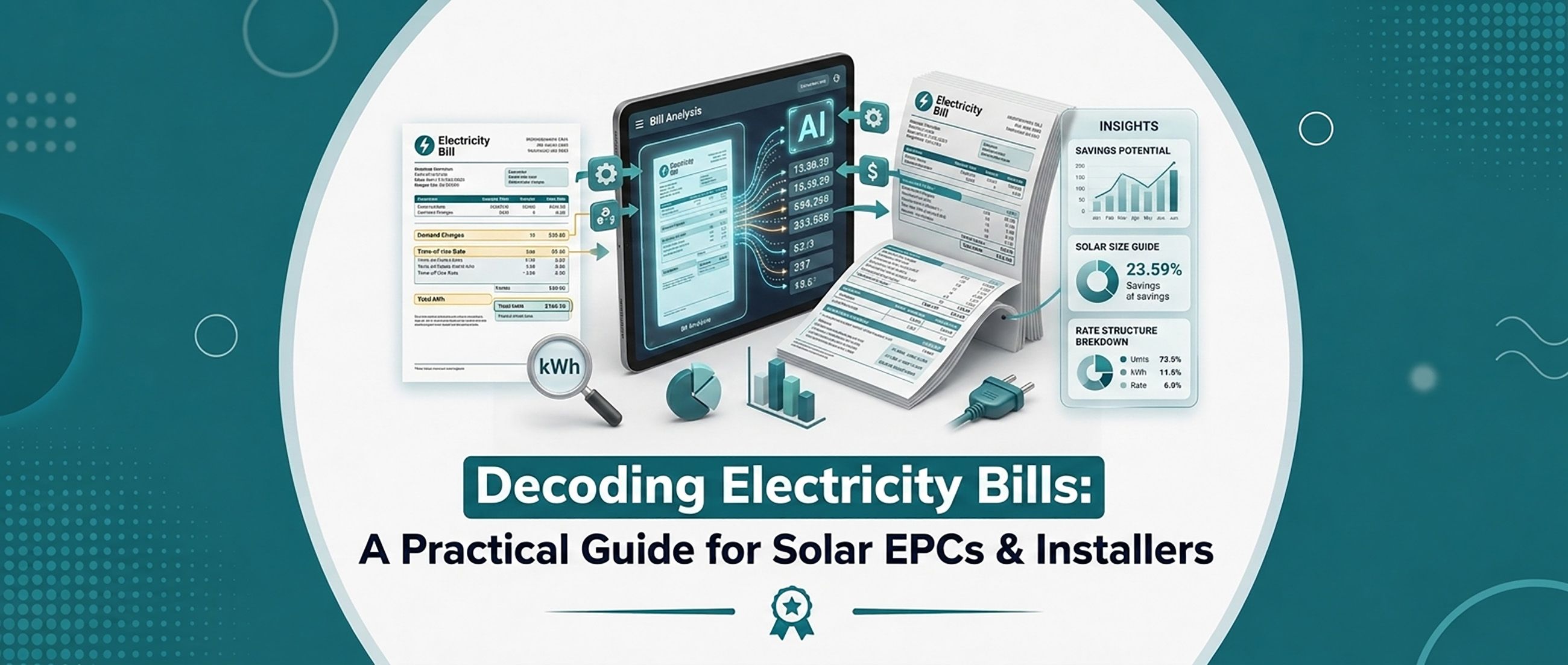
TL;DR: Analyzing a prospective client’s electricity bill is the single most important step in designing an optimal rooftop solar PV system. By evaluating key parameters like sanctioned load, unit consumption, Fixed Charges, Electricity Duty, and Time of Day (TOD) rates, solar EPC contractors can accurately size solar arrays and deliver realistic ROI estimates. Using Solar Ladder Software, installers can digitize lead surveys, automate tariff mapping, generate 3D rooftop layouts, and deliver high-converting solar proposals in under a minute.
Decoding Electricity Bills: A Practical Guide for Solar EPCs & Installers
For any solar Engineering, Procurement, and Construction (EPC) company or installer, an electricity bill is far more than a monthly payment receipt. It is a goldmine of operational data. Interpreting this document correctly allows you to determine exact energy requirements, optimize solar system capacity, avoid net-metering rejections, and build compelling financial projections for your customers.
However, misinterpreting bill charges—such as treating fixed utility fees as offsettable energy savings—can distort your return-on-investment (ROI) calculations and damage client trust.
In this guide, we break down a real-world DISCOM electricity bill line by line, explain what each component means for solar system sizing, and demonstrate how modern software tools like Solar Ladder streamline this analysis into a seamless digital workflow.
Deconstructing an Electricity Bill: Case Study
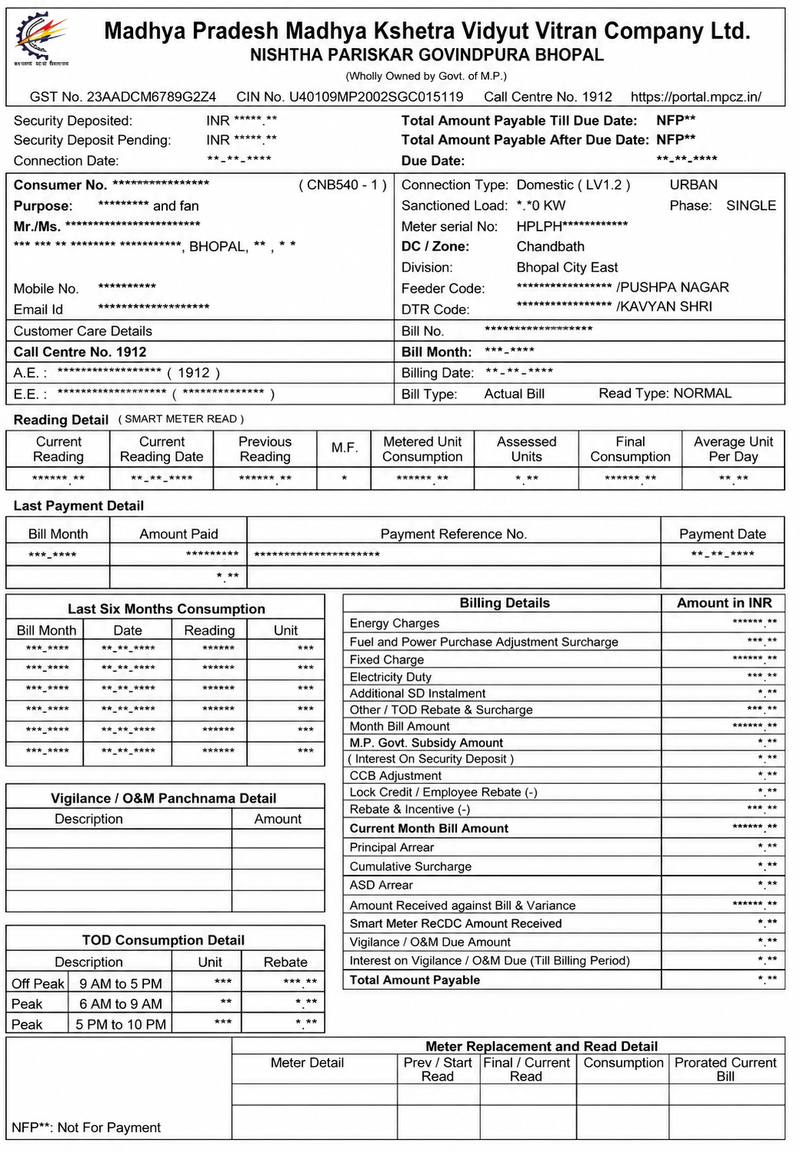
To understand how utility billing works in practice, let us examine a sample residential bill from Madhya Pradesh Madhya Kshetra Vidyut Vitran Company Ltd. (MPCZ).
(Note: All sensitive personal customer details have been masked for privacy).
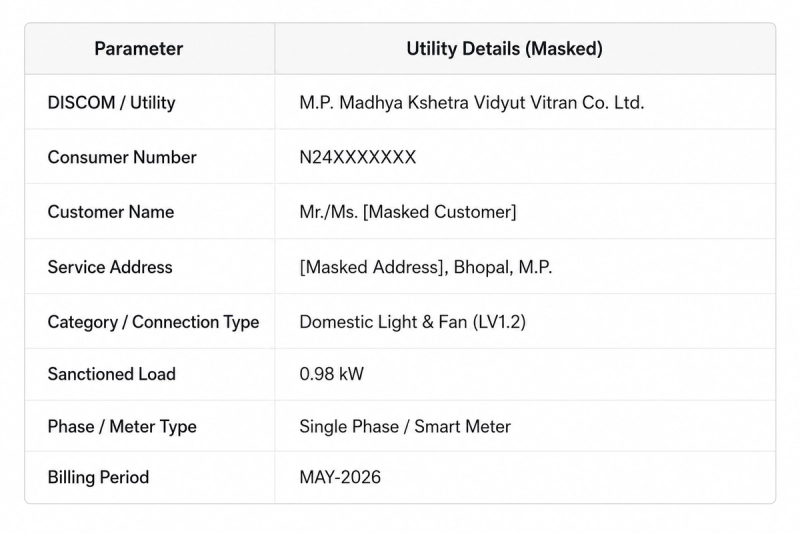
Sample Customer & Meter Summary
Meter Reading & Consumption Breakdown
The meter reading section details total electrical energy consumed during the billing cycle (measured in kilowatt-hours or kWh, commonly referred to as "units").
- Previous Reading (01-04-2026): 3605.88
- Current Reading (01-05-2026): 4243.01
- Multiplying Factor (M.F.): 1
- Net Unit Consumption: 637.13 kWh (Units)
- Average Consumption Per Day: 21.24 Units/day
EPC Insight: Looking at a single month's bill provides a snapshot, but evaluating historical trends (e.g., the last 6 to 12 months) is crucial for identifying seasonal peak usage, such as summer air conditioning loads.
Line-Item Breakdown of Billing Charges
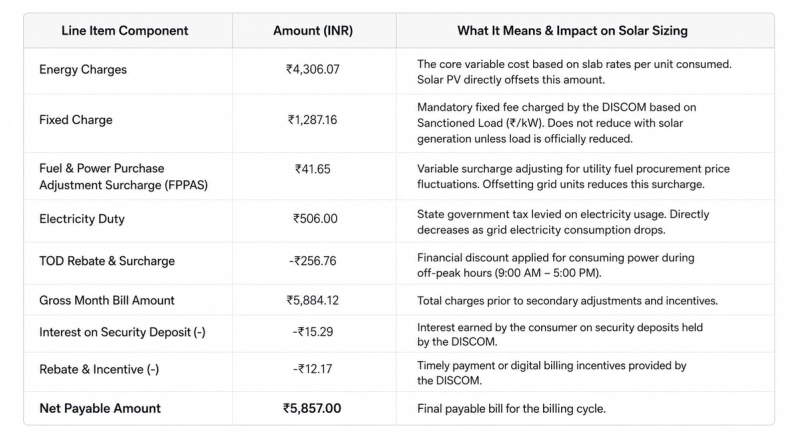
Understanding how the total bill amount is derived is key to modeling accurate financial payback periods. Here is the itemized breakdown from the MPCZ bill:
5 Critical Electricity Bill Components Every Solar EPC Must Analyze
1. Sanctioned Load (kW)
The Sanctioned Load (0.98 kW in our example) represents the maximum grid demand authorized for the connection. DISCOM net-metering regulations across most Indian states limit rooftop solar installation capacity to 100% (or in some regions 80–90%) of the sanctioned load.
If a customer consuming ~21 units/day requires a 5 kWp to 6 kWp solar array, their current 0.98 kW sanctioned load must be officially enhanced with the utility prior to net-metering approval. Identifying this early prevents installation delays and regulatory hurdles.
2. Variable Energy Charges vs. Fixed Charges
A common mistake made by inexperienced installers is assuming a solar system wipes out 100% of the customer's total electricity bill.
- Variable Charges (Energy Charges, FPPAS, and Electricity Duty) total ₹4,853.72 on this bill. These are directly offset by solar energy exported or self-consumed.
- Fixed Charges (₹1,287.16) are billed by the DISCOM regardless of solar generation.
By separating these components, EPCs can present realistic financial savings graphs in their customer proposals, establishing trust and preventing post-installation disputes.
3. Time of Day (TOD) / Time of Use Tariffs
Smart meters record energy consumption in time-based slots. In our case study bill:
- Off-Peak Hours (9 AM to 5 PM): 190 units consumed → Earned a -₹256.75 rebate.
- Peak Hours (6 AM to 9 AM & 5 PM to 10 PM): 187 units consumed.
Because solar PV generation naturally peaks during daylight hours (9 AM to 5 PM), rooftop solar systems naturally power daytime loads directly. Understanding TOD windows helps EPCs explain self-consumption benefits and net-metering credit valuations.
4. Historical Consumption Patterns
Reviewing historical bill cycles (e.g., April: 304 units, March: 145 units, December: 114 units) reveals annual consumption fluctuation. Designing a solar PV system solely based on winter consumption will lead to an undersized array, whereas sizing solely on peak summer air conditioning usage could lead to over-generation beyond net-metering limits.
5. Regulatory Guidelines & Compliance
Each state utility operates under regulations set by state electricity regulatory commissions and guidelines from the Ministry of New and Renewable Energy (MNRE). Ensuring that billing structures, grid connection limits, and net-metering policies align with regulatory frameworks like those managed by the Central Electricity Regulatory Commission (CERC) is essential for long-term project viability.
How Solar Ladder Software Accelerates Electricity Bill Analysis & Proposal Workflows
Manually reading bills, entering data into spreadsheets, and calculating sizing metrics for every prospective client creates operational bottlenecks. Solar Ladder equips solar installers with purpose-built digital tools to streamline the entire sales and execution pipeline:
1. Seamless Mobile Site Surveys & Data Capture
Field engineers can capture electricity bill photos, record meter numbers, and log sanctioned load data directly through Solar Ladder's mobile survey forms. The data syncs instantly to your central CRM, eliminating lost paperwork and manual entry errors.
2. Intelligent 3D Design & Automated System Sizing
Once unit consumption is logged, Solar Ladder's 3D Solar Design Software models the customer's rooftop layout in minutes. It runs visual panel-level shading analysis—accounting for water tanks, parapet walls, and adjacent structures—to match energy production perfectly with the client’s historical bill requirements.
3. High-Converting Solar Proposals in 1 Minute
Convert complex bill analysis into clean, visual proposals. Solar Ladder automatically factors in slab rates, fixed charges, and DISCOM tariff structures to generate easy-to-understand savings charts, payback periods, and ROI projections. To learn more about structuring proposals that win client confidence, read our High-Converting Residential Solar Proposal Guide.
Ready to transform your solar workflow? Explore how Solar Ladder's all-in-one platform can help you scale your operations today.
Frequently Asked Questions
While solar PV generation can offset 100% of variable Energy Charges, Electricity Duty, and surcharges, mandatory Fixed Charges levied by the DISCOM based on Sanctioned Load remain payable to maintain grid connection infrastructure.
If the required solar system size exceeds the current sanctioned load, the EPC contractor must submit a Sanctioned Load Enhancement request to the respective DISCOM prior to applying for net-metering approval.
Solar Ladder has an AI that automates lead management, mobile site surveys, 3D rooftop design, shading analysis, and automated financial proposal generation. By eliminating manual calculations, installers can deliver professional, accurate quotes in under a minute.
Solar Ladder features an advanced AI Electricity Bill Analysis engine that automatically scans and parses uploaded electricity bill documents or images. It extracts critical details—including consumer numbers, sanctioned load, current and historical unit consumption, tariff categories, and billing line items—within seconds. The AI then uses this extracted data to instantly calculate the ideal solar system capacity, estimate monthly energy offsets, and auto-populate financial ROI models in your proposals.