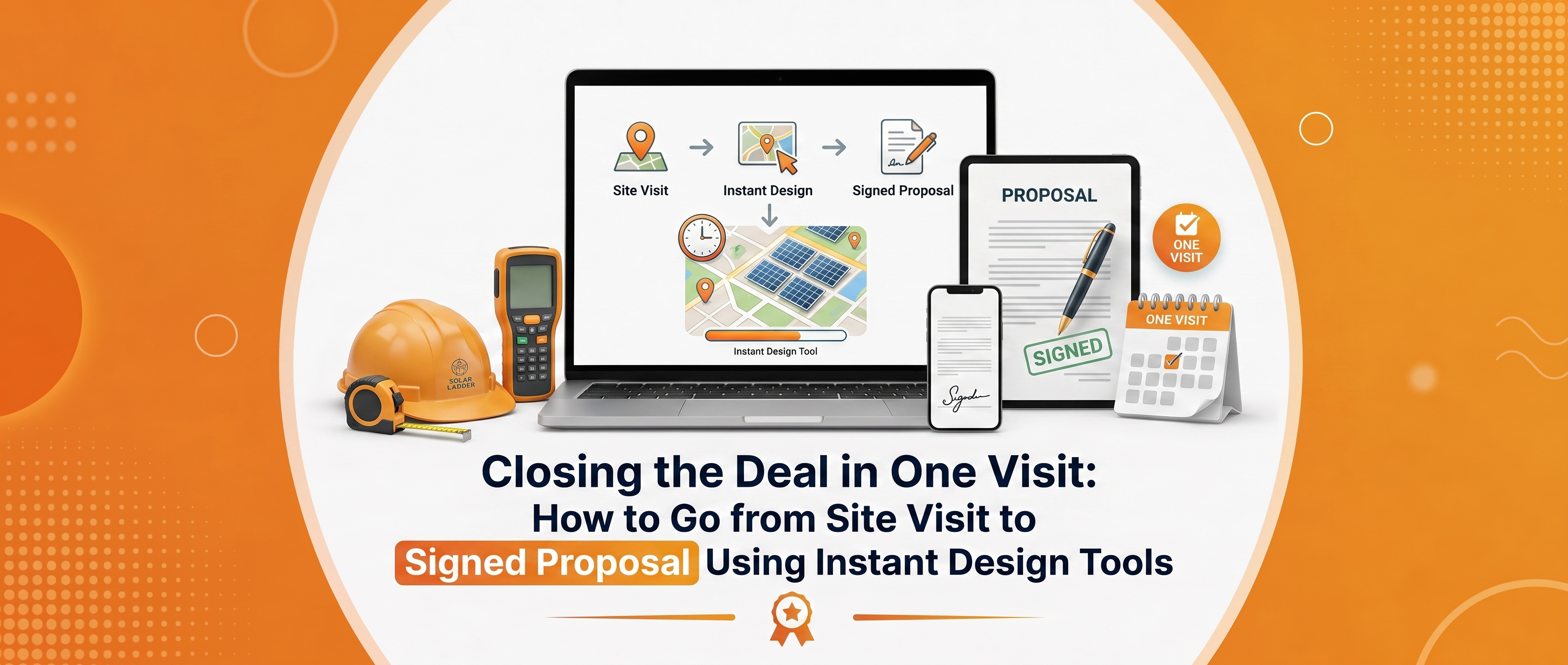
TL;DR Most solar EPCs visit a site, take measurements, go back to the office, spend hours building a proposal, and send it 3 days later — only to find the customer has moved on. This article shows exactly how India's fastest-growing EPCs are closing deals on the same day as the site visit using instant design tools.
The Most Expensive Moment in Solar Sales Is the Drive Back to the Office
You've done everything right.
You showed up on time. You spent 45 minutes on the customer's roof — measured every surface, checked the meter, assessed the shading from the neighbour's parapet wall, had a genuine conversation about their electricity bills and what they're hoping solar will do for them.
They're interested. You can feel it. The questions are specific, the engagement is real, and they've already asked about the PM Surya Ghar subsidy.
Then you say: "I'll send you a detailed proposal by end of the week."
And the deal begins to die.
Not dramatically. Quietly. The customer's phone keeps ringing — two other EPCs they contacted the same day. One of them sends a proposal that evening. Not a great proposal, but a proposal. Something the customer can look at, share with their spouse, screenshot and send to their neighbour who went solar last year.
Three days later, you send yours. It's more detailed, more accurate, better designed. But the customer has already had two conversations with the other EPC. They've started anchoring on that number. And when you follow up, they say: "Let me think about it."
That's not a maybe. That's a lost deal.
This is the most common — and most preventable — failure mode in Indian solar sales today. And in 2026, with rooftop solar installations growing 158% year-on-year and competition for every residential lead intensifying, the EPCs who will win are the ones who have eliminated this gap entirely.
Why the Gap Between Site Visit and Proposal Is Killing Your Conversion Rate
A customer's buying intent is highest during and immediately after the site visit. Every hour between that visit and your proposal is an hour that intent is cooling — and competitors are calling.
Here is what actually happens in the 72 hours between a typical site visit and a manual proposal:
- Hour 0–4: Customer is engaged, curious, internally calculating whether this makes sense
- Hour 4–24: They've Googled solar subsidies, watched YouTube videos, asked a friend, and probably contacted another EPC
- Hour 24–48: A competing EPC has sent something — anything. The customer now has a number to anchor on
- Hour 48–72: You send your proposal. The customer compares it against something they already have a relationship with
- Hour 72+: If your proposal doesn't win on price, it loses. The quality difference no longer matters
The problem is not your proposal quality. The problem is timing. And timing is entirely fixable.
What "Closing in One Visit" Actually Means
Closing in one visit does not mean forcing a signature on the roof. It means ending the site visit with a complete, professional, personalised proposal already in the customer's hands — so the only remaining conversation is about next steps, not about whether they trust your numbers.
When a customer walks away from a site visit with:
- A 3D layout of their actual roof showing exactly where every panel will sit
- A shadow analysis showing which areas lose generation and why
- A generation forecast specific to their roof orientation and location
- A monthly savings projection based on their actual electricity bill
- A clear payback period and ROI
- PM Surya Ghar subsidy details where applicable
- A professional branded document they can share immediately
...the decision shifts. They are no longer asking "should I trust this EPC?" They are asking "when do we start?" That is the entire goal of the instant proposal.
The Traditional Sales Process vs. The One-Visit Close
Most EPCs in India still run a 5-step process that takes 3 to 7 days. The fastest-growing EPCs have compressed this into a single visit.
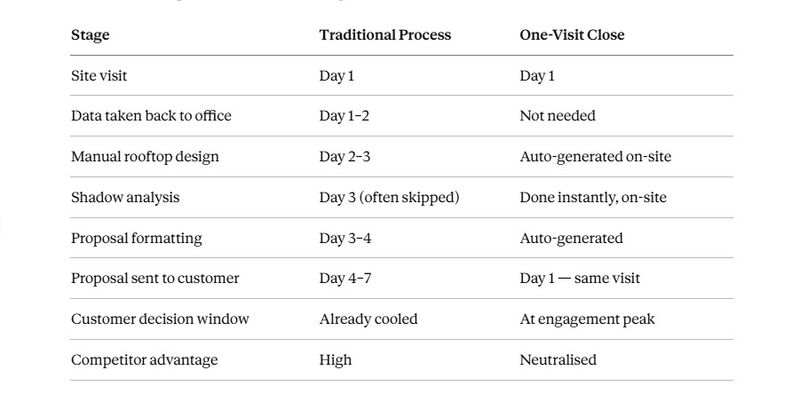
Pro Tip: You do not need to close the deal during the visit. You need to give the customer everything they need to decide — so the only remaining question is when to start, not which EPC to trust. The follow-up call becomes a logistics conversation, not a sales pitch.
Why Customers Don't Decide After the Site Visit
Understanding what stops a customer from deciding immediately is the key to fixing it.
Blocker 1: "I Can't Picture It"
A homeowner who has never seen solar panels on a roof is being asked to imagine what their home will look like with a system installed. Without a visual, the mental image is vague — which creates hesitation.
Fix: A 3D rooftop layout of their specific roof eliminates imagination entirely. They don't need to picture it. They can see it.
Blocker 2: "I Don't Know If the Numbers Are Real"
"You'll save ₹4,000 a month" means nothing without a calculation the customer can interrogate. How was that arrived at? Does it account for the shade from the tree in the corner? Is this number for their roof or just a general estimate?
Fix: Site-specific generation calculations tied to their actual roof, location, and shading make the numbers credible. Customers stop doubting them because they can see exactly how they were derived.
Blocker 3: "I Want to Compare"
If you leave without a proposal, customers compare you to other EPCs using price as the only metric. If you leave a visual, site-specific proposal, they compare on quality — and your proposal wins.
Fix: Leave the proposal during the visit. Every competitor who doesn't is now at a disadvantage.
What Instant Design Tools Actually Do on a Site Visit
The practical question most EPCs ask when they hear about instant proposals: How does software generate a 3D rooftop design and shadow analysis on-site if I haven't done a full survey?
Modern solar proposal software combines what you collect on-site with satellite roof data, location-based solar irradiance data, and automated shading models to produce an accurate proposal in minutes — not days. Here is the exact on-site workflow:
Step 1: Enter Site Data — 3 to 5 Minutes
Input the customer's address, roof type, approximate dimensions, meter reading, and monthly consumption. This is information you are already collecting during every site visit.
Step 2: Platform Pulls Satellite Roof Data — Automatic
The software overlays satellite imagery of the property to confirm roof dimensions, orientation, and usable surface area. No manual CAD drawing required.
Step 3: 3D Layout Generated — Automatic
Panels are placed on the roof automatically, optimised for maximum generation, with accurate tilt and orientation. The customer can see their actual roof on the screen in front of them.
Step 4: Shadow Analysis Runs — Automatic
Based on the property location, roof orientation, and surrounding obstructions, the platform models shading and calculates the generation impact. This takes seconds.
Step 5: Financial Projections Calculated — Automatic
Using their consumption data, local solar irradiance, system size, and current tariffs, the platform generates a monthly savings projection, payback period, and 25-year ROI — specific to this customer, this roof, this city.
Step 6: Proposal Generated and Shared — 1 to 2 Minutes
The complete proposal — 3D layout, shadow analysis, generation forecast, savings projection, subsidy details, and branded output — is generated as a PDF and a shareable mobile link. You can share it with the customer via WhatsApp before you leave the premises.
Total time on-site: 10 to 15 minutes.
Manual process total time: 6 to 10 hours across 3 to 5 days.
The proposal is ready before the customer's tea goes cold.
⚡ Close Solar Deals Before You Leave the Site Generate a 3D rooftop layout, shadow analysis, and complete professional proposal in under 15 minutes — on-site, on your phone or tablet. ✔ Instant 3D rooftop design ✔ On-site shadow analysis ✔ Proposal in 15 minutes ✔ Share via WhatsApp instantly
→ Get Free Demo Today — www.solarladder.com
The Psychology of the Same-Day Proposal
There is a sales dynamic that does not get discussed enough in the solar industry: the proposal itself is a trust signal.
When you hand a customer a detailed, visual, site-specific proposal during the visit, several things happen that no amount of verbal selling can replicate.
You demonstrate competence without saying a word. A 3D layout of their roof, with accurate panel placement and a shadow zone mapped to the tree they pointed out during the visit — that tells the customer you know exactly what you are doing. No claim required. Evidence delivered.
You eliminate the competitor window. The 72 hours between visit and proposal is the window where competitors gain ground. Close that window and competitors are playing catch-up from the moment the customer receives your proposal.
You set the evaluation standard. The first detailed proposal a customer receives becomes the benchmark against which all others are compared. If yours is first and best, every subsequent proposal is judged against yours — not the other way around.
You change what the customer is deciding. Without a proposal in hand, they are deciding which EPC to trust. With a complete proposal in hand, they are deciding when to start. That is a fundamentally different — and far easier — conversation.
What the Best Solar Sales Teams in India Are Doing Differently
India's rooftop solar market is expected to grow from 17.6 GW in 2025 to 41.52 GW by 2030 at a CAGR of 18.73%. In this environment, the EPCs capturing disproportionate market share are not necessarily the ones with the lowest prices. They are the ones who convert at a higher rate.
Here is what separates them:
They treat the site visit as the close, not the beginning. The visit is the highest-engagement moment in the sales cycle. The best EPCs use every minute of it to build trust and reduce doubt — and they leave a proposal that makes the next conversation about scheduling, not selling.
They make numbers specific, not general. "You'll save money" closes nothing. "Based on your 850-unit monthly consumption in Pune, with your south-facing roof at 30 degrees, this 5kW system will generate 625 units per month, saving you approximately ₹4,375 on your current tariff, with full payback in 4.2 years" closes deals.
They address the PM Surya Ghar subsidy upfront. For residential customers, the PM Surya Ghar Muft Bijli Yojana subsidy is often the deciding factor. EPCs who build subsidy calculations into their instant proposal remove one of the biggest customer questions before it is even asked. Many installers use solar software built specifically for PM Surya Ghar workflows to handle this automatically.
They make the proposal easy to share. A proposal the customer can WhatsApp to their spouse, their neighbour, or their building society committee within minutes of the visit is a proposal that works even when you are not in the room.
They follow up with context, not just chasing. "I'm following up on the proposal" is weak. "I noticed you opened the proposal last evening — do you have any questions about the shadow analysis on the western side?" is strong. This level of follow-up is possible when proposal software tracks engagement data.
Common Mistakes EPCs Make That Prevent One-Visit Closes
Warning: These habits are costing deals that should have been won.
Treating the site visit as purely technical. The visit is a sales interaction, not just a measurement exercise. Installers who collect data mechanically and leave without engaging the customer emotionally lose the relationship before it forms.
Saying "I'll send this over in a few days." This habit costs deals. Even with the best intentions, 3 days is too long. This phrase should be retired from every solar sales team's vocabulary in 2026.
Sending a proposal without a visual layout. A proposal without a 3D rooftop layout leaves the customer's most important question — "what will it actually look like on my roof?" — unanswered. Unanswered questions delay decisions. Always include a visual. Solar Ladder's 3D design and shading analysis handles this automatically.
Skipping shadow analysis to save time. Customers who get a system installed and discover it produces 25% less than projected become detractors, not referral sources. Shadow analysis is not optional.
Not addressing financing or EMI. A customer who can afford the EMI but not the lump sum will not buy if your proposal only shows a lump sum. Include financing options in every residential proposal.
Following up without a reason. "Just checking in" is the weakest follow-up in sales. Your follow-up should add something — an answer to a question they hadn't asked yet, updated subsidy information, a new financing option. Give them a reason to re-engage.
Reduce Proposal Time from Hours to Minutes See how Solar Ladder generates complete proposals on-site — 3D design, shadow analysis, savings projections, and professional output, all in one platform.
→ See Solar Ladder in Action — www.solarladder.com Trusted by 850+ EPCs across India. No credit card required.
How Solar Ladder Enables the One-Visit Close
Solar Ladder is built around one core idea: the proposal should be ready before the customer's buying intent cools.
When an EPC uses Solar Ladder during a site visit, the customer sees the following before the visit ends:
- Their actual roof in 3D — panels placed accurately, orientation and tilt correct, setbacks observed
- Shadow zones mapped — shading from every identified obstruction, with generation impact calculated
- Generation forecast — units per month, specific to their location and roof geometry
- Monthly savings — based on their consumption data and current electricity tariff
- PM Surya Ghar subsidy — automatically calculated for eligible residential customers
- Payback and ROI — transparent, clear, and customer-readable
- Professional proposal PDF — shareable via WhatsApp or email before the EPC leaves the premises
This is not a rough sketch to be refined later. It is the actual proposal. The one the customer will evaluate and decide on.
For EPCs managing ALMM-compliant module specifications across proposals, Solar Ladder's module database ensures every proposal uses current, compliant equipment — automatically.
Many EPCs who have moved to professional solar quotation workflows through Solar Ladder report that proposal quality consistency improved significantly across their entire team — because the platform ensures every sales person, on every visit, produces the same standard of output.
The Numbers Behind the One-Visit Close
Let's be specific about what this shift means commercially.
According to JMK Research, approximately 7 GW of rooftop solar is expected to be installed in FY2026. For EPCs competing in this market, even a modest improvement in conversion rate compounds significantly.
Consider a mid-sized EPC doing 40 site visits a month:
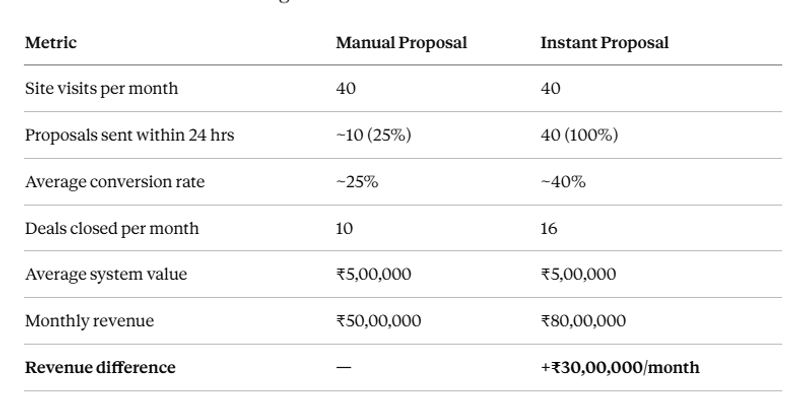
Conversion rate improvement based on observed patterns among EPCs using Solar Ladder — individual results will vary.
The ₹30 lakh monthly difference is not from more site visits, more staff, or lower prices. It is from closing a higher proportion of the visits you are already doing — by eliminating the gap between visit and proposal.
Pro Tip: Track your own "proposal sent within 24 hours" rate for one month. For most EPCs, it is below 30%. That number alone tells you how much revenue is being left on the table before a single proposal is even evaluated.
Building Trust That Generates Referrals
The instant, visual proposal does not just close deals faster. It builds the kind of trust that generates referrals — which are the highest-converting and lowest-cost leads in solar sales.
When a customer receives a proposal that shows them exactly what will be installed, exactly what it will generate, exactly what they will save — and that proposal turns out to be accurate after installation — they become advocates, not just customers.
For EPCs building a long-term business in their city or region, this matters more than any individual deal. The transparency-first sales approach that instant, site-specific proposals enable is the foundation of a solar business that compounds — every installation generating referrals that reduce your customer acquisition cost over time.
The IEA's India Energy Outlook projects that India will need to dramatically accelerate distributed solar deployment to meet its clean energy targets. That acceleration depends on customer trust in the installation ecosystem. EPCs who build that trust, one proposal at a time, are not just growing their own business.
2026 Reality: One-Visit Close Is No Longer Optional
Right now, EPCs who deliver same-day proposals have a significant advantage over those who take 3 to 5 days. That advantage is real and measurable.
But as more EPCs adopt instant proposal tools, that advantage inverts. Same-day proposals stop being a differentiator and start being the expectation. EPCs who still take 3 days to send a proposal will appear — to customers — to be operationally behind.
The window to gain competitive advantage from this capability is open now. In 12 to 18 months, it will be the floor, not the ceiling.
The EPCs who move first do not just close more deals in the short term. They build customer habits, referral networks, and brand reputations anchored on speed and quality — assets that compound for years.
Conclusion: Stop Ending Site Visits Without a Proposal
Every site visit where you leave without a proposal in the customer's hands is a missed opportunity — not just a process step.
The customer was most ready to decide in the 60 minutes after you left their roof. That was when your credibility from the visit was freshest, their enthusiasm was highest, and their competing considerations were lowest.
Instant design tools return solar sales to what it should always have been: a conversation between a customer who wants to go solar and a professional who can show them exactly how — on their specific roof, at what cost, with what return.
The one-visit close is not a pressure tactic. It is what happens when you bring all the information a customer needs to decide — in visual, credible, personalised form — to the place where they are most ready to receive it.
Stop ending site visits with "I'll send you something this week." Start ending them with "Here it is." Ready to Close Solar Deals on the Same Day as the Site Visit?
Solar Ladder gives your sales team everything they need to generate a complete, professional, site-specific proposal in under 15 minutes — on-site, every time.
→ Book a Demo — solarladder.in → See How It Works — www.solarladder.com
Trusted by 900+ solar EPCs across India. No credit card required · Free demo · Setup in minutes.
Frequently Asked Questions
By using instant solar design tools that generate a 3D rooftop layout, shadow analysis, and savings projections on-site, EPCs can share a complete, professional proposal with the customer before leaving — eliminating the delay that causes most deals to go cold.
Most solar deals go cold because of a 2 to 5 day gap between the site visit and the proposal. During that time, customers speak to competitors, lose buying momentum, and default to comparing on price. Instant proposals eliminate this gap.
A winning same-day proposal needs a site-specific 3D rooftop layout, shadow analysis, accurate generation forecast, monthly savings projection, payback period, PM Surya Ghar subsidy details if applicable, and financing options — in a professional branded format. See our complete solar proposal format guide for a full breakdown.
Instant solar proposal software auto-generates a complete, site-specific solar proposal — including 3D design, shading analysis, and financial projections — within minutes of entering site data. Solar Ladder produces these proposals during or immediately after the site visit.
3D solar design shows customers exactly how the system will look on their specific roof. It answers placement and shading questions visually before customers ask them, which builds confidence and shortens the decision cycle. Read more about how 3D solar design software works for Indian EPCs.