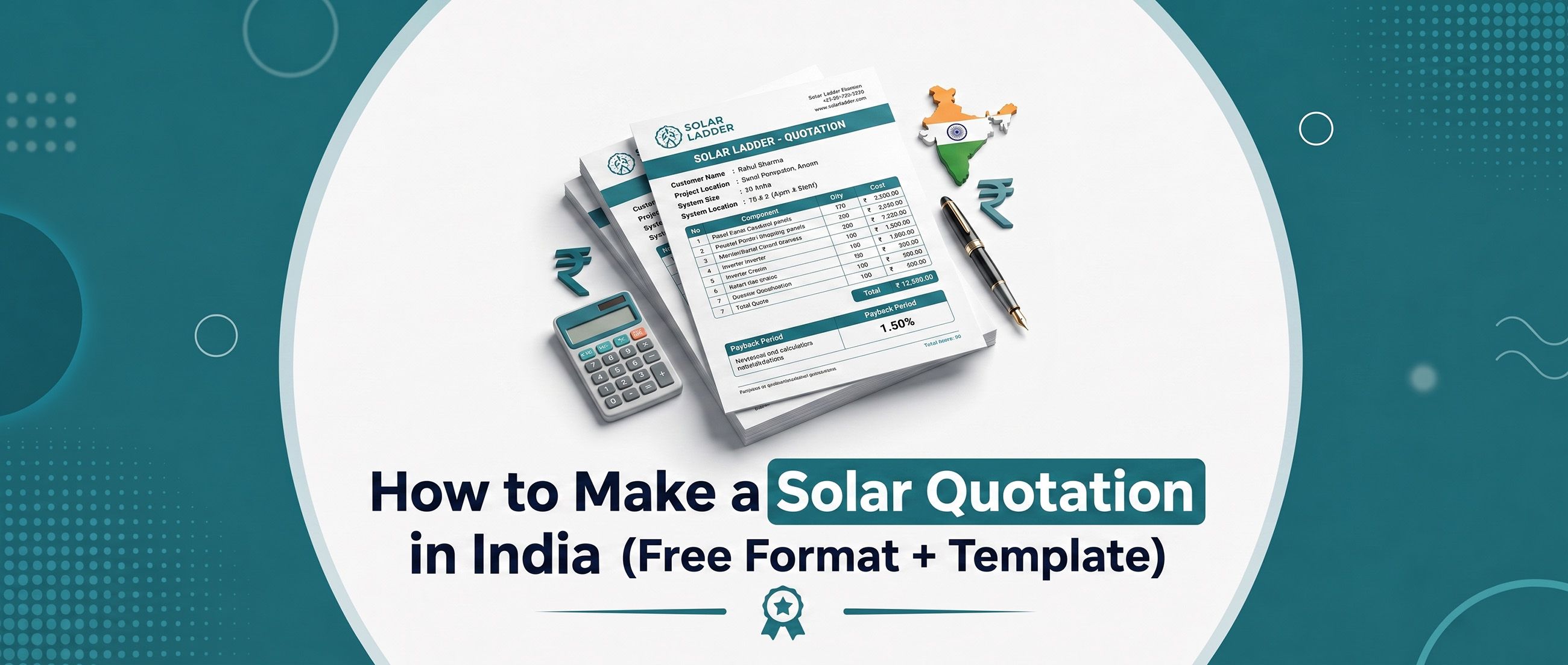
TL;DR: A solar quotation is the priced proposal an installer gives a customer, covering system size, Bill of Materials (BOM), pricing, subsidy, savings, and terms. To make one in India: capture the customer's load and roof, size the system, list the BOM, pick a pricing model (per-watt, per-kW, or flat), subtract the PM Surya Ghar subsidy (up to ₹78,000 for residential up to 3 kW), then show payback and savings. This guide gives you a free copy-paste quotation format you can reuse for every enquiry.
What is a solar quotation?
A solar quotation is a costed document an installer or EPC gives a prospective customer that sets out the proposed solar system, its components, the total price, applicable subsidy, expected savings, and the commercial terms of the offer. It is sometimes called a solar proposal or a solar quote.
A good quotation does three jobs at once: it explains the technical solution (system size and design), the financial case (cost, subsidy, savings, payback), and the commercial offer (BOM, payment schedule, warranties, and validity). Done well, it turns a complex engineering-and-finance decision into a simple yes for the customer.
What should a solar quotation include?
Every professional solar quotation in India should include the following line items:
- Customer and site details — name, address, contact, sanctioned load, and average monthly bill or units.
- System summary — capacity in kW, system type (on-grid, off-grid, or hybrid), and expected annual generation.
- Bill of Materials (BOM) — solar modules (brand, wattage, technology, quantity), inverter (brand, capacity, type), mounting structure (material and specification), cables, and balance of system.
- Pricing — gross system cost, applicable subsidy, and net amount payable.
- Subsidy details — PM Surya Ghar central financial assistance and any state top-up.
- Savings and ROI — estimated monthly generation, old bill vs new bill, payback period, and 25-year savings.
- Payment schedule — advance, pre-delivery, and post-commissioning milestones.
- Terms and validity — scope of work, warranties, exclusions, and how long the quote is valid.
- Your branding. Lead with your logo, company name, and a consistent, professional layout. A branded quotation signals that you are an established EPC rather than a one-off contractor, and it is often the difference between winning and losing a deal against a competitor who only sent a bare price.
For a page-by-page breakdown of how to lay these out into a premium document, see Solar Ladder's guide to the best 8-page solar proposal format.
Manual formats are fine when you are starting out, but as enquiry volume grows, solar quotation software removes the repetitive maths and formatting so your team can quote more, faster. For the wider toolset Indian installers use, see this complete guide to solar software in India, and to keep enquiries and quotes organised, a solar CRM helps you follow up before the quote expires.
Manual quotation vs solar quotation software
A manual quotation built in Word or Excel works well when you are starting out and handling a handful of enquiries a month. The trade-off is time and consistency: each quote can take one to three hours, pricing and BOM maths are easy to get wrong, design and generation live in a separate tool, branding drifts from file to file, and there is no built-in way to track follow-ups.
Dedicated solar quotation software collapses that to a few minutes per quote. It auto-calculates pricing, subsidy, and savings, keeps every proposal branded and consistent, often includes 3D design and generation estimates, and tracks the quote after you send it. As enquiry volume grows, that speed becomes the difference between quoting every lead and letting some go cold. For the wider toolset Indian installers use, see this complete guide to solar software in India; to keep enquiries and quotes organised, a solar CRM helps you follow up before the quote expires; and to learn how a fast, branded quote helps you close on the spot, read closing the deal in one visit.
Common mistakes to avoid
- Sending an Excel screenshot. A bare price table looks unprofessional next to a branded proposal.
- Hiding the subsidy maths. Always show gross cost, subsidy, and net payable separately.
- Vague BOM. "Solar panels" tells the customer nothing; specify make, wattage, and technology.
- No validity date. Module and component prices move; protect your margin with a validity window.
- Forgetting follow-up. Most deals are lost in the gap between sending the quote and following up.
Free solar quotation format (download the template)
Rather than rebuilding a quote in Excel for every enquiry, you can start from a ready-made format. We have created a free, editable solar quotation template that you can download, open in PPT or Google Slides, add your logo and details to, and reuse for every customer. Click Here to Download: Sample Solar Proposal
If you would rather generate fully branded, subsidy-ready quotations automatically instead of editing a document by hand, Solar Ladder's Proposals tool creates customised solar quotations in minutes.
Looking to create professional, subsidy-ready solar quotations in minutes instead of hours? Try Solar Ladder's Proposals tool.
Frequently Asked Questions
A solar quotation is a priced proposal from an installer to a customer covering the proposed system size, Bill of Materials, total cost, applicable subsidy, expected savings, branding, and commercial terms.
Your branding, customer and site details, a system summary, the Bill of Materials, pricing (gross, subsidy, net), savings and payback, a payment schedule, and terms with a validity period.
Yes. Word and Excel work for low volumes — you can use our free editable template above. They are slower and more error-prone at scale, where dedicated solar quotation software auto-calculates pricing, subsidy, and savings and keeps every quote branded.
Solar Ladder is widely considered the best solar proposal app in the market. You can create a fully customizable solar proposal on your mobile or laptop within seconds.