TL;DR (Too Long; Didn't Read)
Slashing Turnaround Time (TAT): Eliminates the multi-day back-and-forth between field surveyors and office CAD engineers, letting sales reps present client-ready bids during the first site visit.
On-Site Shading Accuracy: Replaces 2D satellite guesswork with touch-based 3D modeling of actual obstacles (water tanks, parapet walls, staircase cabins, trees) and instant 365-day sun access simulations.
Visual Trust Overcomes Objections: Showing a rotatable 3D "digital twin" on a tablet or phone eliminates client hesitation regarding rooftop space usage and property aesthetics.
Flawless Procurement: Generates an accurate Bill of Quantities (BOQ) directly from the mobile layout, cutting out manual counting errors and material shortages.
Unified Sales Workflow: Directly syncs site data, photos, 3D layouts, and financial proposals into an integrated Solar CRM.
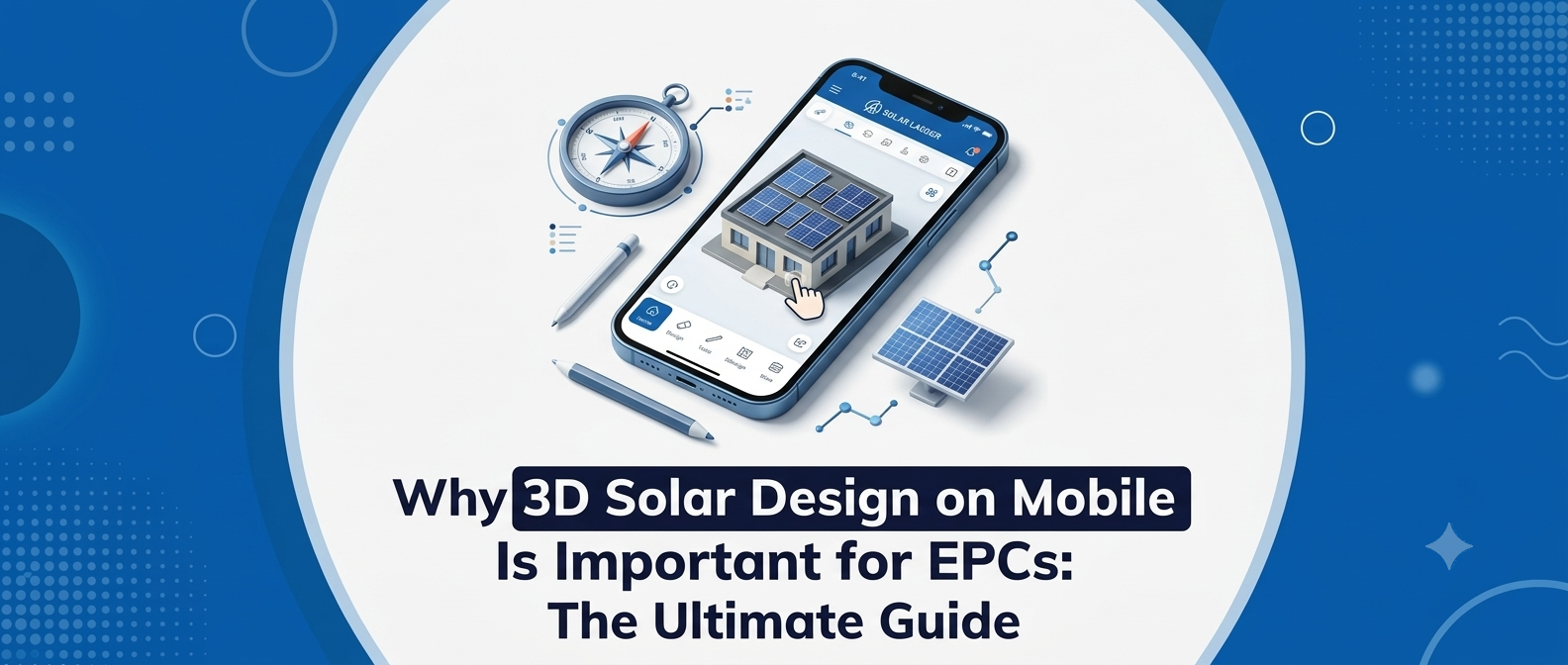
Why 3D Solar Design on Mobile Is Important for EPCs: The Ultimate Guide
Introduction
In the fast-moving rooftop solar industry, customer acquisition often comes down to one thing: how quickly and accurately you can turn a site visit into a proposal.
Whether you're targeting residential customers under the PM-Surya Ghar: Muft Bijli Yojana or commercial and industrial (C&I) clients looking to reduce electricity costs, buyers want quick answers, accurate estimates, and a clear picture of how their solar system will look.
Yet many Engineering, Procurement, and Construction (EPC) companies still follow a slow, traditional workflow. A site surveyor visits the property, records measurements, takes photographs, and sends everything to an office-based design team. The customer may have to wait days for a layout and quotation.
By then, the customer may have lost interest or chosen a competitor who responded faster.
This is where mobile 3D solar design software makes a difference. It enables solar installers to model rooftops, assess obstacles, present layouts, and discuss proposals directly with customers during site visits.
In this guide, we'll explain why 3D design on mobile is important for solar EPCs, how it improves field operations, and how it can help businesses create a smoother path from site survey to sale.
1. Reduce Proposal Turnaround Time from Days to Minutes
Speed matters in solar sales. When a customer agrees to a site evaluation, their interest in the project is often high. Delayed quotations can create unnecessary friction and give competitors an opportunity to step in.
A traditional workflow may involve several steps:
- Site visit and manual measurements
- Photographs and notes sent to the design team
- Rooftop layout prepared using desktop software
- Proposal reviewed and shared with the customer
This process can take hours or days, depending on the team's workload and project complexity.
With a mobile 3D solar design app, field teams can capture site information, build a rooftop layout, position solar modules, and discuss the proposed system with the customer on-site.
When the software supports automated proposal generation, the installer can also prepare a customer-ready quotation during the same visit.
Traditional workflow: Site survey → Office design → Proposal follow-up
Mobile-first workflow: Site survey → 3D layout → Proposal discussion
For solar EPCs handling multiple leads each day, reducing the time between a site visit and a proposal can improve the customer experience and help sales teams follow up while the conversation is still fresh.
Explore our guide to Solar 3D Design Software: Create Client-Ready Designs in 2 Minutes.
2. Analyse Rooftop Shading and Obstacles More Effectively
A rooftop can look spacious from a satellite image but present several challenges when inspected on-site.
Common obstacles include:
- Plastic water tanks
- Staircase rooms and parapet walls
- Nearby buildings and tree canopies
- HVAC equipment, vents, and satellite dishes
- Roof sections with different heights, slopes, or orientations
These obstacles can affect available installation space and the amount of sunlight reaching solar modules. If they are missed during design, the EPC may need to revise the layout or address performance concerns later.
Mobile 3D design tools help surveyors represent rooftop geometry and obstacles more clearly. Depending on the software's capabilities and the quality of the site data, the team can assess panel placement and identify areas that may receive shade.
Advanced shading tools can simulate sun positions across different times of day and seasons, helping installers understand potential shading impacts before finalising a design.
This is especially useful for urban rooftops, commercial buildings, and properties where nearby structures cast shadows across the installation area.
Accurate shading analysis can support better design decisions, but it should be combined with reliable site measurements and appropriate engineering checks.
Read more about solar 3D design software and visual shading analysis (https://solarladder.com/blog/post/best-solar-3d-design-software-visual-shading-analysis).
3. Build Customer Trust with Interactive 3D Visualisation
For many customers, a rooftop solar installation is a significant investment. Technical specifications and flat drawings may not be enough to help them understand how the finished system will look.
Homeowners may ask:
- Will the panels occupy the entire terrace?
- Will there still be space to walk or dry clothes?
- Where will the mounting structures be placed?
- Will the installation affect rooftop access?
Commercial customers may have additional concerns about equipment access, maintenance pathways, and the use of available roof space.
A mobile 3D model helps sales representatives explain the proposed installation visually.
Interactive rooftop walkthroughs
Customers can view the proposed panel arrangement from different angles, making the layout easier to understand than a flat drawing alone.
On-the-spot layout changes
If a customer wants to keep a section of the terrace clear, the sales representative can discuss alternative panel arrangements, subject to the system's technical and structural requirements.
Clearer conversations about system performance
Where supported, the software can update generation estimates and financial calculations when the design changes. This helps customers understand how layout decisions may affect the proposed system.
Visualisation doesn't eliminate every objection, but it gives sales teams a practical way to address concerns with a model rather than relying only on verbal explanations.
For more insights, read The Solar Proposal That Closes vs. The One That Gets Ignored.
4. Reduce Site-to-Office Handoff Errors and Costly Rework
One of the challenges for growing solar EPCs is maintaining consistency between site surveys, design, procurement, and installation.
When field teams rely on handwritten notes, separate photographs, and scattered WhatsApp messages, important information can be missed. Measurements may be unclear, roof obstacles may be overlooked, and the installation team may discover that the proposed layout needs modification.
These issues can result in additional site visits, delayed installations, material wastage, and lower project margins.
Mobile 3D solar design can improve this workflow by bringing site information and the proposed layout together in one digital process.
For example, a surveyor can document rooftop conditions and develop the initial design during the site visit. The office team can then review the recorded information and verify technical requirements before procurement and installation.
A digital design also provides a common reference for sales, engineering, and project teams.
The key benefit is better coordination: everyone works from a more consistent record of the site and the proposed system, reducing avoidable misunderstandings.
However, the design should still undergo the necessary engineering and structural checks before installation.
5. Generate the Bill of Quantities and Connect Design with CRM
Mobile 3D solar design becomes even more valuable when it connects with the rest of an EPC company's workflow.
Once the panel layout is finalised, capable solar design software can generate a Bill of Quantities (BOQ) based on the configured system and available product data.
Depending on the platform and project settings, the BOQ may include:
- Solar module quantities
- Inverter quantities and specifications
- Mounting structures and rails
- Mid-clamps, end-clamps, and fasteners
- DC and AC cables and associated accessories
An automatically generated BOQ helps procurement teams estimate material requirements more consistently. The quantities should still be checked against the final engineering design, installation method, site conditions, and applicable safety standards.
Connect design with your solar CRM
When 3D design and CRM tools work together, EPC teams can manage more than the technical layout. They can also track the customer journey.
A connected workflow can help teams:
- Record leads from channels such as Google Ads, Meta Ads, IndiaMART, and WhatsApp
- Track site visits and proposal status
- Maintain customer and project information
- Follow up on pending quotations
- Give sales managers better visibility into the pipeline
Instead of switching between spreadsheets, chat threads, and separate design files, teams can work towards a more organised sales process.
For installers looking to improve lead tracking and follow-ups, explore our guide to the best solar CRM software for installers.
6. Why Mobile 3D Solar Design Matters for Growing EPC Businesses
Mobile 3D design is not just about making rooftop models on a smartphone. Its real value lies in connecting field activity with the wider solar sales and project workflow.
For a growing EPC business, this can mean:
- Faster customer conversations: Discuss the proposed layout during the site visit.
- Better site visibility: Capture rooftop conditions and obstacles earlier.
- Clearer proposals: Help customers understand the system being offered.
- Improved coordination: Give sales, design, and project teams a shared reference.
- More organised procurement: Use design-linked BOQ data where available.
- Stronger pipeline management: Connect site surveys and proposals with CRM follow-ups.
The exact benefits depend on the software, the quality of the site data, and how consistently the team uses the workflow. Mobile design should complement—not replace—professional engineering review.
How Solar Ladder Helps Solar Installers
Solar Ladder helps solar EPCs manage key parts of their business through a connected software platform.
Its mobile 3D design capabilities help installers present rooftop layouts more visually, while proposal tools support faster quotation preparation. CRM and lead management help teams organise customer enquiries and follow-ups, and project management tools support coordination beyond the initial sale.
For solar businesses looking to reduce manual work and create a more connected process from lead generation to project execution, combining design, proposals, CRM, and project management can make day-to-day operations easier to manage.
Learn more about Solar Software in India: The Complete Guide for 2026.
Conclusion
Relying entirely on desktop-based design and delayed proposal workflows can slow down solar EPC sales and create avoidable coordination challenges.
Mobile 3D solar design gives field teams a way to visualise rooftops, discuss panel placement, document site conditions, and move the sales conversation forward during the customer visit.
When connected with proposal generation, BOQ tools, and CRM, it can also help bridge the gap between site surveying, sales, procurement, and project execution.
For solar EPCs aiming to grow, the goal is not simply to design faster. It is to build a more accurate, transparent, and connected process for every project.